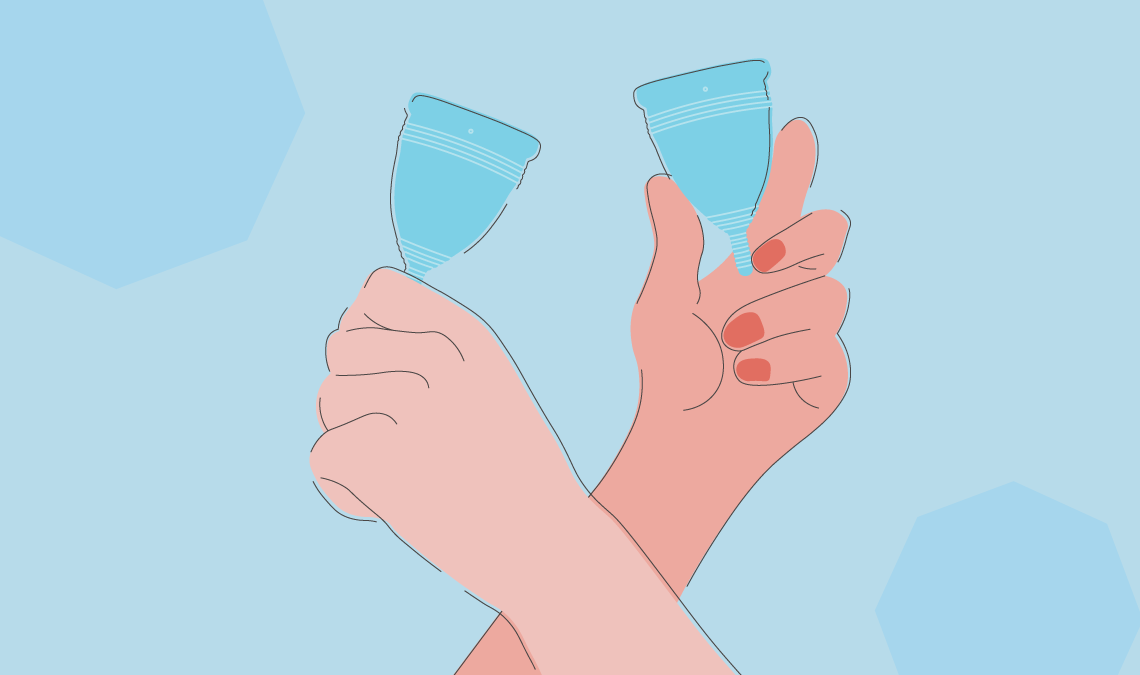
So you’ve finally bought a menstrual cup, and are starting to think… what now? We get it. The thought of inserting something up there, especially for the first time, can be pretty intimidating. But the truth is that menstrual cup insertion is actually pretty straightforward and pain-free.
Studies show that most women report the use of a menstrual cup as a positive experience. Sure, it’s tricky at first (what isn’t), but once you get the hang of it, it can honestly be life-changing.
Here’s a step-by-step guide on everything you need to know about comfortable menstrual cup insertion.
Step 1: Pick the right cup (yep, size matters!)
Just like bras, menstrual cups come in different sizes, and picking the right one makes all the difference when it comes to pain-free insertion. If your cup is too small, it can leak or sit up too high, which could hurt. And if it’s too big, it could cause a little pain as it might put pressure on tissues around the vagina or be hard to insert all the way.
Nua offers the perfect options: Medium (around 29 ml) and Large (around 36 ml). If you’ve never used a menstrual cup before or haven’t given birth vaginally, the medium cup is a good place to start. It can be more firm and flexible, which makes it easier to insert.
On the other hand, if you have given birth or are over 30, the bigger ones may be a better choice. So find your right size to stay comfy throughout the day.
Step 2: Sanitise the cup before every cycle
As per the Centers for Disease Control and Prevention, it’s important to sanitise your menstrual cup at the start of every period. This just means boiling the cup in water for 5-10 minutes to kill any germs or bacteria and make sure it’s clean and safe to use.
If the cup isn’t fully clean, you may experience pain and irritation. Without sanitisation, the cup can introduce bacteria into your vagina and cause an infection like TSS (toxic shock syndrome). It sounds scary, but don’t worry, just sanitising it is enough to keep you safe.
While boiling, pay attention that the cup is fully submerged and doesn’t touch the bottom of the pan. Use a tong to hold it in place if needed and let it cool before inserting. This step is only needed at the start (and end) of your period, not after every use. To clean it during your cycle, just rinse it with water or a mild, unscented soap.
Step 3: Relax (seriously, this helps a lot)
Now that your cup is clean and you’re ready to insert it, the next most important thing is… relax. Tension in your pelvic muscles can make insertion tricky, painful or even a little uncomfortable. So take a deep breath, find a position that works for you, and take your time.
Some people find it easiest to insert the cup while squatting, sitting on the toilet, or standing with one leg raised (like on the edge of your tub or toilet seat). There’s no right or wrong, just whatever feels most natural to you.
Step 4: Lubricate and fold before inserting
A lack of lubrication is one of the biggest reasons for insertion-related strain. Wetting the rim with water or, even better, using a water-based lubricant can make the cup slide in very easily with absolutely no pain.
Another thing that helps is folding the cup before inserting it. This helps make the rim smaller so it can slide in more easily without any pain. There are 3 popular ways to fold it:
The Punch-Down fold for beginners
This fold makes the tip of the cup super narrow. It’s one of the easiest and gentlest ways to insert. Just press one side of the rim down into the base. It should kind of look like a tiny funnel or bullet. Because it’s so small at the tip, it’s less likely to cause any pain – perfect for beginners! You might need to fiddle with it a bit (once it’s inside) to make sure it opens fully.
The 7-fold for something easy but firm
This one’s still beginner-friendly, but slightly firmer than the punch-down. You flatten the cup, then fold one corner down at an angle so it makes a ‘7’. It goes in easily but still pops open nicely once it’s inside. If you want something that’s not too wide but still gives a secure fit, this is a good one to try.
The C-fold for experts
This one’s a classic and very well-known, so most people start with it. But (heads-up), it makes the widest shape at the top. So if you’re new to cups or feel any pain while inserting, you should try the other 2. But once you get the hang of it, it’s super simple. Just press the cup flat and fold it in half so it looks like a ‘C’ from the top. It also opens up really easily inside, which means less fiddling around.
If you want to understand all the folds better, we have diagrams here for a visual guide. Have a look at it, take your time with the folds and see what feels right for your body!
Step 5: Insert the cup but not too high up
The cup should be comfortably inside your vagina without any part sticking out. But it has to sit a little lower. If you push it too far up, it can cause pain and discomfort.
So, once folded, angle the cup slightly towards your tailbone, not straight up, and gently insert it into your vagina. Don’t push it as high as a tampon. Then, let it unfold. You might hear or feel a soft “pop.” That’s your cue that it has opened and sealed.
If you’re not sure it’s open, gently rotate the base or run a finger around the rim to check if it feels round. It should sit snugly and not feel loose or uneasy.
Research shows that it can take around 3 cycles for 90% of women to get the hang of menstrual cup insertion. After which, they find it super easy and even recommend it to others. So, don’t get disheartened if you’re taking time adjusting to the cup.
Step 6: Remove with a gentle pinch and wiggle
The cup creates a suction inside your vaginal canal. Removing the cup without breaking the suction first is a recipe for pain and discomfort. So, don’t just go tugging or pulling the stem of the cup to remove it.
When it’s time to empty the cup, wash your hands, and find a comfy position again. Gently reach for the base of the cup (not the stem), pinch it to break the suction seal, and then slowly wiggle it side-to-side as you pull it out. Remember to keep it upright to avoid spills.
The best part is that you don’t have to do this very often, as cups last for hours. Especially the Nua one, as they can be worn for up to 12 hours with zero irritation. You can insert it in the morning and forget about it until nighttime.
Step 7: Store it safely till your next period
Once your period is over, give your cup one last clean. Boil it again for 5–10 minutes to fully sanitise it, let it air dry completely, and then store it in a breathable cotton pouch (like Nua’s antibacterial pouch). This keeps it dry, clean, and ready for next month.
For more information on how to store and clean them, check out our blog here.
Tried everything but the menstrual cup insertion still hurts?
If you’ve tried different sizes, folding techniques, lubes, and still feel pain while inserting your cup, it might be something more.
For some people, the vaginal muscles can tense up so much that even inserting a finger, tampon or cup can feel really difficult or painful. This could be a sign of a condition called vaginismus. It’s when your vaginal muscles tighten on their own, sometimes because of physical discomfort, and sometimes because of anxiety or fear.
The good news is that it’s treatable. Just talk to a doctor or gynaecologist who can guide you through the next steps.
Clear your mind of any doubts
Is menstrual cup insertion safe?
Yes! Menstrual cups that are 100% biocompatible and recommended by gynaecologists (just like Nua’s) are completely safe for insertion.
Will menstrual cup insertion stretch out my vagina?
The cup doesn’t stretch your vagina or mess up its shape as your vagina is elastic and goes back to its usual shape right after.
Can I pee after menstrual cup insertion?
Yes! Your cup sits in your vagina, and your pee comes out of your urethra. They’re totally separate. So it’s completely fine to pee (and poop) while wearing a menstrual cup.
What if I can’t reach it afterwards?
Don’t panic. Menstrual cups can’t get lost inside you. Just squat like during a bowel movement and feel the base come down, which you can then take out.
You’re a pro now!
If you ever feel unsure or uncomfortable, remember that there’s no rush to get the menstrual cup insertion perfect on Day 1.
Like anything new, it takes a little practice. But once you get the hang of it, menstrual cups can be amazing! They’re eco-friendly, budget-friendly, and give you hours of leak-free comfort.
And we’re always here to help if you’ve got questions along the way. Just drop your queries in the comments.