
What you will learn about breastfeeding milk supply in this blog:
- Your breastfeeding milk supply is demand-driven after the first week, so frequent removal is the strongest signal you can send.
- There are three biological stages, and the bumpy day-2-to-5 transition is normal, not a red flag.
- Most worry about low supply is perception, not reality. 50% mothers worry about this but true insufficiency sits around 10 to 15% of mothers.
- Leaks signal a working let-down, manageable with the right nursing pads and hygiene habits.
- Latch quality, frequency, sleep, and hydration matter far more than any single galactagogue.
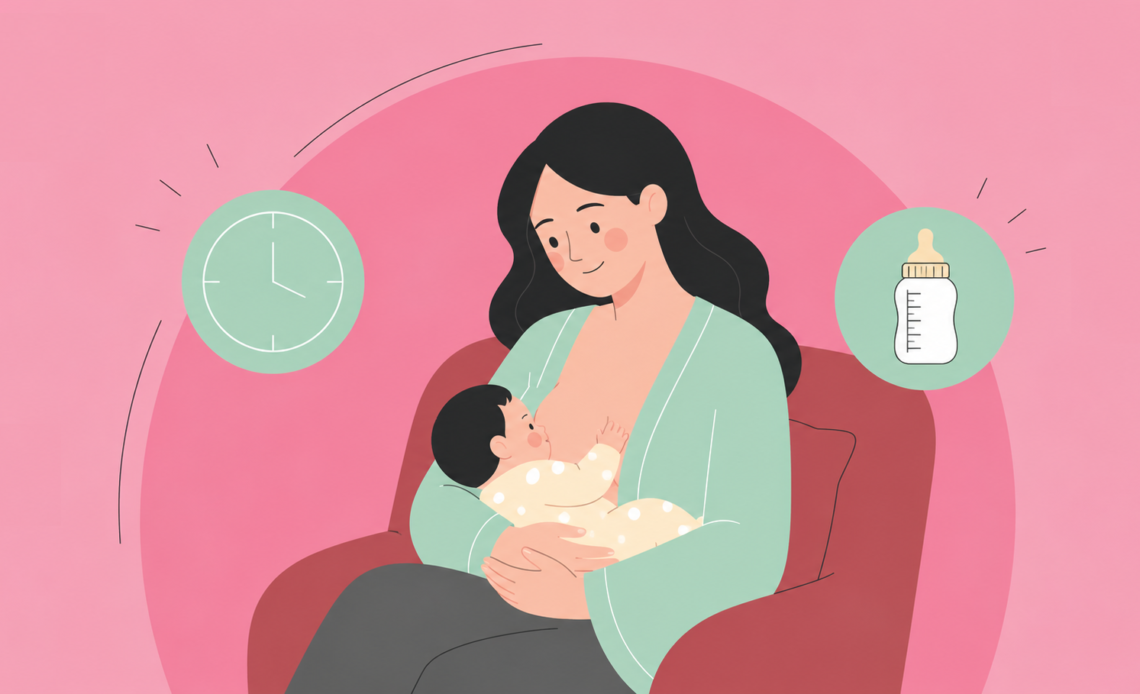
If there’s one thing nobody warns you about, it’s how much mental real estate your breastfeeding milk supply will occupy in those early weeks. You’ll find yourself googling at 3 a.m., squinting at the half empty bottle of pumped milk that just won’t fill up and wondering if your body is doing it properly.
So let’s break it down, give you the information and spare you the anxiety.
How Does Breast Milk Production Work?
How breast milk production works comes down to a hormone duo of prolactin, which makes the milk and oxytocin, which pushes it out.
Prolactin spikes every time your baby latches. So every time your baby feeds, your body gets another signal to keep producing milk. That’s why frequent feeding in the early weeks helps build and regulate your breastfeeding milk supply for the months ahead. Oxytocin is responsible for the let-down reflex, which is the process that moves milk from the milk glands through the ducts so your baby can actually drink it. Some women feel this as warmth, tingling, sudden thirst, sleepiness, or a slightly disoriented feeling. It helps the body relax and encourages bonding with the baby. These effects are part of your body’s way of supporting rest, connection, and breastfeeding itself. Together they create a feedback loop where demand creates supply.
Blog continues after the ad.

There’s also a small protein called the Feedback Inhibitor of Lactation (FIL) that tells your breasts to slow production when they’re full and ramp up when they’re empty. A baby who feeds frequently signals your body to make more, while skipped feeds signal it to chill. This is why everything you should know about breastfeeding eventually circles back to one rule: emptying the breast.
Somewhere between the 2 a.m. feed and the 5 a.m. one, you’ll realize the hardest part isn’t the feeding, it’s the leaking through your third shirt of the night. That’s why we built these soft, breathable nursing pads built for the version of you who’s already exhausted.
The Three Stages Of Breastfeeding Milk Supply
Most people don’t realize that breastfeeding milk supply starts during pregnancy, not after birth. The breast milk production stages unfold in a specific sequence :
- Lactogenesis I (mid-pregnancy onward): Your breasts start making colostrum (the very first form of breast milk which is thick, concentrated, and usually yellow or golden in colour) around week 16. Progesterone keeps the floodgates closed, so you only see a few drops of milk.
- Lactogenesis II (day 2 to 5 postpartum): Milk “comes in.” Progesterone drops sharply after the placenta delivers, prolactin takes over, and your breasts start to feel full and warm.
- Lactogenesis III (around day 9 onward): Supply shifts from hormone-driven to demand-driven. Now your body listens to your baby, not your bloodstream.
Research found that delayed onset affects roughly 26% of mothers globally. If your milk takes a beat to arrive, don’t worry, it will come in eventually.
What Affects Breast Milk Supply?
It’s usually a stack of small, fixable variables. The biggest contributors:
- Frequency of feeding or pumping: More emptying means more making. Long gaps slow things down.
- Latch quality: A shallow latch (how your baby’s mouth ‘latches’ onto your nipple) means less milk transferred, less stimulation, less supply.
- Stress and sleep: Cortisol can slow let-down because oxytocin is shy around chronic stress.
- Hormonal and medical factors: Thyroid issues, retained placenta, PCOS, and certain birth control pills can all interfere.
- Hydration and nutrition: Because your body is making fluid out of fluid.
A 2022 systematic review in Maternal & Child Nutrition found that 50% of breastfeeding mothers report perceived insufficient milk, while only around 10-15% have a true physiological supply issue. The gap between perception and reality is huge, and mostly built out of misinformation.
For the women who are still figuring out their supply, here’s some support!
What Are The Signs Of Low Breast Milk Supply?
True signs of low breast milk supply are about your baby, not your breasts.
The reliable ones:
- Inadequate weight gain
- Fewer than six wet diapers a day after day five
- Very dark or scant urine
- Persistent lethargy
What’s not a reliable sign:
- Softer breasts after a few weeks
- Shorter feeds
- No leaking
- Evening cluster-feeding
- Your pump output dropping
Those are features, not bugs. Your body is just becoming efficient.
This matters because low breast milk supply causes and solutions are often misdiagnosed at home. Mothers introduce formula assuming they’re under-producing, which then reduces stimulation and creates the actual shortage they were worried about.
The research on perceived insufficient milk shows this pattern repeatedly: the worry creates the problem, then validates it.
How To Increase Breast Milk Production Naturally: A Guide
How to increase breast milk production naturally is less about lactation and more about removing friction. Here’s what actually moves the needle for your breastfeeding milk supply:
- Feed or pump every 2 to 3 hours in the early weeks, including overnight: Prolactin is highest at night, so the 3 a.m. feed is doing serious work.
- Get a lactation consultant session: Thirty minutes can fix something you’d struggle with for months.
- Try power pumping for 3 days: Pump 20 minutes, rest 10, pump 10, rest 10, pump 10. It mimics cluster feeding.
- Eat enough, drink to thirst: Severe calorie restriction in the first months can dent supply.
- Protect your sleep where you can: Even fragmented rest helps oxytocin do its job.
- Skip the bra that flattens you: Compression can reduce supply over time. Choose soft, supportive, breathable.
How Do You Manage Breast Milk Leaks Without Losing Your Mind?
The honest answer to how to manage breast milk leaks is to stop fighting them and design around them. Leaks signal a healthy let-down reflex, not a malfunction. They peak in the first 6 to 12 weeks and ease as your breastfeeding milk supply regulates. They can also be triggered by the smallest things like hearing any baby cry, a long stretch between feeds, a warm shower, or thinking about your baby at the wrong moment.
Until your supply settles, the goal is staying dry, comfortable, and not changing your top three times before brunch. A few things that actually help:
- Wear a nursing pad from day one, even if you think you don’t need it: The first surprise leak almost always hits in public, on the day you forgot.
- Change pads the moment they feel damp, not soaked: Wet fabric on skin for hours is what causes thrush, clogged ducts, and that stinging soreness everyone whispers about.
- Choose pads with a liquid-lock core: A proper core doesn’t wick moisture back onto your skin or trap heat.
- Air-dry between feeds when you can: Five minutes with your bra unclipped after a feed makes a real difference.
- Apply gentle pressure with the heel of your hand if a let-down hits in public: It buys you 30 seconds to find a bathroom.
- Sleep on a folded towel in the early weeks: Nighttime let-downs are the messiest, and your sheets will thank you.
What To Look For In A Nursing Pad
The ones worth keeping in your bag check a few specific boxes:
- Liquid-lock design: Because you shouldn’t have to worry mid-meeting, mid-feed, or mid-anything else.
- Soft and breathable fabric: Your skin is already doing a lot. It deserves the kind of care that doesn’t add to the list.
- Super-absorbent and thin: Discreet so you’ll forget it’s even there, which is exactly the point.
- 100% toxic-free materials: For the safety of you and your little one, who is, after all, latching onto the same surface.
- Made Safe and dermatologically tested: Non-irritant and cruelty-free certified, so the small print actually means something.
If you’ve been quietly tolerating soggy cotton rounds folded into your bra, try these nursing pads designed for the leaks no one prepared you for.
In conclusion
Your breastfeeding milk supply is not a personality test, a moral score, or a measure of how much you love your baby. It’s a biological system that responds to rhythm, rest, and removal.
The more you trust it and the less you panic-google it, the easier the whole thing gets. And on the days it feels like too much, the small comforts (soft pads, dry skin, a bra that doesn’t fight you) are the ones that quietly hold you together.
FAQs
1. How does breastfeeding milk supply work?
Breastfeeding milk supply is largely demand-driven. Frequent breastfeeding or pumping signals the body to keep producing milk through hormones like prolactin and oxytocin.
2. When does breast milk supply increase after birth?
Milk production develops in three stages, with mature milk typically coming in around days 2–5 after birth. From around day 9 onward, supply becomes increasingly regulated by how often milk is removed.
3. What are the signs of low breast milk supply?
Reliable signs include inadequate infant weight gain, fewer than six wet diapers a day after day five, very dark or scant urine, and persistent lethargy. Softer breasts or less leaking alone don’t necessarily mean low supply.
4. How can I increase my breast milk supply naturally?
Frequent feeding or pumping, improving latch, eating enough, drinking to thirst, protecting your sleep, and working with a lactation consultant can help support milk production.
5. Is leaking breast milk a sign of good milk supply?
Leaking is a normal part of breastfeeding and can happen when milk lets down. Leaks are often more common during the first 6–12 weeks and usually become less frequent as supply regulates.
6. How can I manage breast milk leaks while breastfeeding?
Nursing pads can help absorb leaks and keep your skin and clothing dry. Choose soft, breathable, super-absorbent pads and change them when they become damp.
Disclaimer
The content of this article is provided for general informational and educational purposes only and is not intended to constitute medical advice, diagnosis, or treatment. The information shared is of a general nature and may not be appropriate for all individuals or specific circumstances. Readers should not disregard, delay, or substitute professional medical advice based on the information contained herein.
If you experience any symptoms, notice anything unusual, or have concerns relating to your health or overall wellbeing, you should consult a qualified healthcare professional. While every effort is made to ensure the information shared is accurate and up-to-date, Nua makes no representations or warranties, express or implied, regarding the accuracy, completeness, or suitability of the information provided and disclaims all liability arising from reliance on this content to the fullest extent permitted by law.