What you’ll learn about ovulation tracking vs. period tracking in this blog:
- Period tracking helps log your period dates, flow, PMS, and symptoms, while ovulation tracking helps estimate your fertile days.
- Ovulation tracking is most useful for anyone sexually active, especially if you are trying to conceive or actively avoiding pregnancy.
- Your fertile window includes the 5 days before ovulation, ovulation day, and sometimes the day after.
- The more consistently you log things in a period tracking app, the more accurate period and ovulation predictions become.
- If your cycles suddenly change, become very painful, heavy, or irregular, tracking records can also be useful to discuss with a doctor.
Ovulation tracking vs. period tracking becomes important the moment you need answers that your period dates alone cannot give you.
You know, like that very specific Google spiral a lot of girlies have been through, the one that starts with can I be pregnant if…? and suddenly you are ten tabs deep, counting days, checking dates, and trying to figure out whether the sex in question was anywhere during your fertile window.
And honestly? That is completely understandable. All most of us know about our cycles is when the period started and when, thank the universe, it ended. Which is fine for about 90% of life. But then there is that other 10%. The part where you are either really, really trying to get pregnant or really, really making sure you do not, and suddenly knowing your period date is just not enough information anymore. You wish you knew about your fertile dates and when you’re ovulating.
So, yes, let’s help you with that. Let’s clear the ovulation tracking vs. period tracking dilemma and make your cycle a tad bit less scary and a lot easier to follow.
Ovulation Tracking vs. Period Tracking: What Is the Difference?
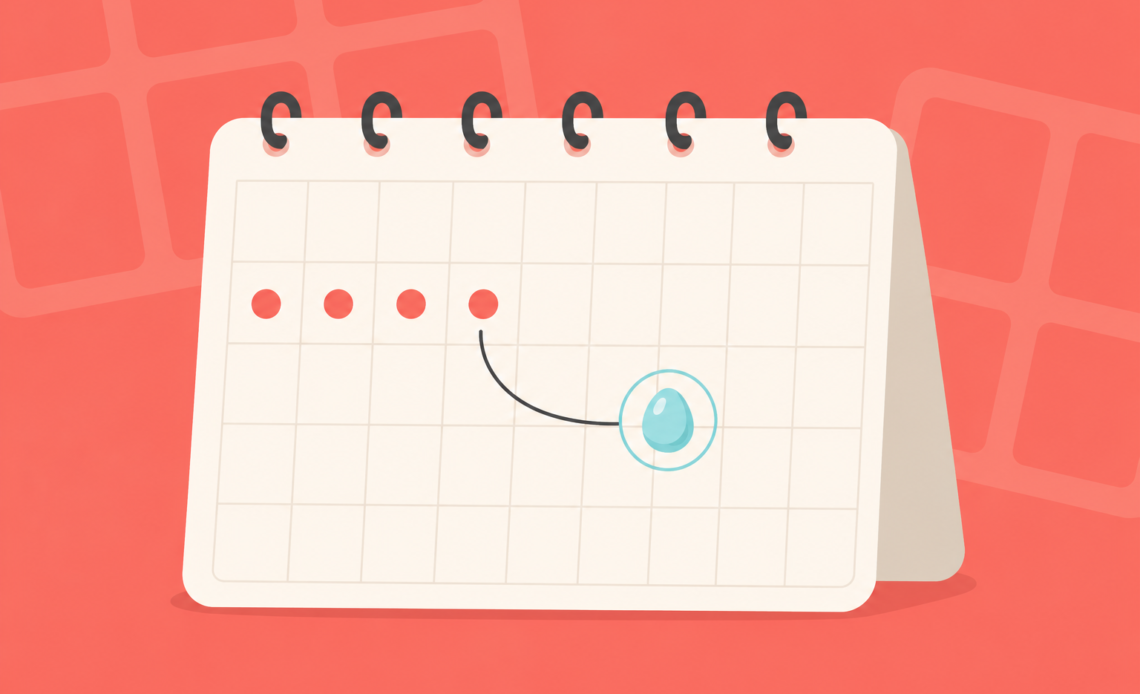
Period tracking follows your period dates, PMS and other menstrual symptoms, while ovulation tracking tells you when you are most fertile, a.k.a, most baby-ready.
To break it down a little more, period tracking or general menstrual cycle tracking is about noticing the visible parts of your cycle.
- When did your period start?
- How long did it last?
- Was the flow light, heavy, or unexpectedly chaotic?
- Did you have cramps, acne, bloating, cravings, or mood swings?
Over time, tracking these details can help you understand your cycle pattern and what to expect and when.
Blog continues after the ad.

Ovulation tracking is paying attention to, well, as the name suggests, ovulation, which is when one of your ovaries releases an egg.
Now here is the wild part. An egg only lives for about 12 to 24 hours after ovulation, while sperm can survive inside the body for up to 5 days. That overlap creates your fertile window, which is the only 5-6 days in a cycle when pregnancy is most likely to happen. Not the whole month. Not ANY time outside your period. Just these 5-6 very specific days that fall at a different point in every woman’s cycle and can even shift from month to month in the same woman.
This window seems small, but if you’re actively trying to get pregnant or avoid pregnancy, tracking it could be a game-changer. And the easiest way to do it every month is with an app like Nua’s Period Tracker. It literally maps EVERYTHING, from your period dates, symptoms, predicted ovulation, and fertile days, all in one place, so you are not piecing it together from memory.
Ovulation Tracking vs. Period Tracking: Who Needs to Be Tracking What?
Period tracking is useful for anyone with a menstrual cycle, while ovulation tracking is most helpful for those trying to conceive, avoiding pregnancy, or just sexually active.
To elaborate, everyone with a cycle should be period tracking, as it helps you:
- Plan ahead for trips, weddings, dates, or busy work weeks
- Keep period supplies handy instead of being caught off guard
- Notice if stress, travel, or poor sleep affects your cycle
- Understand mood dips, low energy days, or cravings a little better
- Recognise when a delay is normal for you versus unusual delays
- Notice period signs that can be linked to issues like PCOS, thyroid imbalances, fibroids, or endometriosis
Apart from this, period tracking is especially helpful for girlies with PCOS/PCOD, where cycles are often irregular, delayed, or unpredictable, making it easier to spot patterns and plan management. In fact, research has found that digital tracking apps helped regular cycles rise from 3.3% to 43.1% over time in PCOS.
Ovulation tracking is for anyone sexually active. And yes, that includes both the trying-to-conceive crowd and the absolutely-not-right-now crowd. If pregnancy is on the table in either direction, knowing when your fertile window actually falls is just useful information to have. It helps you:
- Time unprotected sex better if you are trying to conceive, with studies showing around 11% higher first-cycle pregnancy rates with ovulation tracking.
- Be extra careful with contraception during your fertile window if you are avoiding pregnancy
- Understand that ovulation does not always happen on the same day every month
- Make more sense of symptoms like ovulation pain, changes in discharge, or a sudden rise in libido
- Notice if you may not be ovulating regularly, which can be worth discussing with a doctor
NOTE: Ovulation tracking alone is not a reliable contraception method because ovulation can shift each month. If you are trying to prevent pregnancy, use it alongside a primary method like condoms, the pill, an IUD, or any other medically approved birth control.
Ovulation Tracking vs. Period Tracking: How Do They Actually Work?
Both ovulation tracking and period tracking work pretty similarly by monitoring different parts of your overall menstrual cycle. Basically, they are looking at the same monthly report, just through different data points. And a good app, like Nua’s Period Tracker, lets you do both at once, which is ah-mazing because, truly, who needs more apps.
Here’s how ovulation tracking vs. period tracking actually works:
Step 1: You begin by logging when your period starts, which tells the app a new cycle has started. Think of it as Day 1 every month. You can also log your symptoms, like cramps, bloating, acne, or mood swings, which can also help the app understand your hormonal clock better.
Step 2: You then log the day your period ended to see how many days your period lasted. This helps the app understand your usual bleeding pattern.
Now here’s what the app gives you, once you’ve done your bit.
- After a few months, it finds your average cycle length, like 28, 30, or 32 days.
- Using that average, it predicts your next period date.
- Then it predicts ovulation, which biologically happens around 12-16 days before your next period.
- It also uses clues you log, like stretchy discharge, one-sided cramps, a rise in libido, or ovulation test results, to fine-tune ovulation prediction.
- Then it marks your fertile window that includes the 5 days before predicted ovulation, the ovulation day itself, and sometimes the day after.
The more you log, the more accurate it gets. Because the app learns your cycle instead of using generic averages, giving you more personalized results.
For a full breakdown of how to track your menstrual cycle, including period dates, cycle length patterns, and PMS management, read our complete guide to period tracking here.
Ovulation Tracking vs. Period Tracking: How Accurate Are They?
When done properly on a reliable app, both period tracking and ovulation tracking can be pretty accurate. The catch? Your app needs a little history first. She cannot read your mind on Day 1. So, give it at least 3-4 months before you truly start trusting her.
Between the two, period tracking is usually the more accurate one because periods are easier to log. You either started bleeding or you did not. After around 3 to 6 months of regular tracking, many apps can predict your next period quite well. If your cycle is fairly regular, it may only be off by a day or two.
But if you have PCOS/PCOD, irregular cycles, recent stress, weight changes, illness, postpartum hormones, or recently changed birth control, things can get a little messier. And the app might need more time and data points to understand and analyze them.
Ovulation tracking, on the other hand, is a bit more mysterious. Unlike your period, ovulation isn’t very obvious. You can not really log when you ACTUALLY ovulated this month because there aren’t any visible signs like the period bloodbath. So, the app has to estimate it using your past cycle data.
Therefore, apps are rather better at predicting your overall fertile window than the exact ovulation day. Meaning, they can usually tell you the 5 to 6 day zone where pregnancy is more likely.
And TBF, for a lot of people, that is enough. But if you are tracking ovulation specifically to get pregnant, especially if you have been trying for a while, you may need to do a little more to support the app:
- Track your cervical mucus as it becomes clearer and stretchier around ovulation, with a texture similar to raw egg white.
- Log your body temperature because research shows a rise of around 0.2 to 0.5°C after ovulation, which confirms the egg has been released.
- Notice if you have a mild one-sided pelvic pain, which is common around the time of ovulation, sometimes called mittelschmerz.
- Use LH strips to track a surge in LH hormone that happens typically 24 to 36 hours before ovulation.
A Quick Argument For Cycle Syncing
Knowing where you are in your cycle via period tracking can help you plan tougher workouts, easier recovery days, skincare changes, appetite shifts, or those random low-energy phases a little better. Think of it as working with your hormones instead of being confused by them every month.
And if you already track your cycle and feel ready to level up, ovulation tracking adds more precision by helping you understand exactly where you are in the month, instead of relying only on rough estimates.
To Track Or Not To Track, That is the Question
If your cycle feels predictable, you are not trying to conceive, not worried about pregnancy, and simply living your life, you do not have to track every little thing. You are allowed to exist without turning your uterus into a side project.
But if your periods surprise you, symptoms confuse you, pregnancy is either the dream or the nightmare, or you just want to understand your body better, tracking can be wildly helpful.
You do not need to become a spreadsheet diva about it either. Even logging basic things like period dates, symptoms, and cycle changes can give you useful answers over time.
And that is exactly why apps like Nua’s Period Tracker make it easier. It helps you track periods, symptoms, predicted ovulation, and fertile days in one place, without making it feel like homework. It also suggests the right products based on where you are in your cycle, so you are prepared before your body decides to be chaotic.
If you’ve any more questions around ovulation tracking vs. period tracking, drop them in the comments, and we’ll be right there to help you.
Disclaimer
The content of this article is provided for general informational and educational purposes only and is not intended to constitute medical advice, diagnosis, or treatment. The information shared is of a general nature and may not be appropriate for all individuals or specific circumstances. Readers should not disregard, delay, or substitute professional medical advice based on the information contained herein.
If you experience any symptoms, notice anything unusual, or have concerns relating to your health or overall wellbeing, you should consult a qualified healthcare professional. While every effort is made to ensure the information shared is accurate and up-to-date, Nua makes no representations or warranties, express or implied, regarding the accuracy, completeness, or suitability of the information provided and disclaims all liability arising from reliance on this content to the fullest extent permitted by law.