What you’ll learn about managing postpartum nights in this guide:
- Postpartum nights are exhausting because newborn sleep cycles (50–60 minutes) constantly interrupt your deeper sleep cycles.
- Hormonal shifts after birth disrupt sleep and increase alertness, making it harder to rest even when the baby sleeps.
- Anxiety-filled wake-ups and vivid dreams are common due to heightened maternal vigilance.
- Nighttime can bring extra physical discomfort from postpartum bleeding, night sweats, and milk leaks.
- Breastfeeding hormones can help you fall back asleep faster, but pain or cracked nipples can disrupt that effect.
- Postpartum sleep disruption can last several months, so recovery takes time and support.
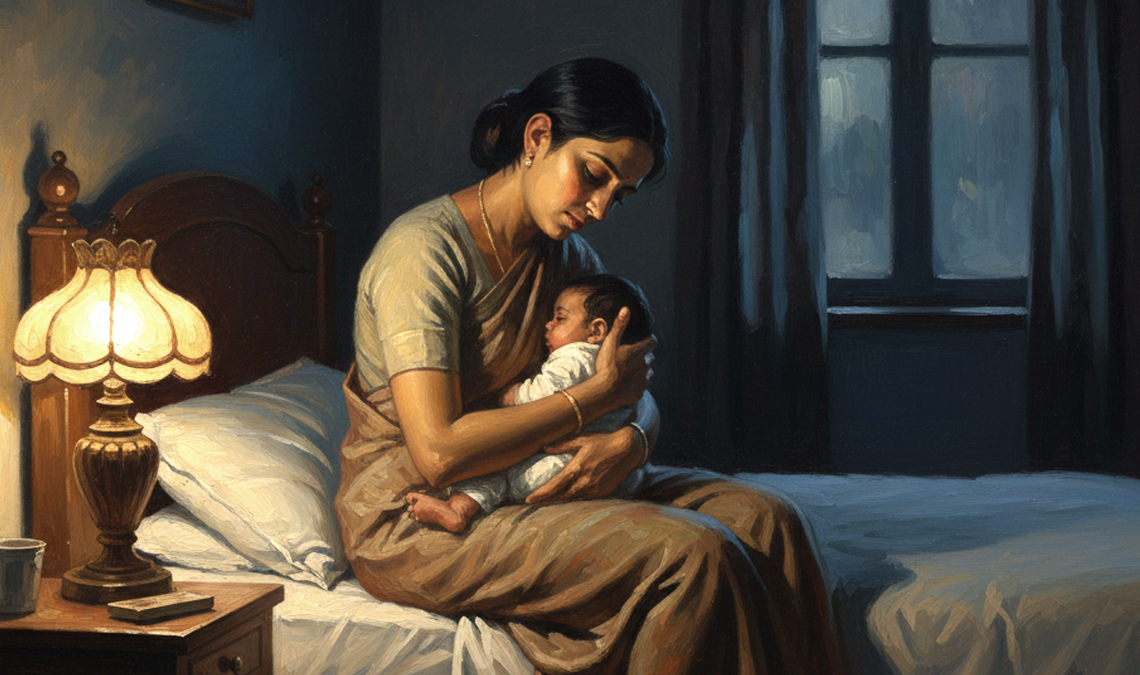
We’re guessing you’ve just received your appointment letter for the night shift of motherhood, a.k.a the postpartum nights. You probably accepted it immediately, imagining cuddling with a cute little button covered with the newborn smell.
But then reality hit.
Turns out your 4-kilo boss does sleep a lot. Just not when you do. And they communicate exclusively through cries, bodily fluids and the occasional explosive poop, all thoughtfully scheduled for the darkest hours of the night.
No doubt you feel like a tired, overworked employee. In fact, studies tell us that new moms lose around 1236 minutes of sleep in the first month postpartum. That’s basically three full days of sleep gone.
But don’t worry, there are surprisingly meaningful, even beautiful things that come with it. So, let’s get into the nitty-gritty of postpartum nights and how to deal with it all.
Why Are Postpartum Nights So Exhausting? The Science Explained
The short answer: it’s not just about sleep loss. Postpartum nights destroy your rest at a structural level, and here’s why.
We all know that new moms barely sleep. Research shows that over 50% of new mothers get less than 7 hours of sleep a night in the early postpartum period. But here’s the twist: Even on the rare nights when you do manage to lie down for a decent number of hours, your body still doesn’t get real rest. Here’s what’s happening:
- Your sleep cycles never complete: Grown-ups sleep in cycles that last about 90 minutes each, moving through deep sleep (where your body repairs itself) and REM sleep (where your brain processes emotions and memory). Your newborn runs on a very different system. Their sleep cycles are only 50-60 minutes long, and they spend a big chunk of that time in active sleep, which looks like grunting, squirming and startling awake. So just when your brain is about to finally slide into deep, restorative sleep, you’re up again. Feeding. Changing. Or doing that quiet panic-check to see if they’re still breathing.
- Sleep fragmentation hits harder than sleep loss: This constant waking is called sleep fragmentation, and it’s just as physically damaging as not sleeping at all. It affects your cognitive performance, leading to that lovely thing we call mom brain, where you put the milk in the pantry and your keys in the fridge.
- Your body never gets to recover: You’re not only sleeping less, you’re also never finishing a full rest cycle. That’s why postpartum exhaustion feels so extreme.
Blog continues after the blog.

Why Won’t Your Brain Switch Off at Night? Postpartum Hormones, Explained
One of the strangest parts of postpartum nights is how your brain simply refuses to switch off. And postpartum hormones are almost entirely to blame.
You might just not be able to fall asleep
After birth, your female hormones drop sharply. Estrogen and progesterone fall to pre-pregnancy levels within five days and take up to 3-6 months to stabilise. This hormonal crash messes with your sleep rhythm and increases anxiety, making it harder to fall asleep even when the baby finally does. This is also a big driver of postpartum mood swings, that strange emotional rollercoaster where you feel fine one moment and tearful the next.
At the same time, hormones like oxytocin (the love hormone) and cortisol (the stress hormone) remain slightly elevated. This keeps your brain running a 24/7 background scan. Is the baby too hot? Too cold? Does that sound mean hunger or gas? Did I overfeed? Do I not feed enough? That constant worry is protective, but it also keeps you stuck in a light, restless kind of sleep.
You dream differently even when you do fall asleep
This is the one that scares moms the most, but it is incredibly common.
You jolt awake, heart pounding, clawing at your sheets. You’re convinced the baby is lost or hurt. You might even shake your partner, shouting, “Where is the baby?” only to realize the baby is safely asleep next to you.
This is called postpartum dream enactment behavior. It happens due to a mix of sleep fragmentation and hypervigilance. In simple words, your brain is so tuned into protecting this new human that it blurs the line between sleep and reality. In fact, this is also an evolutionary trait. It’s what kept our ancestors alert to protect their offspring from danger. So, the next time you wake up frantically, know that it’s just your brain being a really, really good bodyguard and your baby is just fine.
Why Are Postpartum Nights So Wet? Postpartum Bleeding, Sweat and Milk Leaks
If the exhaustion wasn’t enough, postpartum nights come with a lot of moisture too. Between the milk, the sweat and the blood, you hardly know what leaked and when. Here’s what’s going on with each one.
- Postpartum bleeding gets heavier at night: You might notice that your postpartum bleeding (lochia) seems manageable during the day, but at night it’s a different story. When you’re sleeping horizontally, blood pools in the vagina rather than draining out continuously. The moment you get up for that 2 AM feed? Gravity takes over, and it’s all out, altogether. Nighttime nursing also triggers a release of oxytocin, which causes your uterus to contract (a process called involution), squeezing the blood vessels and often leading to a heavier flow or a sudden gush during night feeds.
- Postpartum night sweating is your body flushing out pregnancy fluid. During pregnancy, your body holds onto roughly 50% more fluid to support the baby. Once the baby is out, your hormone levels (specifically estrogen and progesterone) plummet, signalling your body to flush out all that extra fluid. And since your kidneys can only do so much, your body pushes the liquid out through your pores, mostly at night because that’s when your body finally slows down.
- Milk leaks happen because prolactin peaks at 2 AM. Your body produces milk using a hormone called prolactin and its levels are significantly higher at night, particularly around 2 AM, to ensure there’s enough milk supply for the following day. If the baby sleeps an extra hour (a small miracle), you wake up to a soaked t-shirt and rock-hard boobs. Or the let-down reflex kicks in on its own, and you wake up in a puddle of sticky milk.
When you’re half-asleep and navigating a latch at 2 AM, you shouldn’t also be worrying about leaking through your sheets. That’s why we built Nua’s Maternity Pads for nights like these.
How Do You Sleep Better Through Postpartum Night Sweating?
You finally get the baby down, you have a solid two-hour window of sleep, you drift off… and then you wake up shivering, soaking wet, wondering if you peed the bed. Welcome to postpartum night sweating. Here’s how to make it less miserable with a few simple postpartum night rituals.
- Wear light, breathable cotton to bed. Synthetic fabrics trap heat and make night sweats worse. A loose cotton top and shorts let your skin breathe and cool down naturally.
- Keep a fan or AC on low. Your body is actively trying to cool itself down. Giving it a slightly cooler room speeds up that process and helps you drift back off faster after feeds.
- Keep a spare set of clothes next to the bed. If you wake up drenched, you don’t want to be fumbling around at 3 AM. A quick change takes 60 seconds and makes a huge difference to how you feel.
- Lay a towel or absorbent sheet under you. This saves you from changing your entire bed at midnight. A simple layer between you and the sheets is enough.
- Wear protection you can trust. Combine postpartum night products like high-coverage maternity panties with your maternity pads so you’re protected from bleeding and leaks without waking up to a mess.
- Stay hydrated. It sounds counterintuitive, but sweating more means losing more fluids. Keep a water bottle on your nightstand and sip throughout feeds.
For protection that moves with you through all of it, the sweats, the leaks, the 2 AM chaos, use Nua’s Maternity Panties: 360° coverage so you can just focus on the feed.
Is Breastfeeding at Night Worth the Sleep Disruption? The Bittersweet Truth
Breastfeeding at night is a lot of things at once. It’s exhausting, it’s leaky, and it’s also, somehow, secretly helping you sleep better.
The bitter part
If the baby sleeps an extra hour (a small miracle), you wake up to a soaked t-shirt and rock-hard boobs. Or the let-down reflex kicks in on its own, and you’re in a puddle of sticky milk. Slipping in Nua’s Nursing Pads before bed absorbs the overflow with a liquid-lock design so you can sleep dry, a tiny luxury you absolutely deserve.
The sweet part
When you breastfeed at night, your body releases a cocktail of prolactin and oxytocin. Together, they act as a powerful sedative. They help you relax and fall back asleep much faster after a feed than you would otherwise. It’s like nature’s built-in sleeping pill!
The only thing that breaks this magical sedative spell is pain. If your nipples are sore or cracked, the pain will keep you wide awake. Keep Nua’s Nipple Butter right on your nightstand and apply it after every feed to soothe the skin so you can drift back off instantly.
Why Do Postpartum Nights Feel So Lonely? Managing Postpartum Nights Together
There is a specific type of loneliness that exists only at 4 AM. The world is silent. It’s just you and the baby. And then, you hear it. The sound of your partner snoring. In that moment, the rage is real. You might wonder, why am I the only one awake? Managing postpartum nights alone is genuinely hard, and you don’t have to.
Part of this is biological. The mom brain undergoes changes that make you more sensitive to your baby’s cries, while your partner might literally not hear them.
But carrying the entire night shift alone is a recipe for burnout and resentment and postpartum mood swings that compound over weeks..
Even if you are breastfeeding, you don’t have to do it all. Try splitting the shift or tag-teaming. You handle the feeding (because, well, biology), but your partner handles the burping, the diaper change, and the soothing back to sleep. Teamwork makes the dream work (literally). This is one of the most practical postpartum wellness tips you’ll ever hear: ask for help before you hit the wall.
How Long Do Postpartum Nights Last? What to Expect from Your Recovery
One of the biggest myths about postpartum nights is that they end once the newborn phase is over. The first 4 weeks postpartum are the hardest on your sleep, but your body can still feel out of sync for up to 16 weeks postpartum.
So when your baby finally begins to sleep longer stretches, but you still feel tired, foggy or strangely fragile, it doesn’t mean something is wrong with you. Your body is still recovering from weeks of broken, low-quality sleep. Give it time. This is postpartum wellness, the slow kind.
The Bottom Line on Postpartum Nights
Postpartum nights are relentless. They’re messy and wet and lonely. They strip you of your vanity and your energy. But then, the room starts to turn grey, then blue, then gold. The sun creeps through the curtains. The birds start chirping. And that little boss of yours unlatches, milk-drunk and heavy, and gives you that first, involuntary, gummy smile. During that quiet moment, the chaos of the night fades, and you realize it’s all kinda worth it. You survived. You kept a human alive.
In short, the motherhood night shift is the hardest job you will ever love. You’ve got this, mama. Now, go take a nap.
Disclaimer:
The content of this article is provided for general informational and educational purposes only and is not intended to constitute medical advice, diagnosis, or treatment. The information shared is of a general nature and may not be appropriate for all individuals or specific circumstances. Readers should not disregard, delay, or substitute professional medical advice based on the information contained herein.
If you experience any symptoms, notice anything unusual, or have concerns relating to your health or overall wellbeing, you should consult a qualified healthcare professional. While every effort is made to ensure the information shared is accurate and up-to-date, Nua makes no representations or warranties, express or implied, regarding the accuracy, completeness, or suitability of the information provided and disclaims all liability arising from reliance on this content to the fullest extent permitted by law.