
In this guide:
- Why vulvar skin is 10-50x more absorbent than regular skin and what that means for pad safety
- How common pad chemicals like phthalates, parabens, and VOCs can enter your bloodstream
- The role of breathability, pH balance, and friction in preventing rashes and irritation
- What certifications actually prove a pad is toxic-free and dermatologically safe
- How ultra-soft MyWave pads deliver zero-irritation comfort through science-backed design
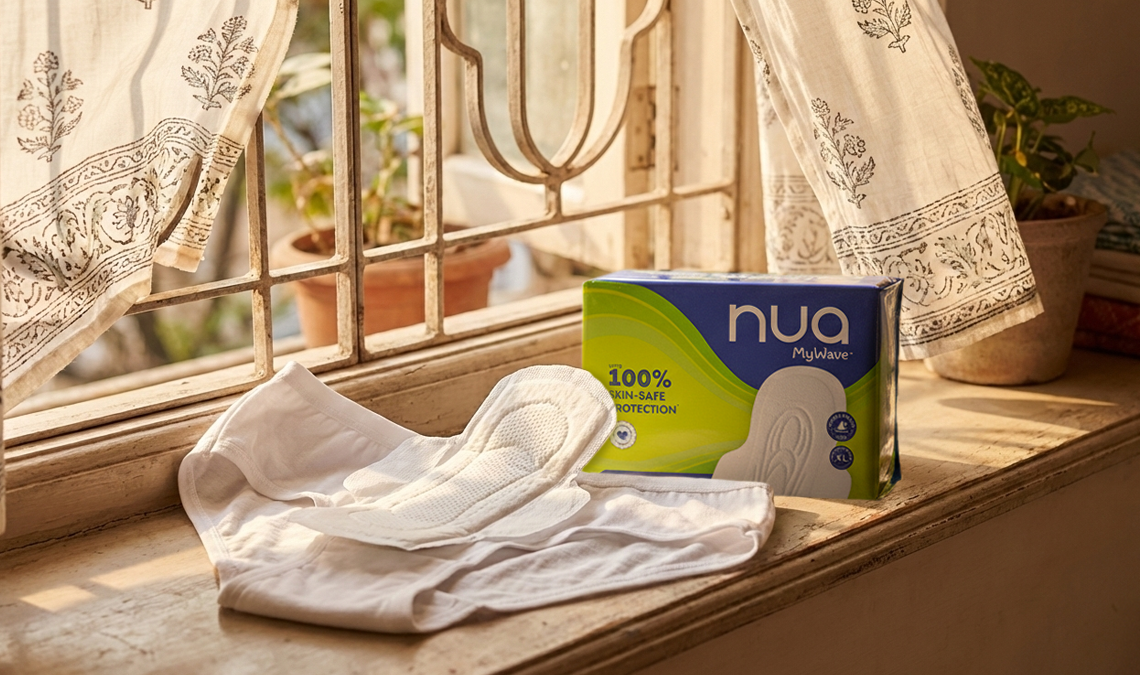
If you head to the product page of our ultra-soft MyWave pads, you see us tell you that they are 100% skin-safe, but have you ever paused and wondered… what does skin-safe really mean?
And when every brand claims its pad is skin-safe, what actually makes Nua different? And why does this claim matter so much more than anyone realises?
It’s because your skin is only a few millimetres thick, and the skin in the genital area? It’s even thinner. Research shows it has just 4-8 cell layers. For context, your arm has 15 and the heels have a whopping 86. So, you can already guess how delicate this area truly is.
In fact, it’s also one of only two places where mucous membranes are directly exposed. This means it has lots of nerves and lots of blood vessels, making it super quick to react to anything that touches it.
Now, add the environment your vagina and vulva live in. They’re covered almost all day, rubbing against clothes and dealing with constant friction. Considering that a menstruating woman (a.k.a. you) uses up to 10,000 pads in their lifetime, that’s a hella lot of repeated, airtight interactions with the most sensitive skin on the body.
Which brings us back to the big question, if this skin is that delicate, that reactive and that exposed, how can a pad NOT be skin-safe? Well, we agree. Let’s break it all down.
Do Skin-Safe MyWave Pads Contain Any Chemicals?
No, skin-safe MyWave sanitary pads are free of chemicals, and irritants.
Dermatologists follow something called the 500 Dalton rule (Dalton = molecule size). It says that anything smaller than 500 Daltons can slip through your skin barrier. And guess what? Most common pad irritants, like phthalates, parabens and VOCs, fall WAY below that size. Which means… yes, they can be easily absorbed.
And because the skin down there is a mucous membrane, it absorbs 10-50x more. Plus, whatever gets absorbed by it goes straight into the bloodstream without any natural filtration. So even tiny amounts of chemicals matter A LOT in this area.
What makes this even more worrying is how common these chemicals are. Studies found that >90% of pads tested contained at least one type of phthalate, and almost all pads had detectable VOCs and traces of dioxins. These are hormone-disrupting chemicals your skin should never meet.
This is exactly why Nua’s ultra-soft MyWave pads are made free of them, forming the foundation of our Zero Irritation Promise.
Blog continues after the ad.
How Do Breathable Pads Prevent Skin Barrier Damage?
Breathable pads maintain healthy skin by allowing air circulation and preventing moisture buildup. The soft top layer MyWave pads use makes this possible. Here’s your guide to understanding skin barrier protection:
- Understand Your Vulvar Skin: You probably think twice before putting anything on your face because, well, we’ve all been taught it’s sensitive. But the skin down there? It’s even more delicate. Studies show that vulvar skin loses about 25 g/m² of moisture per hour, that’s 2.5x faster than your facial skin, making it naturally fragile and super prone to irritation.
- Recognize the Sweat Factor: This area has a lot of sweat glands, making things damp and itchy, really easily, really fast.
- Avoid Non-Breathable Pads: When a pad isn’t breathable and traps this moisture and sweat against the skin, it causes the humidity down there to shoot up and the skin starts to swell. When this happens, the bonds between skin cells loosen, inviting irritation and rashes to form.
- Choose Breathable, Skin-Safe Pads: Breathable pads, like Nua’s rash-free MyWave pads comfort design, avoid this by letting air flow through. Plus, the cherry on top is MyWave Pad’s dual-wrapped core, which locks away the moisture and keeps the skin comfortably dry and protected.
Can Pads Disrupt Your pH Balance?
Yes, conventional pads can disrupt pH balance, but leak-proof MyWave pads prevent this.
Here’s how:
Your vulva stays naturally acidic (pH 3.8-4.5) to keep the bad bacteria away. But menstrual blood is basic (pH 7.3-7.5), and every time it touches the skin, it temporarily neutralizes that acidity.
With many conventional pads, the problem isn’t just absorption, it’s that moisture often stays on the surface instead of being pulled away quickly. This keeps the surface pH elevated for much longer than it should be, making irritation and infections far more likely.
Therefore, a skin-safe pad shouldn’t just soak up blood, it should lock it away. That’s exactly what Nua’s comfortable MyWave period care does. They have a long-lasting leak-lock core to absorb blood quickly, lock it in and keep your skin safe, dry and comfortable all day long.
What Prevents Skin Allergic Reactions in Pads?
Truly skin-safe pads stay well below allergen thresholds and eliminate all common irritants. Here’s what you need to know:
- How Allergic Reactions Happen: Your immune system doesn’t react to most allergens until they actually bind to your skin proteins. But once enough of the substance binds, it triggers an allergic reaction.
- Understanding NESIL: That’s why scientists define a safe daily limit for chemicals. It’s known as NESIL (No Expected Sensitization Induction Level). It is the maximum amount of an allergen your skin can handle without causing allergies.
- The Problem with Conventional Pads: When researchers tested common period products, they found that several period products had fragrance allergens that leached out onto the skin and reached up to 0.9× the NESIL limit. That’s high enough to trigger allergic reactions, like contact dermatitis, in sensitive skin.
- Nua’s Allergen-Free Solution: A truly skin-safe pad keeps all common allergens below the NESIL. Nua’s ultra-soft MyWave pads are completely free of allergens, including fragrances. So there are no hidden perfume molecules, no bleaching chemicals and no risk of allergic reactions.
How Do Pads Prevent Friction and Chafing?
Skin-safe pads use soft materials and stay-put technology to eliminate friction. Here’s the science behind comfortable MyWave period care:
- The Friction Problem: When a pad folds or curls, it creates tiny ridges that rub against your skin every time you walk. And considering we take thousands of steps a day, that’s thousands of micro-frictions you’re dealing with.
- Plastic Mesh Dangers: What makes this worse is that many pads use plastic mesh top sheets that have microscopic, jagged edges. Under a microscope, they genuinely look like a cheese grater. Now imagine that pressed against your soft, sensitive skin while you move.
- Nua’s Dual Solution: Nua’s long-lasting MyWave pads tackle both problems. They use StayLock Technology to keep the pad in place and prevent bunching, while the cloud-soft topsheet replaces harsh mesh, protecting your skin from those microscopic edges. The result? No friction, no chafing and all-day comfort.
How Can You Verify If a Pad Is Truly 100% Skin-Safe?
Look for independent certifications that prove toxic-free and dermatologically tested claims. Here’s what to check:
- Beyond Marketing Claims: With so many brands claiming to be 100% skin-safe, the only real way to know is to look for proof that goes beyond marketing. This is where independent certifications matter. They tell you whether a pad has actually been tested, verified and cleared by experts who have nothing to do with the brand.
- Made Safe Certification: One of the most reliable markers is Made Safe Certification, which ensures the product is free from known toxins. If a pad carries this, you already know it has passed one of the world’s strictest safety filters.
- Certified Toxic-Free Seal: Another strong indicator is the Certified Toxic-Free seal, which validates that harmful chemicals have been eliminated at the source.
- Dermatological Testing: Pads should be evaluated under medical supervision to make sure they don’t trigger irritation or allergic reactions on sensitive skin.
- Nua’s Gold Standard: Nua’s ultra-soft MyWave pads meet all of these standards, and more. They’re verified through ISO 14389 testing, which checks for harmful chemicals at a molecular level. So when Nua says 100% skin-safe, it’s a documented claim backed by global benchmarks.
Key Takeaways
When it comes to period care, skin-safe isn’t just a buzzword, it’s a necessity. Your vulvar skin is incredibly delicate, with mucous membranes that absorb chemicals 10-50x faster than regular skin and send them directly into your bloodstream. That’s why choosing ultra-soft MyWave pads matters. They’re designed to protect this sensitive area through toxic-free materials, breathable construction, pH-friendly absorption, allergen elimination, and friction-free comfort.
With independent certifications like Made Safe and ISO 14389 testing backing every claim, Nua’s skin-safe MyWave sanitary pads deliver on the promise of 100% skin-safety. Because you deserve period care that prioritizes your health, not just convenience.
Disclaimer:
The content of this article is provided for general informational and educational purposes only and is not intended to constitute medical advice, diagnosis, or treatment. The information shared is of a general nature and may not be appropriate for all individuals or specific circumstances. Readers should not disregard, delay, or substitute professional medical advice based on the information contained herein.
If you experience any symptoms, notice anything unusual, or have concerns relating to your health or overall wellbeing, you should consult a qualified healthcare professional. While every effort is made to ensure the information shared is accurate and up-to-date, Nua makes no representations or warranties, express or implied, regarding the accuracy, completeness, or suitability of the information provided and disclaims all liability arising from reliance on this content to the fullest extent permitted by law.