
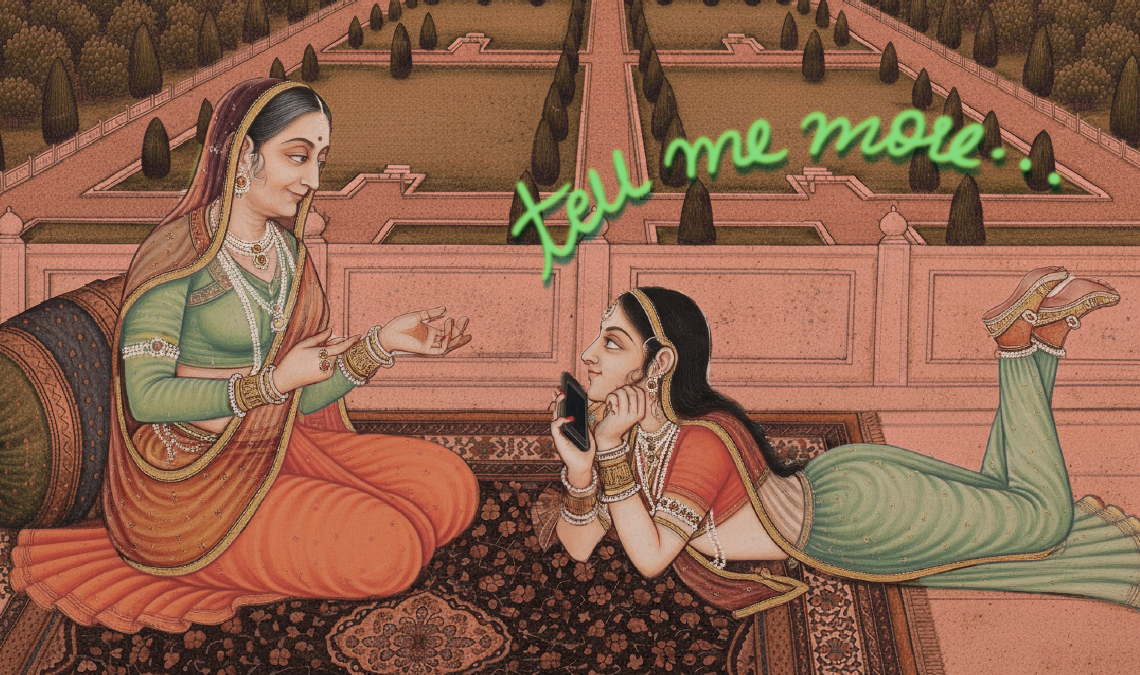
At 32, I don’t get worked up about as many things as I did at 20. And compared to when I was 13? Forget it. I used to be a walking ball of self-consciousness — embarrassment, shame, anxiety, you name it. Now? Most of those feelings roll off me. And if I’m already this much calmer at 30, I can only imagine what I’ll be like at 50 or 70. That’s why life lessons from grandmothers can be invaluable. My grandmothers, who are right around 70, prove the point. They’re completely unfazed by the small stuff and have this unbelievable tolerance for day-to-day inconveniences that easily rattle me sometimes.
And when it comes to periods, menstrual health, and reproductive health? Their level of “I-couldn’t-be-bothered” is unmatched. They keep it short, simple, no-nonsense. They’ve lived through everything—puberty, at least 400 cycles, three pregnancies, perimenopause, and then menopause.
Add to that the experience of walking their daughters (and granddaughters) through puberty and pregnancy, and you’ve got women who have truly seen it all. Nothing surprises them anymore. They are living archives of the female body. So they don’t dramatize, they don’t whisper, they don’t sugarcoat. They keep it real, because they’ve earned that perspective.
And their perspective is both grounding and freeing.
The Science Behind the ‘Granny Perspective’: Why Life Lessons from Grandmothers Are Essential
This is where science adds an extra layer of awe. Enter the ‘Grandmother Hypothesis’, the idea that menopause isn’t a flaw in biology, but an evolutionary feature, according to research.
For decades, scientists found menopause puzzling. Evolutionarily, living beings have no reason to stay alive if they are past the phase of reproduction. But now studies are suggesting that menopause has actually been an evolutionary strategy all along.
No longer tied down by their own child birthing and child rearing responsibilities, post-menopausal women became the bedrock of early communities, investing in grandchildren and passing on survival skills. Their role was so crucial that human society is thought to have been shaped around their presence. In other words, life lessons from grandmothers are not just a cultural idea, they are an evolutionary necessity.
Lessons on womanhood from grandma aren’t just lectures to be met with eyerolls; our DNA is literally coded to benefit from them. Who else but women who’ve lived through decades of cycles, births, losses, and changes are best equipped to teach us resilience? If wisdom is passed down from lived experience, then grandmothers are like walking, talking textbooks.
And it’s not just abstract theory to me. I’ve seen this truth play out in my own life, in moments with both my grandmothers. Their small, ordinary acts became extraordinary life lessons that shaped my understanding of womanhood. Here are two stories that live in me as proof.
Dadi and the Stained Bedsheet
I got my first period at 13 and just a couple of months later, I was off to spend my summer holidays alone with my grandparents. It was the first time I had to handle my period without my mom around. Since it had only happened twice before, I wasn’t really thinking about it. I was too busy being 13, watching movies, playing around the house, tagging along on errands.
Then one morning, I woke up in a pool of blood.
In reality, the stain was no bigger than an inch, but to me it felt catastrophic. I panicked, I was beyond mortified. I stripped the sheet, ran to the bathroom and hunched over the tub, scrubbing furiously with hand soap, trying to erase my shame.
Hearing what I’m sure was a commotion, my Dadi walked in. She watched me for a moment, then gently took the sheet from my hands, tossed it in the washing machine, and guided me out of the bathroom. She told me that stains happen, and that bleeding on a sheet was no different than drooling on a pillow or crying into a napkin – it is what it is.
At breakfast, she mentioned it casually, not to embarrass me, but to normalize it. No lectures, no empowerment monologues, just calm. A calm that came from decades of navigating the messiness of being human. That day, she gave me one of the most powerful female life lessons from an elder: that the body is never something to be ashamed of. Not blood, not discharge, not spit, not vomit. Nothing human is disgusting.
Now, years later, my Dadi has aged and sometimes struggles with incontinence. I see the flicker of embarrassment in her eyes when it happens. But I vowed to be her calm in those moments, the way she was mine. It’s not just about calm, though,it’s about empathy. Older women pass on empathy borne of having lived these moments already, and that empathy circles back when it’s their turn. That’s the intergenerational wisdom women pass on quietly—not through speeches, but through presence — the kind that strengthens the sisterhood across generations.
My Nani and Her Goddess Strut
Growing up, I never saw my mother naked. As an adult, I find that odd. How is a young girl supposed to learn what a woman’s body really looks like if not from seeing her mother’s? But I did learn — from my Nani.
Nani did not bother about modesty in front of my mother and me. When she was changing her clothes, she’d walk around naked with complete confidence, even into her 50s, 60s, and 70s. To me, she looked like a goddess. Not because her body matched magazine ideals, far from it. She had cellulite, she had stretch marks, she had scars – but she also had ease. Her confidence radiated more than any “perfect” body could.
This was one of the most enduring lessons on womanhood I learned as a child — to just be, unapologetically. Her counter may have been cluttered with anti-wrinkle creams, but none of that overshadowed the deep comfort she had in her skin. That comfort could have only come with time, with living through everything a female body can experience and carrying those lessons through the rest of your life. She’s gone now, but as strange as this sounds, that’s the image of her I hold most tightly: gloriously naked, unashamed, divine.
As I step into my 30s, I notice the changes in my own body. A little back fat, a muffin top, jiggly arms. When I’m looking at my reflection, my critical voice sometimes stirs, but then I think of Nani. I think of her strut, her comfort, her ‘chill’. That memory flips the script in my head. Instead of critique, I feel gratitude. My body has carried me this far, and it will continue to do so, strong and unwavering.
Why We Need Grandmothers More Than Ever
If my grandmothers taught me anything, it’s that there are lessons about womanhood you simply cannot learn from books, YouTube, or even your peers. You need to sit with elders.
Teenage girls, especially, should spend time with their grandmothers. They’re not just women who “used to be young.” They’re guides. They can tell you what truly matters, what’s temporary, and what’s survivable. Their lives are proof that embarrassment, shame, and self-consciousness fade with time. They embody female wisdom, like how to carry yourself, how to love your body, how to forgive its messes.
Science is now affirming what our instincts already knew: women past menopause aren’t just lingering at the edges of society. They are society’s backbone. The Grandmother Hypothesis frames it in evolutionary terms, but we know it emotionally. Grandmothers are wells of knowledge, perspective, and humour. They teach by example, pass on resilience and keep families tethered together. They show us that survival isn’t just about food or shelter (although Indian grandmothers love to house and feed you), it’s about the strength of spirit, the acceptance of the body, and the unshakable dignity of knowing you are enough exactly as you are.
Life lessons from grandmothers are about not apologizing for the body you live in, about helping us see beyond the crisis of today to the bigger arc of tomorrow. The intergenerational wisdom women carry is the invisible glue that holds us together. And if we’re smart, we’ll keep listening.
Looking Back, Moving Forward
So this Grandparents’ Day, I’m celebrating not just my grandmothers but all grandmothers. The women who carry centuries of human experience in their bodies and their stories.
Their wisdom is evolutionary, emotional, and eternal.
If you’re lucky enough to still have yours around, spend time with them. Ask questions. Watch them move. Learn their humour, patience and confidence. Life lessons from grandmothers are not just about survival. They’re about living—fully, unapologetically, and gloriously human.