
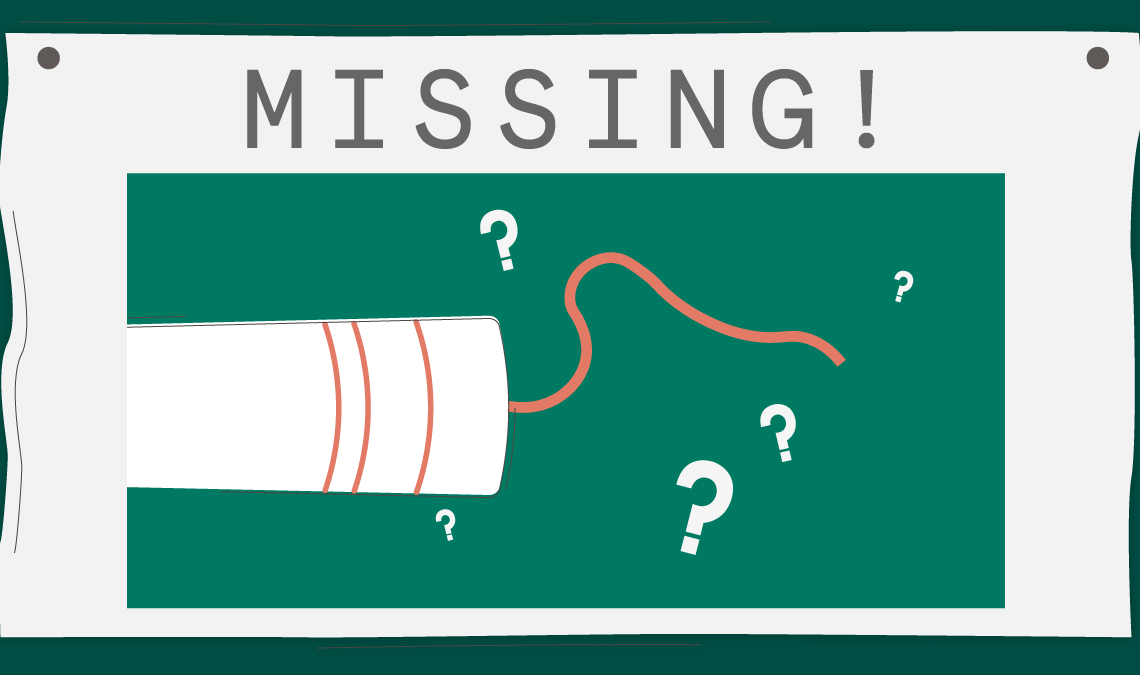
What you will learn about a missing tampon string in this blog:
- If you can’t find the tampon string, stay calm. The tampon cannot get lost inside your body and is still in the vaginal canal.
- Sit on the toilet, relax your pelvic muscles, and take slow breaths. Tension can make removal harder.
- With clean hands, gently insert one or two fingers to feel for the string or base of the tampon and pull slowly.
- Bearing down slightly, like you’re trying to poop, can help move the tampon lower for easier reach.
- Do not use tweezers, random objects, douche, or insert another tampon. These can cause irritation or make removal harder.
- If you still can’t remove it after trying calmly, a healthcare provider can remove it quickly and safely.
You’re in the bathroom, you reach down to remove your tampon, and… there’s nothing there. You can’t find the tampon string!
First of all, breathe. This is way more common than anyone admits, and your body is not doing anything wrong. Tampons don’t vanish into some mysterious internal portal (more on the lost tampon myth here). There is literally nowhere for them to go. Your cervix is not an open hallway, it’s more like a closed room with a peephole. A tampon cannot pass through it. So if the tampon string is not visible, the tampon is still in your vaginal canal, just sitting a little higher than usual.
Why A Tampon Can’t Really Be Lost Inside You
Your vagina isn’t a straight, empty tube. It’s flexible, muscular, and constantly responding to movement, arousal, and even where you are in your cycle. When you walk, sit, squat, or bear down, those muscles shift. A tampon that was perfectly placed an hour ago can migrate upward slightly, especially if it was inserted a bit high to begin with, which, by the way, is often more comfortable (here’s an insertion guide that may help if you’re learning how to use tampons).
It’s also possible that the tampon didn’t travel up with the tampon. Sometimes the string just gets tucked up alongside the tampon. Or sometimes it gets folded. Sometimes it’s there but playing hide-and-seek behind a vaginal wall. None of this is dangerous.
Blog continues after the ad.

That said, panic is not helpful, but doing nothing also isn’t the move. You do want to remove it, because leaving a tampon in for too long increases the risk of bacterial growth, which is where infections and the very rare but very real toxic shock syndrome come into play. The risk is still low (only 1 in 1,00,000 according to research), especially if we’re talking hours and not days, but your goal is removal, not avoidance.This is why tampon change frequency is such an important part of basic menstrual hygiene and overall tampon safety.
So let’s talk about what actually helps.
How to Remove a Tampon When the String Is Missing
Step One: Relax Your Pelvic Muscles
- Sit on the toilet with your feet flat on the floor.
- Take a few slow breaths into your belly.
- On each exhale, soften your pelvic muscles, the same way you do when you’re about to pee or poop.
- Avoid clenching. Stress makes the muscles around your vagina hold on tighter, which is the opposite of what you want.
- If you’ve ever noticed how tampons seem easier to remove when you’re already on the toilet, that’s not coincidence. Squatting slightly shortens the vaginal canal and changes the angle.
This is just biomechanics.
Step Two: Use Your Fingers
- Wash your hands thoroughly. Trim your nails if needed.
- Gently insert one or two fingers into your vagina and feel around for the tampon.
- Think of it like finding the edge of a contact lens in your eye, not a rescue mission.
- You’ll usually feel either the base of the tampon or the string tucked alongside it.
- Once you locate it, hook your finger around it and pull slowly.
- If you can’t feel anything at first, bear down slightly, like you’re trying to poop. That downward pressure can help bring the tampon lower.
This kind of hands-on tampon removal is safe when done gently and with clean hands. Most of the time, this solves the problem within a minute or two.
For easy insertion and removal, try Nua’s EaseFit Tampons.
Step Three: When to Stop Trying
- If you truly cannot reach it after relaxing, squatting, and bearing down, stop.
- A healthcare provider can remove a tampon in about ten seconds using a speculum and forceps.
- It’s not extra, it’s not rare, and it’s not something they’ll judge you for. This is routine, boring medical work.
- Don’t keep poking and stressing your tissues for half an hour. That just leaves you sore and anxious.
- If your body is telling you this isn’t working, listen.
And just to say it clearly, a tampon stuck without the string does not mean it’s stuck forever. It only means it’s temporarily out of reach.
Why Do Tampon Strings Get Lost in the First Place?
There isn’t usually one big reason. It’s a combination of body, behaviour, and product.
Reason 1: Expanding Shape
Tampon strings are attached to compressed cotton or fibre that expands when it absorbs blood. That expansion helps prevent leaks, but it also shifts the tampon’s shape once it’s inside you. As the tampon expands, the string can get pulled upward or flattened against the body of the tampon. That makes a lost tampon string more likely even when everything else is normal.
Reason 2: Insertion Habits
For beginners especially, it’s not always obvious that the string needs to be fully unraveled before insertion. If the string is still wrapped around the tampon, it can slide right in with it. Even experienced users do this on autopilot. You’re half-asleep, late for work, or changing it quickly in a public bathroom. When the string goes in with the tampon, the tampon itself is still sitting in a normal, safe position. Your usual removal handle is just temporarily unavailable.
Reason 3: Variability of Vaginal Length
Some people have shorter vaginal canals, some longer. That length even changes slightly depending on where you are in your cycle. Around ovulation, the cervix sits higher, which means the tampon may also sit higher.
Reason 4: Movement Matters Too
Exercise, dancing, even just walking a lot can subtly reposition internal products. This doesn’t mean the tampon is too big or too small or that you inserted it wrong. Bodies are dynamic.
Reason 5: Product Design
Some tampons use rougher fibers or less flexible materials that expand more rigidly. That can make removal less intuitive if the string isn’t accessible, because the tampon doesn’t compress as easily when you try to pull it down with your fingers.
Higher-quality tampons are designed to expand evenly and stay soft, which makes them easier to grasp and remove if you ever need to go in manually. That’s one of the reasons women prefer tampons with smoother finishes, like the ones from Nua. Our EaseFit Tampons are designed to be absorbent without turning into a dry brick, which your vaginal walls appreciate.
Comfort isn’t just about how it feels when it goes in. It’s about how it behaves the entire time it’s inside you, which is an often-overlooked part of tampon hygiene and long-term vaginal comfort.
What Not to Do
Let’s quickly clear up a few things that come up a lot.
- Do not use random objects to try to fish out a tampon. Not spoons, not tweezers, not anything that isn’t clean and designed for medical use. You risk scratching delicate tissue and introducing bacteria.
- Do not douche. Ever, but especially not for this. Douching does not remove a tampon and can disrupt your vaginal microbiome, which is a whole other problem you do not need.
- Do not insert another tampon just in case. If you’re unsure whether one is still inside, adding another can push the first one higher and make removal harder. If you genuinely don’t know whether you already removed it, that’s a quick, simple check for a healthcare provider.
Your vagina deserves respect, not improvisation.
Preventing the Situation Next Time
While this can happen to anyone, a few habits reduce how often it happens.
First, make sure you’re using the right absorbency. If your tampon isn’t absorbing much and stays relatively dry, it may sit higher and be harder to grip. Using a lighter absorbency when your flow is light makes removal easier and more comfortable, and supports better tampon safety tips overall.
Second, insert the tampon fully. If it’s sitting too low, it can feel uncomfortable. If it’s sitting at the right depth, it’s less likely to shift unpredictably. The goal is not as high as possible, it’s comfortably in place.
Third, choose tampons with strong, well-attached strings and materials that don’t become overly rigid when they expand. This is another reason product quality matters more than people think. It isn’t only about leaks, it’s about how the tampon behaves in real-life scenarios that aren’t in the instruction pamphlet.
And finally, stay connected to your body. If something feels off, check sooner rather than later. Removing a tampon after four hours is very different from trying to remove one after twelve when everything is dry and swollen.
Disclaimer:
The content of this article is provided for general informational and educational purposes only and is not intended to constitute medical advice, diagnosis, or treatment. The information shared is of a general nature and may not be appropriate for all individuals or specific circumstances. Readers should not disregard, delay, or substitute professional medical advice based on the information contained herein.
If you experience any symptoms, notice anything unusual, or have concerns relating to your health or overall wellbeing, you should consult a qualified healthcare professional. While every effort is made to ensure the information shared is accurate and up-to-date, Nua makes no representations or warranties, express or implied, regarding the accuracy, completeness, or suitability of the information provided and disclaims all liability arising from reliance on this content to the fullest extent permitted by law.