
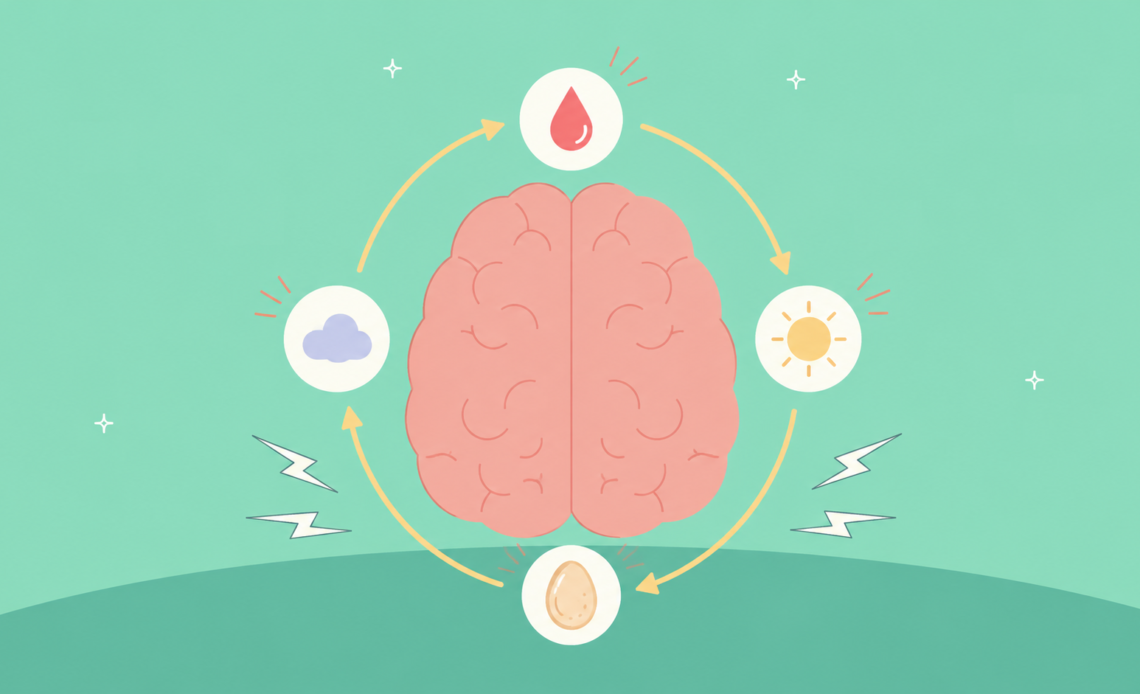
What you will learn about how your menstrual cycle affects your brain in this blog:
- Your brain doesn’t stay the same throughout the different menstrual cycle phases, and scientists can now measure these changes.
- Your brain produces different types of electrical activity called brain waves, and two of them, alpha and theta, change around ovulation.
- These brain changes may be linked to how you feel and function, including your attention, emotional well-being, and tendency to overthink.
- Changing estrogen and progesterone levels may be part of why this happens, because these hormones also act on the brain.
- There are still gaps in understanding how these changes vary across women and different hormonal or menstrual health conditions. But this research provides a foundation for further study and validation.
How your menstrual cycle affects your brain may be something you’ve noticed without really stopping to think about it. You might feel focused and productive at one point in your cycle, only to find yourself struggling with concentration or dealing with brain fog during your period a few days later.
For years, these changes in women’s mood, memory, and mental clarity were often brushed off as “just something hormonal.” But it turns out there’s more going on than that. A 2026 review now gives us some actual brain-level evidence. It brought together 23 studies that measured brain activity across different menstrual cycle phases and found that your cycle can ACTUALLY influence brain function, with measurable changes in your brain waves.
Almost feels a bit sci-fi, right? Like, what do you mean by ’your brain literally changes during your menstrual cycle’? So, let’s look a little deeper and see what the review found, how strong the evidence really is, and what it could mean for you.
Why Did Scientists Start Looking at Brain Changes During the Menstrual Cycle?
Ask any woman if she notices changes in her focus or cognitive function every week, and she’ll probably say yes without a second of hesitation. But ask science to prove it, and for the longest time, there just wasn’t much to point to.
Blog continues after the ad.

That’s the gap a team of researchers set out to explore. In 2026, they brought together 23 existing studies that used EEG, short for electroencephalography, to measure brain activity at different points across the menstrual cycle.
They specifically looked at resting-state EEG, which measures brain activity when you’re not doing anything and are simply resting. This helped researchers compare the brain across all the menstrual cycle phases and find out whether a woman’s brain works differently at different times of the month.
But How Do You Actually Measure Brain Activity?
Your brain is made up of billions of nerve cells, and they’re constantly sending tiny electrical signals to communicate with each other. When lots of these signals happen together, they create patterns of electrical activity. These patterns are called brain waves, and they’re of 5 main types.
- Delta waves: These are very slow and are most strongly associated with deep sleep and the brain’s restorative processes.
- Theta waves: These are linked to things like memory, learning, attention, and processing information.
- Alpha waves: These are commonly seen when you’re awake but relaxed. For example, when you’re sitting quietly and not actively concentrating on something.
- Beta waves: These are faster and are associated with being alert, focused, and actively thinking, such as when you’re concentrating on a task.
- Gamma waves: These are the fastest of the five and are associated with more complex information processing.
So, by measuring these different brain waves at different points in the menstrual cycle, researchers can look for changes in brain activity throughout the month.
So, What Did The Review Actually Find?
When researchers looked across the 23 studies, changes in 2 of the 5 types of brain waves stood out:
- During the late follicular phase (the days leading up to ovulation), alpha activity decreased while theta activity increased.
- During the luteal phase (right before your period), this pattern reversed, with relatively higher alpha and lower theta activity.
As for delta, beta, and gamma? The researchers didn’t find consistent enough changes across the studies to draw firm conclusions. So, yeah, we don’t have the complete picture of how every type of brain activity changes throughout your cycle just yet. But we do have pretty interesting clues that your brain shifts how it processes and responds to information around ovulation.
What Do These Changes Actually Mean For You?
As per the review, right before ovulation, alpha activity decreased in the frontal, parietal, and temporal regions (areas of the brain involved in attention, memory, and processing information). Since alpha activity is more associated with a relaxed, resting state, having less of it suggests that the brain may be less “idle” and more actively engaged.
At the same time, theta activity increased, a pattern associated with more efficient brain processing. Taken together, these changes suggest that around ovulation, your brain may be more alert and tuned in to what’s happening around you, with less tendency to get caught up in its own thoughts.
- You may find it easier to stay focused with your attention feeling sharper. The same was confirmed in another study, where women noted a 9% faster reaction time to tasks during ovulation.
- You may feel more emotionally positive and socially open, finding it easier to regulate your emotions and willing to connect with others
- You may spend less time overthinking, feeling more present and engaged with what’s happening around you.
But during the luteal phase, the pattern shifts.
Alpha activity increased while theta activity decreased compared with the late follicular phase. This happens as progesterone rises after ovulation, creating a different hormonal environment for the brain. Since higher alpha activity is generally associated with a more relaxed, internally focused state, while theta activity is linked to attention and information processing, these changes suggest that the brain may be operating in a less externally focused state during this phase.
So, what might you notice?
- You may find it takes more effort to stay focused, particularly as you get closer to your period.
- You may feel more emotionally sensitive, as hormonal changes during the luteal phase can influence brain regions involved in emotional processing.
- You may feel more mentally tired or foggy, especially in the days before your period, although these experiences vary from person to person.
The important bit? This doesn’t mean your brain is functioning worse during the luteal phase. It’s responding to a different hormonal environment, and researchers are still figuring out exactly what these changes mean for everyday cognition and mood.
Note: These findings don’t mean that women will ALWAYS be more productive and happier around ovulation or less focused before their period. They simply show that brain activity changes across the menstrual cycle, and we’re only beginning to understand what these shifts mean in everyday life.
Want to spot these patterns in your own cycle? Tracking your cycle with Nua’s Period Tracker can help you see how your period lines up with how you feel.
What Causes These Changes in Your Brain Waves?
The reason behind these brain changes during the menstrual cycle is hormonal fluctuations.
Your estrogen and progesterone levels are constantly changing across the different menstrual cycle phases. These hormones don’t just work on your reproductive system. They also act on your brain, interacting with neurotransmitters, the chemical messengers that help brain cells communicate. In other words, hormones and brain function are more connected than you might think.
Estrogen has a more activating effect on the brain, so when it rises during the follicular phase and peaks around ovulation, you may feel more alert, sharp, and mentally switched on. Progesterone has a more calming effect, so when it rises after ovulation during the luteal phase, you may feel more relaxed, slower, or foggier.
Basically, your brain is responding to a changing hormonal environment throughout your menstrual cycle phases (more on that here).
Why Does This Review Actually Matter?
Seeing measurable changes in brain activity across the menstrual cycle gives us a new way to understand experiences that women have been talking about for years.
- It validates what many women already feel. Measurable changes in brain activity give scientific backing to the mental and emotional changes women experience, which are often dismissed as subjective or “just in their head.”
- It reframes PMDD and PMS as neurophysiological issues. For anyone living with PMS (premenstrual syndrome) or PMDD (premenstrual dysphoric disorder), it reinforces that these experiences are real medical issues, not simply a matter of mood (more on that here).
- It could improve diagnosis for period-related conditions. Studying brain activity alongside menstrual symptoms could eventually help understand why some women are more sensitive to hormonal shifts and who may be more vulnerable to cycle-linked disorders.
What Does the Review Still Not Tell Us?
The review gives us some pretty interesting findings, but there are still gaps. It looked at studies that had already been done rather than one large study where everyone was tested in the same way. This means the results can’t be compared as neatly as they could in one controlled study.
Most participants also had healthy, naturally occurring cycles, so we don’t yet know if the same patterns apply to women using hormonal birth control, going through perimenopause, or living with PCOS or endometriosis.
And finally, EEG is not a diagnostic tool for menstrual cycle changes YET. Researchers haven’t identified a specific brain-wave pattern that can reliably tell whether someone is in a particular cycle phase or has a specific condition.
Turns Out, Your Brain Has a Cycle Too
Your brain doesn’t exist separately from the rest of your menstrual cycle. As your hormones rise and fall, your brain responds too, and this review gives us some of the clearest evidence yet that those changes can actually be measured.
That doesn’t mean every woman will feel sharper at ovulation or foggier before her period. But it does mean that the next time your brain feels a little different at a particular point in your cycle, there’s more science behind that experience than we once thought. And honestly, it’s about time we started paying attention to it.
Still have questions about how your menstrual cycle affects your brain? Drop them in the comments, and we’ll get back to you.
FAQs
1. Does your menstrual cycle affect your brain?
Yes. Research shows that brain activity changes across the menstrual cycle, particularly in the alpha and theta brain waves. These changes appear to be linked to shifting hormone levels.
2. How does your menstrual cycle affect your brain?
Changes in estrogen and progesterone throughout the cycle can influence brain activity. Research suggests that around ovulation, the brain may become more actively engaged, while activity patterns shift again during the luteal phase.
3. Why do I feel more focused around ovulation?
The research suggests that changes in brain activity around ovulation may be linked to sharper attention and more efficient processing. One study also found that women had 9% faster reaction times during ovulation, although this does not mean everyone will experience better focus at this time.
4. Why do I feel mentally foggy before my period?
During the luteal phase, alpha activity increased while theta activity decreased. This pattern may be associated with feeling more mentally drained or finding concentration more difficult before your period, although the research does not mean everyone will experience brain fog.
5. What hormones affect your brain during your menstrual cycle?
Estrogen and progesterone are the main hormones discussed in the review. As their levels rise and fall across the menstrual cycle, they interact with the brain and may contribute to changes in brain activity, attention, and emotional experiences.
Disclaimer
The content of this article is provided for general informational and educational purposes only and is not intended to constitute medical advice, diagnosis, or treatment. The information shared is of a general nature and may not be appropriate for all individuals or specific circumstances. Readers should not disregard, delay, or substitute professional medical advice based on the information contained herein.
If you experience any symptoms, notice anything unusual, or have concerns relating to your health or overall well-being, you should consult a qualified healthcare professional. While every effort is made to ensure the information shared is accurate and up-to-date, Nua makes no representations or warranties, express or implied, regarding the accuracy, completeness, or suitability of the information provided and disclaims all liability arising from reliance on this content to the fullest extent permitted by law.