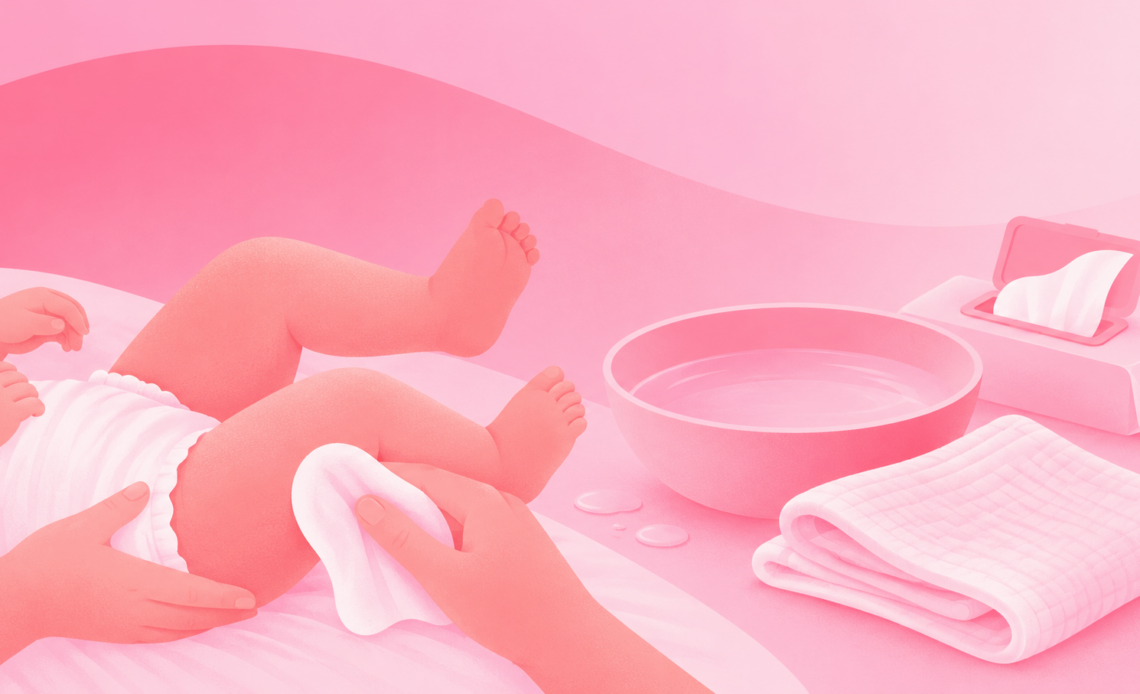
You’re at the changing mat with one hand holding your baby’s ankles, and you’re wondering whether that pack of wipes is actually help or irritating their skin, and whether the bowl of water your mother swears by is just extra effort or worth it for the safety of your baby. Here’s the short answer to the wipes vs. water for baby question: both are fine, as long as they’re gentle.
Plain water with a soft cloth or cotton wool does nothing to the skin, so it’s the simplest choice and the best fit for newborns and for skin that’s already red or sore. Mild wipes that are fragrance-free and alcohol-free are a reasonable option when convenience matters, and the NHS lists both as acceptable for nappy changes. What decides whether your baby’s skin stays comfortable is less the method and more how you use it.
What Matters Most When Cleaning Your Baby’s Skin
Your baby’s skin has the same basic design as yours, but its outer protective layer is thinner and still maturing over the first weeks, so things pass into it and water escapes from it more easily.
To understand more about your baby’s delicate skin and how to care for it every day, read our baby skin care guide here.
In the diaper area, two things wear that outer layer down. The first is stool, which carries digestive enzymes from the gut whose job is to break down proteins and fats. Skin is made of proteins and fats, so stool left on skin keeps “digesting” it, and those enzymes have more impact once urine has made the skin less acidic. The second is friction. Skin that has sat in a damp diaper for a couple of hours is softened, like your fingertips after a long bath, and softened skin scrapes away easily when rubbed.
So the best way to clean baby’s bottom is whichever one removes stool fully while adding as little friction and as few extra ingredients as possible. That’s the yardstick for the whole wipes vs. water for baby comparison.
Here’s how to put it into practice, whichever method you pick:
- Dab, don’t rub: Press the cloth or wipe onto the skin and lift it away, rather than dragging it across. Pressing lifts stool off, dragging pulls the softened outer cells off with it. Use a fresh section of cloth or a fresh wipe for each pass, because a used one just smears stool back onto skin you’ve already cleaned.
- Clean thoroughly, even if it means more passes: A common assumption is that the gentlest approach is the one that touches the skin least. In practice, a smear of stool left in a skin fold means those enzymes stay in contact with the skin until the next change, which could be three hours away. Use enough water that stool lifts easily. A barely damp cloth needs more pressure to do the same job, which brings the friction back.
- Dry the skin before the new diaper goes on: Wet skin is weaker skin, and a fresh diaper traps whatever moisture is left. Pat with a soft towel or give a minute or two of diaper-free air, which dermatologists recommend for letting skin dry and heal. Pay attention to the creases at the tops of the thighs, because they hold water longest. Damp creases are also where chafing starts. Here’s how to prevent it.
- Keep added ingredients to a minimum: Nothing you put on during a change gets rinsed off. It sits under the diaper, sealed against warm skin, for hours. Every extra ingredient is one more thing that skin might react to, so fewer is better for gentle diaper area cleaning.
For the full step-by-step changing routine, see our guide here.
Plain Water: Benefits and Limitations
Water’s biggest advantage is what it leaves behind, which is nothing. It evaporates, so there’s no residue sealed under the diaper. That’s why the NHS advises that plain water is best for your baby’s skin in the first month, and why cotton wool and water for diaper change is the standard advice for newborns in many hospitals. It’s also the easiest option on irritated skin, because there’s nothing in it to sting.
Many families, especially in India, wash the diaper area under a gentle stream of water from a mug or tap rather than wiping at all. This is a very gentle way of cleaning baby’s bottom with water, because flowing water carries stool away without any rubbing.
Two things make it work well:
- Keep the water lukewarm
- Pat the skin completely dry afterwards, especially in humid weather when skin dries slowly on its own.
Water does have real limitations. Stool contains fats, and fat doesn’t dissolve in water, so sticky stool can take several tries to remove, and each try adds friction. Water is also less practical away from home. And it needs to be clean. If you’re not sure about the cleanliness of your tap or stored water, use water that’s been boiled and cooled to lukewarm.
Baby Wipes: Benefits and Limitations
Wipes are convenient, especially on the go, and most contain a mild cleanser that helps lift sticky stool in fewer passes. The question most parents ask is are baby wipes safe for newborns, and there’s good research on it. In a randomised trial of 280 healthy newborns, half had their diaper area cleaned with cotton wool and water and half with an alcohol-free, fragrance-free wipe for their first four weeks. Researchers measured skin hydration, water loss through the skin, skin pH and redness, and found the wipe performed as well as water on every measure.
However, the trial tested one specific wipe formulation on healthy, full-term babies for four weeks. This tells you that a well-made, fragrance-free wipe can be as gentle as water. It doesn’t tell you that every wipe on the shelf is, so the wipes vs. water for baby answer really depends on which wipe.
So are wipes bad for baby skin? Not inherently, but they come with ingredients water doesn’t have. A damp pack of cloth would grow bacteria and mould within days, so every wipe needs a preservative, and many add fragrance. Some babies become allergic to these ingredients. A case series in the journal Paediatrics described six children with stubborn rashes on the bottom and face that doctors had mistaken for eczema, psoriasis or infection. All six were allergic to a preservative in their wipes, and the rashes cleared quickly once the wipes were stopped. An allergy builds up through repeated exposure, so a wipe your baby tolerated for months can start causing a reaction later. So, “we’ve always used these” doesn’t rule the wipes out.
Wipes can also sting on broken skin, because cleansers and preservatives reach nerve endings the damaged outer layer would normally cover. And at 10 to 12 changes a day in the early weeks, the cost and waste add up quickly.
Wipes vs. Water: Side-by-Side Comparison
Here’s the wipes vs water for baby comparison at a glance. “Wipes” here means fragrance-free, alcohol-free wipes, since those are the only kind worth comparing.
| Plain water (cloth or cotton wool) | Fragrance-free, alcohol-free wipes | |
|---|---|---|
| Gentleness | Very gentle if you dab rather than rub | Gentle if well formulated; varies by product |
| Newborns | First choice in the early weeks | Acceptable; a tested wipe matched water in a trial |
| Irritated skin | Best choice; nothing to sting | May sting on broken skin |
| Sticky stool | Can take several passes | Mild cleanser lifts it more easily |
| On the go | Needs clean water and a cloth | Very convenient |
| Added ingredients | None | Preservatives, cleansers, sometimes others |
| Cost | Very low | Ongoing cost and more waste |
Which Is Gentler? It Depends on the Situation
Choosing baby wipes or water isn’t a one-time decision. Most parents use both, and the wipes vs. water for baby answer changes with what’s in front of them.
- First few weeks: Plain water. This is when your baby’s skin barrier is least mature and lets ingredients in most easily, so the water vs. wipes for newborn choice leans towards water. Fewer ingredients during this window means fewer chances for a reaction.
- Red or raw skin: Plain water, then pat dry. Damaged skin lets ingredients reach deeper and sting, so it needs nothing extra.
- Outings and travel: A fragrance-free wipe. A clean wipe is gentler than a dry tissue, or a cloth wetted with water you can’t vouch for.
- Sticky stool: Warm water with a little mild, fragrance-free cleanser, or a wipe. Fatty stool needs something that dissolves fat to lift it without scrubbing. If you use a cleanser, rinse it off with plain water so it doesn’t sit under the diaper. Keep cleansers for after the first month.
- Sensitive or eczema-prone skin: Plain water. Eczema-prone skin has a weaker barrier and is more likely to react to preservatives and fragrance, so removing those triggers is the safer default.
If You Use Wipes: Simple Safety Checks
Yes, can I use wipes on my newborn has a simple answer: you can, if you choose carefully. Check the label for both “fragrance-free” and “alcohol-free.” The NHS lists irritation from fragranced wipes or wipes containing alcohol as a cause of diaper rash, because fragrance is a common allergy trigger and alcohol dries skin and stings. Note that “unscented” isn’t the same as fragrance-free, since unscented products can contain a masking fragrance to hide other smells. Stop using a wipe if you notice redness or stinging after it touches the skin. Keep wipes away from your baby’s eyes and mouth.
Signs Your Cleaning Method Isn’t Suiting Your Baby
Ordinary diaper rash and a reaction to your cleaning method can look similar, but they behave differently. Watch for these:
- Redness that appears soon after cleaning: Rash caused by a wet or dirty diaper builds up over hours. Redness that shows up within an hour or so of a change, on skin that looked fine before, points to something in the cleaning itself.
- Crying or discomfort during cleaning: If your baby flinches or cries the moment the wipe or cloth touches them, and didn’t before, something is stinging. That usually means the skin is broken or an ingredient is irritating it.
- Irritation only where the skin was wiped: A reaction to a product follows the places the product touched. If redness matches where you wipe, or also appears on hands or around the mouth where you use the same wipes, the product is the likely cause. This is the pattern behind most cases of baby wipes and rash.
In any of these cases, switch to plain water for a few days. If the skin settles, you’ve found your answer.
If it doesn’t, it may be ordinary diaper rash. Here’s how to prevent and care for it.
Key Takeaways
- Both methods can be gentle. The wipes vs water for baby decision matters less than how you clean.
- Plain water is the best choice for newborns and for red or irritated skin.
- If you use wipes, choose fragrance-free and alcohol-free.
- Technique matters most: dab rather than rub, remove all stool, and dry before diapering.
- Watch your baby’s skin. Redness soon after cleaning, or stinging during it, is a signal to switch.
FAQs
Can I use wipes on my baby’s face and hands?
On hands, a fragrance-free wipe is fine. For the face, a soft cloth with plain water is the better choice, because skin around the eyes and mouth is especially thin and babies put their hands and anything nearby in their mouths. Stop if you see redness where the wipe touched.
Should I use warm or cold water to clean my baby?
Lukewarm, close to body temperature. Test it on the inside of your wrist, where skin is thin like your baby’s. Cold water makes babies startle and cry, and hot water can scald and strips the skin’s natural oils faster.
Are homemade wipes a good idea?
Usually not. Without a preservative, a damp stack of cloths or paper towels can grow bacteria and mould within days, faster in warm climates. Recipes also often add oils or soap that can irritate. A fresh cloth dipped in water at each change gives you the same benefit with none of the risk.
Is a soft cloth better than cotton wool?
Both work well. Cotton wool is used once and thrown away, so there’s no washing, but cheaper types can shed fibres that stick to stool. A soft cloth is smoother and reusable, but it needs washing in hot water and drying fully after every use, and you should start each change with a clean one.
Are water-based wipes the same as using plain water?
No. This is a common misreading of labels. Even a wipe that’s 99% water still needs a preservative to stay germ-free in a damp pack, and that last 1% is exactly where reactions come from. Water-based wipes may be gentler than other wipes, but they aren’t identical to plain water.
Disclaimer
The content of this article is provided for general informational and educational purposes only and is not intended to constitute medical advice, diagnosis, or treatment. The information shared is of a general nature and may not be appropriate for all individuals or specific circumstances. Readers should not disregard, delay, or substitute professional medical advice based on the information contained herein.
If your baby experiences any symptoms, or if you notice anything unusual or have concerns relating to their health or overall wellbeing, you should consult a qualified healthcare professional. While every effort is made to ensure the information shared is accurate and up-to-date, Nua makes no representations or warranties, express or implied, regarding the accuracy, completeness, or suitability of the information provided and disclaims all liability arising from reliance on this content to the fullest extent permitted by law.