
What you will learn in this blog about the rete ovarii:
- The rete ovarii is a small network of tubes that sits inside and around the ovary, with three sections, known as the intraovarian, connecting, and extraovarian rete.
- It was described more than 150 years ago but was later labelled vestigial (non-functional) because scientists could not identify a clear function.
- Newer imaging and a 2025 study in rats suggest that the rete ovarii persists into adulthood and may play an active role in ovarian function.
- Researchers found that the rete ovarii may influence follicle growth and may also help the ovary respond to signals from the body.
- There’s still more to uncover about what the rete ovarii does. As research continues, we may learn whether it plays a role in fertility and reproductive health, too.
Have you ever heard of the rete ovarii? Probably not. And honestly, that is not surprising.
Back in biology class, all we learned about the female reproductive system was the ovaries, vagina, uterus, and hormones. Often with two little ovals on a diagram, a canal and a few arrows.
But there is actually a small network of tiny tubes sitting next to the ovary, known as the rete ovarii. It was first described more than 150 years ago, yet somehow never became part of the usual story we learn about the female reproductive system.
For a long time, it was mostly treated as a leftover structure with little importance. But after a recent 2025 study in rats, scientists are taking another look at it and asking whether there is more to this little network than we thought.
So, where exactly is the rete ovarii, what does it do, and why are researchers interested in it again? Let’s get into it.
What Is the Rete Ovarii?
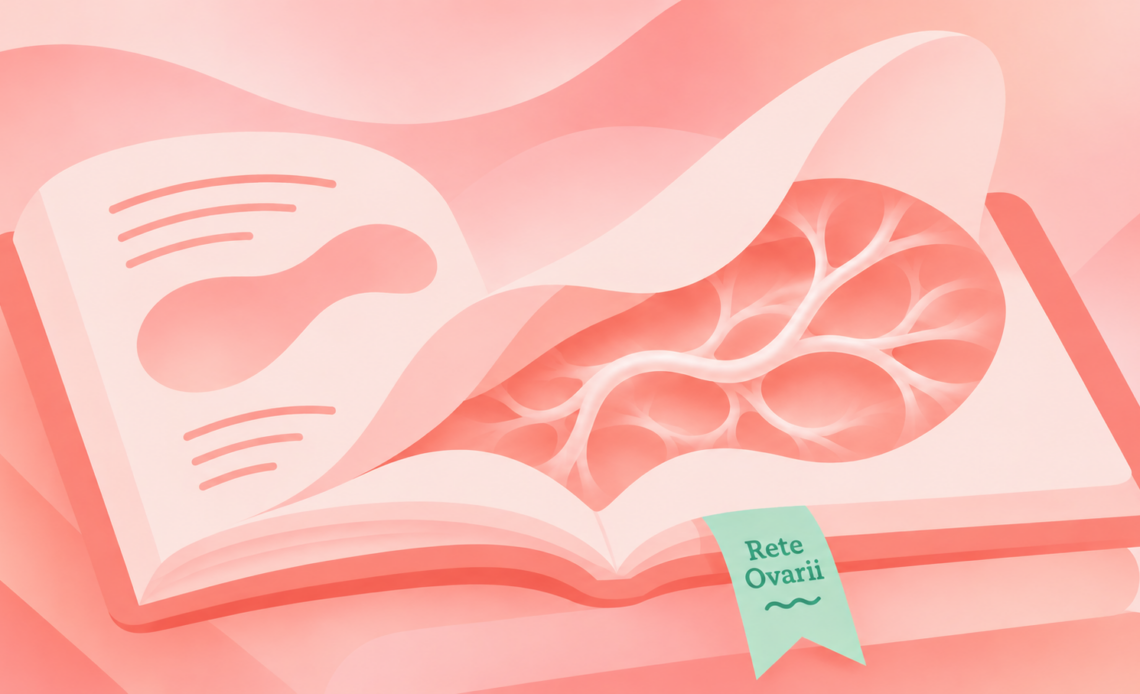
The rete ovarii is a horseshoe-shaped network of tiny tubes and cords that curves around and attaches to the surface of the ovary.
In fact, the name itself tells you what it looks like. Rete means “network” in Latin, so rete ovarii literally means “network of the ovary.”
Scientists divide this network into three sections based simply on where each part is sitting:
- Intraovarian rete (IR)
This is the part inside the ovary itself, tucked into the ovarian tissue. - Connecting rete (CR)
This is the middle section. It connects the part inside the ovary to the part outside it, passing around the hilum (the area where the ovary connects to its blood vessels, nerves, and other structures). - Extraovarian rete (ER)
This is the part outside the ovary. It is also the largest of the three sections and also sits around the hilum.
You can basically picture the rete ovarii as your wired earphones. The IR is the bit that starts inside the phone jack, the CR is the cord that passes through and connects everything, and finally, the ER is the earplugs that sit outside.
And just like the rete ovarii, there’s probably a lot about your own body and cycle that you haven’t discovered yet. Nua’s Period Tracker can help you start spotting those patterns. Try Nua’s Period Tracker today.
Why Have We Never Heard of the Rete Ovarii Before?
The rete ovarii isn’t some brand-new discovery. German anatomist Wilhelm von Waldeyer described it way back in 1870 in his research titled Ovary and Egg. It even appeared in early editions of Gray’s Anatomy, the bible of medical science.
So, if scientists knew about it more than 150 years ago, why have most of us never heard of it?
Well, that is because, over time, the rete ovarii disappeared from modern anatomy textbooks and conversations.
Scientists could see the structure, but their 19th-century microscopes couldn’t tell what it actually did. So, without a clear function, they wrote it off as a vestigial organ, a.k.a. a functionless organ leftover from our evolutionary past. Similar to the tailbone, which is thought to be a leftover from our ancestors with tails.
And that’s quite something, isn’t it? An entire part of the female reproductive system, sitting right there, dismissed and forgotten.
The truth is that science is far from having the female body figured out. There are still SO many gaps in what we know about how it works. This is largely because women’s health hasn’t always received the research attention it needs (read more about this here), and sometimes, when scientists can’t explain certain female things, they just get written off rather than studied further.
And the result? Very little knowledge about the bodies of humans that make up around half of the population.
Your reproductive system has more going on than you think. Read more about how it works here.
Blog continues after the ad.

But Is the Rete Ovarii Really Vestigial?
Well, probably not. Better microscopy and 3D imaging have changed the picture. A detailed 2025 study published in eLife found that the rete ovarii persists into adulthood and may do more than simply sit beside the ovary. It could play a role in ovarian function, help ovarian follicles grow, and help ovaries respond to bodily signals. That’s A LOT of activity for something to be vestigial.
In fact, men have a similar organ, too. It’s called the rete testis. It is a network of tubes inside the testicle that helps carry sperm out of the testis. The rete ovarii is its female counterpart, as both come from the same tissue in the early embryo, called the mesonephric tubules.
Since the rete testis has an obvious job (it moves sperm), it remained well-known and famous. But the rete ovarii, with no such obvious job (the egg doesn’t travel through it), got labelled as vestigial and forgotten.
But, oh well, women have historically been underrepresented in medical research. So, there’s not much surprise to the fact that we know less about women’s bodies, health, and diseases than men’s. Read more about the gender gap in medical research here.
So, What Exactly Is the Function of Rete Ovarii?
As per the recent 2025 findings in rats, rete ovarii seems to receive signals from the body and send them towards the ovary, potentially helping the ovary respond to changes around it.
It may be sending little messages to the ovary
The lining of the rete ovarii releases proteins into the fluid that flows through its tiny tubes towards the ovary. When researchers studied this fluid, they found more than 4,000 different proteins.
Now, proteins form the foundation of all living organisms. They help cells communicate and affect how they grow and behave. So, the proteins found in this fluid could be little messengers, carrying information that helps shape what happens inside the ovary.
Scientists are still figuring out exactly what these proteins do, but this finding gives them a new reason to look at the rete ovarii more closely.
It can affect how the ovarian follicles grow
Ovarian follicles are tiny sacs in the ovaries that contain immature eggs. As they grow, the eggs develop and move closer to being ready for ovulation.
In the 2025 rat study, researchers found a protein called IGFBP2 in the rete ovarii. This protein affects the availability of IGF1, a molecule that helps ovarian follicles grow. By influencing how much IGF1 is available, the rete ovarii may help regulate follicle growth and keep the process in balance.
If you wish to track your ovulation and overall menstrual health, start filling out Nua’s Period Tracker.
It may help the ovary respond to signals from the body
The rete ovarii sits close to the blood vessels and nerves that reach the ovary. This means it could be in a position to pick up signals from elsewhere in the body and pass them on to the ovary.
Researchers think this may help the ovary respond to changes in the body and adjust its activity accordingly. It’s still a theory that needs more research, but it opens up another possibility for what the rete ovarii might be doing.
And Does the Rete Ovarii Affect Fertility?
Maybe. But we don’t have enough evidence to say that with certainty yet.
Researchers think the rete ovarii may help keep the environment around the ovary stable. And because healthy egg development depends on the ovary being in the right environment, it is possible that disrupting the rete ovarii could affect fertility too.
But no one has switched off or removed the rete ovarii in a living animal to show that fertility changes as a result. So, for now, the connection between rete ovarii and fertility is interesting to investigate, but there isn’t a proven link.
And while science catches up, your knowledge of your cycle doesn’t have to wait. Nua’s Period Tracker can help you track your cycle and estimate your ovulation dates, giving you a clearer picture of when you may be most fertile. Try Nua’s Period Tracker today!
What Are We Still Learning About the Rete Ovarii?
A lot. The 2025 findings give us some pretty interesting clues, but they are still the beginning of the story.
We don’t yet know how the rete ovarii changes across a full menstrual cycle, or whether its activity changes as follicles grow, an egg is released, and hormone levels rise and fall. We also don’t know whether changes in the rete ovarii are connected to any reproductive or ovarian health conditions.
And perhaps the biggest missing piece…what actually happens if the rete ovarii is removed?
For now, researchers have shown that this little network is alive, active, and doing more than we once thought. But exactly how important it is to the ovary, fertility, and women’s health is still an open question.
Rete, Set, Go!
The story of the rete ovarii is a good example of how much we still have to learn about the female body, and how easily something can be dismissed when we don’t fully understand it. For over a century, this tiny network was considered largely useless, and it’s only now getting a closer look.
Historically, research into women’s bodies has been limited, leaving gaps in what we know about how they work. As research expands and scientists ask new questions, we may find that there’s a lot more to discover, even in parts of the body we thought we already understood.
In short, all of it does make you wonder what else we might uncover as we keep looking
Did this one surprise you as much as it surprised us? Drop your questions in the comments below. We’d love to hear from you.
FAQs
What is the rete ovarii?
The rete ovarii is a small network of tubes and cords found in and around the ovary.
Where is the rete ovarii located?
The rete ovarii is located inside and around the ovary, with its largest section sitting outside the ovary near the hilum.
What does the rete ovarii do in humans?
The rete ovarii may produce proteins and move protein-rich fluid towards the ovary, potentially helping regulate ovarian activity.
Is the rete ovarii vestigial?
It was long considered vestigial, but recent research suggests it may be an active structure with a role in ovarian function.
What is the difference between the rete ovarii and the rete testis?
The rete ovarii is found in women, while the rete testis is found in men. Both develop from the same embryonic tissue, but the rete testis has a well-established role in transporting sperm, while the function of the rete ovarii is still being investigated.
Does the rete ovarii affect fertility?
It may, but there is currently not enough evidence to establish a direct link between the rete ovarii and fertility.
Disclaimer
The content of this article is provided for general informational and educational purposes only and is not intended to constitute medical advice, diagnosis, or treatment. The information shared is of a general nature and may not be appropriate for all individuals or specific circumstances. Readers should not disregard, delay, or substitute professional medical advice based on the information contained herein.
If you experience any symptoms, notice anything unusual, or have concerns relating to your health or overall well-being, you should consult a qualified healthcare professional. While every effort is made to ensure the information shared is accurate and up-to-date, Nua makes no representations or warranties, express or implied, regarding the accuracy, completeness, or suitability of the information provided and disclaims all liability arising from reliance on this content to the fullest extent permitted by law.