What you will learn in this blog about the extra costs that come with a sanitary pad rash:
- Sanitary pad rash is usually contact dermatitis caused by friction, trapped moisture, or irritating ingredients.
- The costs can extend beyond pads to creams, cotton underwear, extra pads, doctor visits, and lost comfort.
- Treating symptoms without changing the triggering product can create a recurring cycle of discomfort and spending.
- Changing pads every 4–6 hours, choosing breathable fragrance-free options, and wearing cotton underwear may help.
- Persistent, recurring, spreading, painful, or infected-looking rashes need medical attention rather than repeated self-treatment.
You buy a pack of pads. Within a day or two you’re back at the chemist, this time for a cream, because the skin between your legs has gone red, itchy and raw. You dab it on, it settles, and you file the whole thing under “my skin is just sensitive.” Then next month the same thing happens, and you buy the same cream, and you never once look at the pad sitting in the middle of it all.
But that soreness has a name, it’s a sanitary pad rash, and it usually has little to do with your skin being delicate. Your pad seals warm, damp air against some of the thinnest skin on your body for hours at a stretch, rubs against it every time you move, and often carries fragrance or chemicals that your skin reacts to as well.
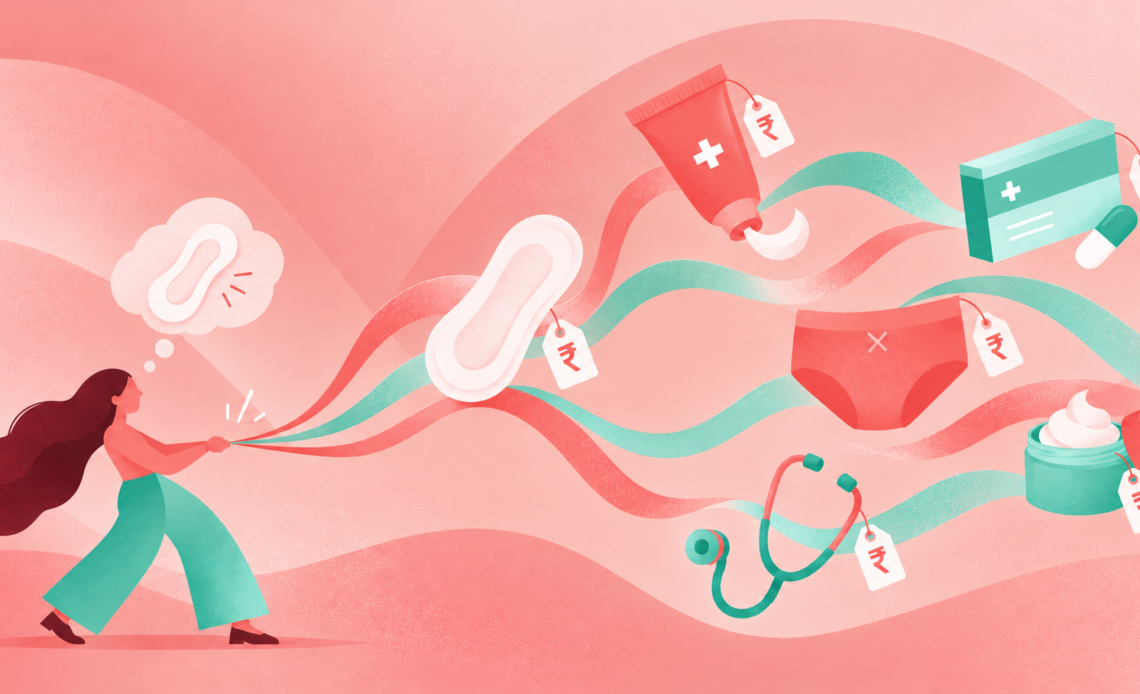
And that’s where the costs pile up. You paid for the pad, then you paid for the cream to undo what the pad did, and if it comes back you’ll pay again, for a barrier balm, for cotton underwear, maybe for a gynaecologist visit. Almost nobody adds up that second set of bills, because each one feels small and unrelated to the last. So let’s do the thing nobody does.
Let’s follow the money, starting with why the rash happens at all.
What Is The ‘Pink Tax’ and What Are We Paying For?
You’ve probably heard of the pink tax. It’s the pattern where products aimed at women cost more than near-identical products aimed at men. This isn’t a rumour. When New York City’s consumer affairs department compared around 800 paired products, women’s versions cost about 7% more on average, and personal care products specifically cost about 13% more.
Blog continues after the ad.

Now the part that matters for an Indian reader, because the usual story doesn’t quite fit here. Menstrual pads in India have been exempt from GST since 2018, so there’s no tax sitting on your pack of pads. But if you’ve felt the pinch anyway, it’s because what most people don’t see is that every step of making a pad still carries tax. From sourcing raw materials to transporting them, packaging and warehousing, it all adds up. So, the cost of pads doesn’t really get reduced by a lot. Read more about the real cost of menstruation here.
And here’s the real kicker, and the main subject of this blog: there’s more costs to menstruation that go beyond the pad, and it’s the money you spend afterwards, fixing what the pad did to your skin. Think of it as a second tax. The first payment buys the product. The second payment cleans up the damage. Nobody itemises the cost of treating pad rash, so it never shows up as a number, which is exactly why it’s worth counting.
A lot of that second bill comes down to what your skin is reacting to in the first place. That’s the thinking behind Nua’s rash-free Sanitary Pads, they’re soft, breathable and fragrance-free, built so the pad isn’t the thing setting off your skin.
What A Sanitary Pad Rash Actually Is (And Why Your Body Isn’t The Problem)
Let’s start with the mechanism, because once you see it you can’t unsee it. A sanitary pad rash is almost always contact dermatitis, which just means skin that gets inflamed by what’s pressed against it. The skin of the vulva is thinner and more absorbent than the skin on most of your body, so it soaks up whatever sits there. A pad works by occlusion, meaning it seals heat and moisture against that skin for hours, and combined with the friction of moving around, that steadily wears down the skin’s protective barrier. Add a fragrance the skin reacts to, and a plain irritation can tip into a full allergic one.
You assume, “my skin is just sensitive, so this is my fault”. But usually it isn’t your skin that changed, it’s the product and the conditions it creates. People wear the ‘sensitive skin’ label for years, treating flare-up after flare-up, without once suspecting the pad. There’s an easy tell. Sanitary pad irritation from friction and moisture settles once you’re dry and clean, but a true sanitary pad allergy, where your body reacts to an ingredient like fragrance, comes back every time you use that product.
And that’s what turns a one-off into a cycle. The pad creates the conditions, the skin gets inflamed, you buy something to calm it down, and then the same pad goes right back on next month. Nothing in that loop touches the cause, so the rash comes back, and the spending comes with it. Everything below is just that loop, added up.
You can’t script your cycle, but you can choose what rests against your skin for eight hours at a stretch. Nua makes its pads soft, breathable and free of added fragrances, so comfort isn’t the thing you’re gambling on during a heavy day.
Follow The Money: The Second Tax Nobody Budgets For
Now the receipts. Here’s where the second tax actually goes, and why each item exists.
- The antifungal cream: When skin stays warm and damp under a pad, yeast and fungi grow more easily. So you buy an antifungal like clotrimazole, sold as Candid or Clocip, which runs roughly ₹40 to ₹130 for a small tube.
- The anti-itch or barrier balm: To calm the redness and stop the rubbing, you reach for a mild hydrocortisone cream or a zinc-oxide barrier balm, usually somewhere around ₹80 to ₹250. These soothe the surface, but they don’t fix the reason it happened, so you keep them in the drawer for next month.
- New cotton underwear: Synthetic underwear traps heat the same way the pad does, so at some point someone tells you to switch to cotton, and you buy a fresh set, often ₹150 to ₹400 for a pack.
- More pads, changed more often: Once you learn that staying dry helps, you start changing pads far more frequently. The pad that irritates you also makes you buy extra pads.
- The gynaecologist visit: When it keeps coming back, or when you can’t tell irritation from infection, you book a consultation. In a private clinic in an Indian metro that’s commonly ₹500 to ₹5,000 before any tests or medicines. This is the point where a period pad rash stops being an annoyance and becomes a real line in your monthly spending.
- The part you can’t invoice: time and attention. The fidgeting in a meeting, the trip home to change, the night you slept badly because everything felt raw. It never shows up as a receipt, but it’s often the most expensive item on the list. (more on the cost of this here.)
Put one bad month together, say a ₹100 cream, a ₹200 balm, a ₹300 pack of cotton underwear and an ₹2,000 consult, and you’re near ₹2,600 in a single cycle. For a lot of people this isn’t a one-off. It repeats, for years.
And this is where the real damage shows up, because it isn’t a one-time purchase, it’s a subscription you never signed up for. Even three or four bad cycles a year can run into a few thousand rupees, and across the decades you menstruate, into a great deal more, all spent managing a problem the pad created in the first place. The money is only half of it. Every flare-up also costs you sleep, focus at work, and the low-grade worry about whether this month will be another bad one. You end up paying twice over, in cash and in comfort, for a rash that was never yours to fix alone.
A gentler pad like Nua’s is one less thing working against your skin when your cycle is already unpredictable enough. It doesn’t refund what you’ve already spent, but it can change what next month looks like.
Why You Keep Paying: The Traps That Keep The Meter Running
- You treat the symptom, not the source: The cream clears this month’s rash, so the problem feels solved. Then the same pad creates the same conditions next month, and you’re back at the start. As long as the pad stays, the loop stays.
- You blame your body: The “sensitive skin” label is comfortable because it asks nothing of your routine. It also rules out the one change that would actually help, which is looking hard at the product.
- “More” feels like the safe choice: Heavier, thicker pads usually mean more plastic backing and less airflow, so the very feature that promised protection can seal in more heat and moisture. That’s a big part of the answer to why do pads cause rashes for so many people.
- Fragrance feels like cleanliness: A scented pad smells fresh, so it feels hygienic. But added fragrance is one of the most common triggers of an allergic skin reaction, and women are especially likely to react to fragrances in the products they use every day, according to research. The thing marketed as cleaner can be the thing irritating you.
- You waited it out: Mild irritation is easy to normalise, so it never gets priced or questioned. Waiting has a cost too. It’s just paid in discomfort instead of rupees.
Lowering the odds of a flare-up is mostly about removing triggers, not adding more products. Choosing a breathable, fragrance-free pad is a simple way to keep your period feeling like less of a negotiation.
How To Stop Paying The Second Tax
- Change your pad every 4-6 hours: The single biggest driver is time spent damp. Even a good pad left on too long recreates the warm, wet conditions that irritate skin. Set a rough schedule instead of waiting until you feel wet.
- Switch to breathable, fragrance-free pads: This removes the two triggers you have the most control over: trapped moisture and added scent. Rash-free sanitary pads are really just pads designed around breathability and skin-friendly materials instead of heavy plastic and perfume.
- Wear cotton underwear on your period: Cotton lets air move and pulls less heat against the skin than synthetics, which lowers the humidity around the pad. Save the synthetic pairs for non-period days.
- Keep the area clean and dry, gently: Rinse with plain water and pat dry. Skip scented washes and harsh soaps, which strip the skin and add another irritant on top of the pad.
- Track the pattern: Note which pad you used and when the rash showed up. If it always follows the same product, you’ve found your trigger, and you never have to pay to rediscover it.
The goal isn’t a cupboard full of fixes. It’s needing fewer of them. Nua’s pads are made so comfort is the starting point of your period, not something you chase after it goes wrong.
When The Second Tax Is One You Can’t Afford
For a lot of women, this second bill isn’t just annoying, it’s out of reach. When every rupee is already accounted for, a ₹200 cream or a ₹2,000 consultation is not a small thing, so the rash gets endured instead of treated. Some stretch a single pad far longer than they safely should to make a pack last, which keeps the skin warm and damp for hours and makes the irritation worse, not better. Others skip the doctor and hope it settles on its own. The cost doesn’t disappear when you can’t pay it. It just moves from your wallet to your body.
The treadmill of creams and repeat visits usually costs more over time than the one thing that would actually break the cycle, which is removing the trigger. Using a soft, breathable, toxic-free and fragrance-free pad like Nua’s costs far less than treating the same rash month after month. So if you’re counting every rupee, prevention isn’t the expensive choice. It’s the cheapest one there is, and no one should have to trade their health just because nobody told them the fix could be this small.
Some Costs Are Worth Paying
None of this means you should tough it out or treat every rupee spent on your body as a scam. There’s a real difference between money that is only paid because of a bad product, like buying cream after cream while the pad that caused it stays in your cart, and money that’s genuinely looking after you. The first kind is avoidable. The second kind isn’t, and skipping it is how a small problem turns into a big one.
A mild rash that clears up in a day or two once you’re dry and clean is usually just irritation, and you can handle that at home. But some things are your body telling you to get help, not save money. See a doctor if the rash lasts more than a few days, keeps coming back, spreads, or the skin breaks open. Go sooner if there’s thick or foul-smelling discharge, burning when you pee, real pain, or a fever, because those point to an infection that needs a proper diagnosis. A yeast or bacterial infection won’t clear on its own, and the wrong cream can drag it out for weeks.
A gynaecologist visit in that situation isn’t the second tax. It’s the smartest money on the list. The right pad rash treatment, prescribed for what you actually have, is what stops one uncomfortable week from becoming a monthly recurring one. Paying to fix the pad is the waste. Paying to look after your health is not.
The Reframe: You Were Never Meant To Tolerate This
The second tax exists because discomfort got built into an everyday product and then sold to us as normal. Scratchy textures, plastic that doesn’t breathe, perfume nobody asked for. We were told this is just what periods feel like, so we stopped questioning it and started paying to manage it.
You don’t have to accept that as your baseline. A pad that leaves you red and itchy isn’t doing its job, however common that experience is. The point of a zero-irritation standard is simple, the pad should be the least eventful part of your period, not a monthly source of irritation, plus the spending that trails behind it.
When you stop treating irritation as the price of admission, the second tax loses its power. You’re not fixing yourself, you never needed fixing. You’re removing the thing that was charging you twice.
FAQs
What causes a sanitary pad rash?
A sanitary pad rash is usually contact dermatitis caused by friction, trapped moisture, heat, or an ingredient such as fragrance. These factors can irritate the sensitive skin around the vulva.
What are the symptoms of a sanitary pad rash?
Common symptoms include redness, itching, stinging, burning, swelling, and sometimes small cracks in the skin. Irritation may improve when the area is kept clean and dry.
How can you prevent rashes from sanitary pads?
Change your pad every 4–6 hours, choose breathable and fragrance-free pads, wear cotton underwear, and gently clean and dry the area. Avoid scented washes and harsh soaps.
When should you see a doctor for a sanitary pad rash?
See a doctor if the rash lasts more than a few days, keeps returning, spreads, or causes broken skin. Seek medical advice sooner if you have unusual discharge, burning while peeing, significant pain, or fever.
How much can treating a recurring sanitary pad rash cost?
The cost may include creams, barrier balms, cotton underwear, extra pads, and a gynaecologist consultation. These expenses can add up over time, making prevention and identifying the cause important.
Disclaimer
The content of this article is provided for general informational and educational purposes only and is not intended to constitute medical advice, diagnosis, or treatment. The information shared is of a general nature and may not be appropriate for all individuals or specific circumstances. Readers should not disregard, delay, or substitute professional medical advice based on the information contained herein.
If you experience any symptoms, notice anything unusual, or have concerns relating to your health or overall well-being, you should consult a qualified healthcare professional. While every effort is made to ensure the information shared is accurate and up-to-date, Nua makes no representations or warranties, express or implied, regarding the accuracy, completeness, or suitability of the information provided and disclaims all liability arising from reliance on this content to the fullest extent permitted by law.