
If you’re searching for hypoallergenic sanitary pads, chances are your skin has already asked for a little extra care because it’s prone to allergies. And honestly, you’re not alone. Research shows that almost 4 in 10 women have sensitive skin, which, according to studies, makes them 2 to 4 times more likely to develop an allergic skin condition like atopic dermatitis.
They’re also 2 to 3 times more reactive to heat, humidity, pollution…and the ingredients used in sanitary pads.
Women have biologically thinner skin, which means allergic reactions can happen more easily, more quickly, and feel more intense.
Plus, as estrogen and progesterone levels drop during your cycle, the skin barrier weakens. This means your already delicate skin becomes even more prone to allergies.
So when you connect all the dots, allergic reactions + thinner skin + higher sensitivity + weaker barrier, the question becomes obvious. In a world where allergies are this common, are hypoallergenic sanitary pads the way to go? And if yes, what does that label actually mean today?
Introduction: What are hypoallergenic sanitary pads?
Hypo = less than normal.
Allergenic = something that can trigger allergies/irritation.
So, hypoallergenic sanitary pads = pads that are less likely to irritate your skin or cause an allergic reaction.
And if you’ve ever dealt with rashes, itching, redness or that horrible burning feeling that comes with allergies, this claim feels like a lifesaver. That’s because many allergic reactions during periods don’t happen randomly. They often come from repeated contact with certain materials used in conventional sanitary pads.
But what ingredients in a pad actually cause allergies?
Multiple studies have found irritants and allergens in menstrual products. These include common ingredients like fragrances, dyes, adhesives or additive chemicals like dioxins, VOCs and bisphenols.
To put it in perspective:
- VOCs can go as high as 75,000 ng/g, when ideally they should be close to zero.
- Fragrances like hexyl cinnamal can reach 95 μg/g, even though fragrances should ideally be avoided altogether.
- BPA, a plasticizer, was found in 72% of pads, and even tiny amounts can weaken your skin barrier and make rashes more likely.
This is why looking for hypoallergenic sanitary pads is a must if you’re a girlie with a skin condition or allergy.
Skin disorders: Who needs to wear hypoallergenic sanitary pads?
The vulva is one of the most sensitive skin areas in the body. Studies suggest that up to 45% of adult women experience some form of vulvar skin condition or allergies at some point. Here are the most common ones.
Contact Dermatitis
Research shows that contact dermatitis alone accounts for more than 17% of hypersensitivity cases. It happens when your skin reacts to something it touches and gets irritated. Like a pad during your period.
It can be of two types.
- Allergic Contact Dermatitis (ACD): It’s a delayed immune reaction, where itching is the main clue and symptoms usually appear 24-48 hours after exposure.
- Irritant Contact Dermatitis (ICD): It’s not an allergic reaction but a direct skin irritation from friction, moisture or heat. It mostly involves burning and soreness that starts within minutes.
Eczema (Atopic Dermatitis)
Eczema is a genetic condition where the skin barrier is naturally weaker. This makes it more prone to dryness, itching and inflammation. On the vulva, eczema often shows up as cracked or raw-feeling skin. Pads that contain allergens can push this already-sensitive skin into a flare.
Psoriasis
Psoriasis is a chronic skin condition caused by immune system overactivity. On the vulva, it may appear as purple patches or fissures in skin folds. And since friction is a known trigger, synthetic pad rubbing and trapped heat can cause new lesions to appear in previously unaffected areas.
Lichen Sclerosus
Lichen sclerosus (LS) is a chronic inflammatory condition that affects skin and mucous membranes, including the vulva in 85–98% of cases. It can be characterized by the presence of white, thin, fragile skin with pain during movement or pad wear.
Recurrent Vulvovaginal Candidiasis
While not an allergy, recurrent yeast infections can cause fissures and soreness, making your skin sensitive. Pads that trap moisture and heat create the perfect environment for fungal growth, leading to flare-ups.
One last thing to know
You don’t need a diagnosed medical condition to need hypoallergenic sanitary pads. If your skin is sensitive and:
- gets itchy easily
- reacts to fragrances or heat
- feels raw or irritated during periods
That’s reason enough to shift to hypoallergenic pads.
Pad friction vs. allergic reactions: What’s really irritating your skin during periods?
If it is just friction, it usually shows up quickly. But if it’s an allergic reaction, it takes a day or two to appear rather than immediately.
And with friction, you may feel burning or chafing exactly where the pad rubs your skin. It also gets worse when you walk, sweat or wear the pad for long hours. An allergic reaction behaves differently. It is more about itching than burning. You may also notice rashes, bumps or swelling.
Plus, friction irritation settles once the pad is changed or removed. Allergies don’t go away that easily. In fact, ongoing friction can weaken your skin barrier over time. Once that happens, allergens can enter the skin more easily. So what starts as friction irritation can slowly turn into an allergic reaction.
So, how do hypoallergenic sanitary pads help?
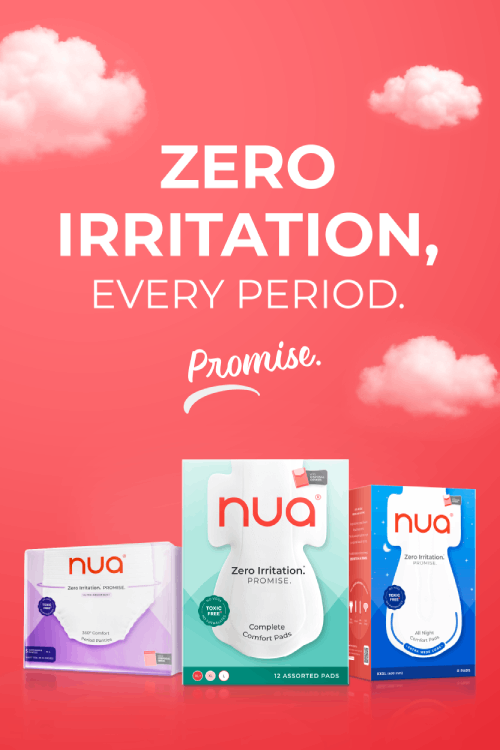
Not all hypoallergenic pads can stop friction altogether. Because, of course, your body will still move. But by removing common allergens and irritants, they reduce what your skin is exposed to when friction happens. However, if you choose a hypoallergenic pad that comes with a cloud-soft top layer, like Nua’s Complete Comfort Sanitary Pads, even friction irritation can be avoided.
How are hypoallergenic sanitary pads different from chemical-free sanitary pads?
Chemical-free is just half the story (because anything could be a chemical!) and is simply used to imply that no harsh chemicals were used. But remember, even natural things like herbal extracts can trigger major allergic reactions in some people. Therefore, hypoallergenic pads go deeper by focusing on the outcome (a.k.a. allergies) rather than just the source (a.k.a. ingredients). It means the pad has been specifically formulated and tested to exclude anything and everything, whether natural or synthetic, that is likely to cause an allergic reaction.
How do you know if a pad is truly hypoallergenic?
A good rule of thumb is to look at what it’s made of and whether those claims are verified by credible, independent testing. A genuinely hypoallergenic pad will have high breathability and absolutely no fragrances, dyes, parabens, phthalates, harsh adhesives or other irritants hiding in the material.
That’s where clear certifications come in. They’re your proof that the pad has been tested for safety and irritation, not just marketed that way. Some of the most reliable ones include:
- Made Safe Certified – ensures it’s free from known toxins
- Certified Toxic-Free & Vegan – confirms clean, ethical formulations
- Dermatologically Tested – checked under medical supervision for skin comfort
Nua’s Sanitary Pads are designed exactly this way. They carry all these certifications and on top of it, they’re also verified through ISO 14389 testing, making them a reliable choice when you want trusted hypoallergenic comfort backed by REAL evidence.
Blog continues after the ad.
But aren’t hypoallergenic sanitary pads very expensive?
They can be. That’s because pads made without fragrances, harsh adhesives or cheap chemical additives usually cost more to produce. Add proper dermatological testing and certifications, and the price often goes up. That’s why irritation-free period care has long felt like something you “upgrade to” rather than something every woman should simply have.
Nua’s MyWave Pads are made to fill this gap for you. They’re designed to be genuinely pocket-friendly while sticking to the hypoallergenic and irritation-free essentials. They’re dermatologically tested, come with a feather-soft top layer and are 100% skin-safe for rash-free comfort.
So… Is Your Pad Working With Your Skin or Against It?
Pads come with a lot of labels. But your skin doesn’t respond to labels. It responds to what actually touches it for hours, especially when it’s sensitive and prone to allergies. That’s why hypoallergenic shouldn’t be a bonus feature for you. It should be a filter.
The truth is, your skin gives feedback every cycle. Itching, burning, redness, rashes, these aren’t things to normalise or power through. They’re signals. And once you start paying attention to them, choosing period care stops being about brand promises and starts being about how your body actually feels.
So next time you’re restocking pads, don’t just look at absorbency or price, look for something 100% hypoallergenic, too.
If you still have any more questions on pads, skin allergies or hypoallergenic labels, drop them in the comments and we’ll get back to you.