What you’ll learn in this guide about how to dispose of pads discreetly:
- Always fold the used side inward and seal before placing it in a bin.
- Never flush a pad, the materials are designed to absorb and expand in liquid and will therefore clog the pipes.
- You need to apply different approaches for school, work, public restrooms, and home disposal.
- Purpose-built disposal covers are genuinely more effective than toilet paper wrapping.
- Nua pads come with individual disposal covers included. If you want just the covers, those are available separately too.
You’re in a restroom, you’ve just changed your pad, and now you’re standing there, quietly engineering a small-scale concealment operation. You ball it up, wrap it in toilet paper, maybe add a second layer just to be safe, and try to slide it into the bin without making a sound. Sound familiar? Learning how to dispose of pads discreetly is one of those unspoken survival skills that most people with periods pick up on their own, usually through a mix of trial, embarrassment, and improvisation. But there’s a lot more going on here than just awkwardness. There’s biology, waste management, and honestly, some design failures in period products that make this harder than it needs to be.
So we’ve put together a guide for you, for something that most people just assume (wrongly) you should figure out on your own. Let’s get into it!
Why Does Pad Disposal Feel So Stressful?
Because you were never really taught that it doesn’t have to be. From the very first time you got your period, the message was clear, even if nobody said it out loud: this is private, keep it invisible, make sure no one knows. You learned to tuck a pad up your sleeve on the way to the bathroom. To run the tap so no one heard the wrapper. To carry spares at the bottom of your bag like contraband. That conditioning runs deep, and it doesn’t just disappear when you’re an adult standing in a restroom trying to figure out how to dispose of pads discreetly without making a sound.
Blog continues after the ad.
The sight of blood, the smell of blood, the evidence that a period is even happening at all, these are things you’re expected to erase entirely. So menstrual waste disposal anxiety is the logical result of absorbing years of messaging that says your body is doing something that other people shouldn’t have to know about.
There’s a biological layer to this too. A used pad contains menstrual fluid, a mix of blood, uterine lining tissue, cervical mucus, and vaginal secretions. According to research, once exposed to air, anaerobic bacteria begin breaking this down, which produces odour faster than most people expect. The blood also oxidises to a darker red-brown and the pad becomes slightly heavier. So the thing you’re trying to conceal isn’t imaginary. There is a smell, a colour, a texture, and you have a limited window to deal with it cleanly.
The stress is a combination of cultural shame and a genuinely practical problem that most period products haven’t been designed to solve. Both things are true at the same time.
So, What’s the Best Way to Throw Away Used Pads?
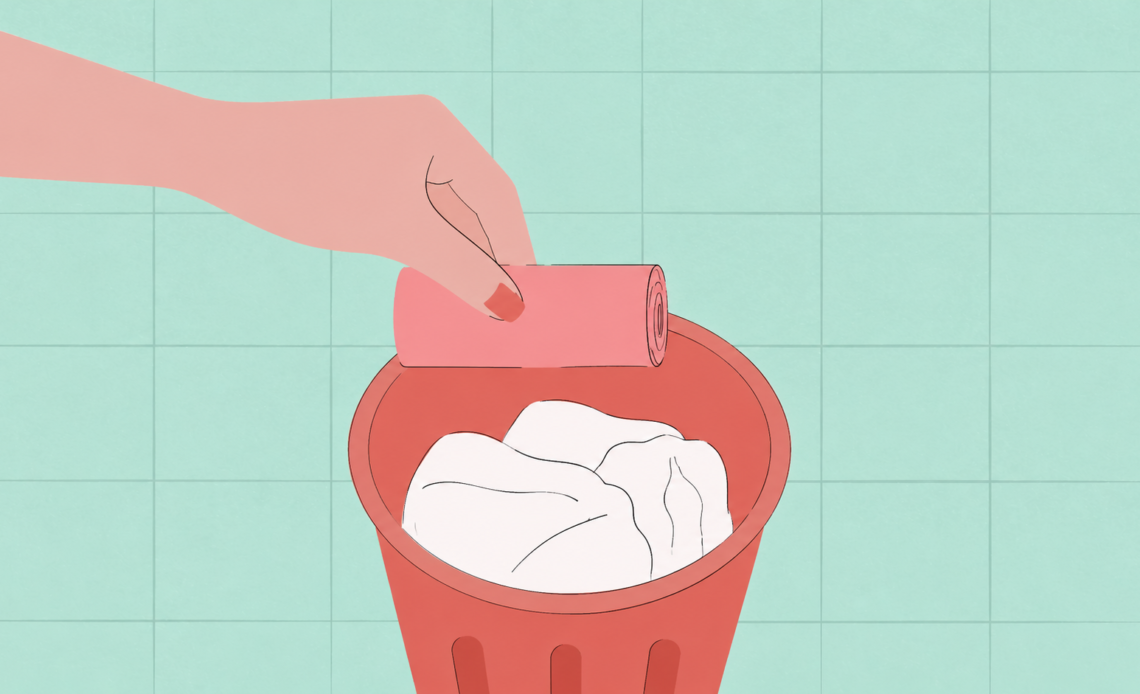
Wrap, seal, bin. That’s the short version. The best way to throw away used pads is to fold the pad inward on itself (so the used surface is on the inside), wrap it tightly in the wrapper from your fresh pad or some toilet paper, and put it in the designated bin.
Never flush a pad. According to research, the absorbent polymers in most pads can absorb up to 300 times their weight in liquid. In sewer systems, this causes serious blockages and contributes to microplastic contamination in waterways.
The problem is that most pad wrappers aren’t actually built for discreet wrapping. That’s because they’re designed as packaging, not disposal tools. They crinkle, they don’t seal, and they leave you guessing about whether you’ve actually contained everything properly.
Nua thought about what happens after you take it’s pads off. That’s why Nua’s pads have built-in individual disposal covers, designed for exactly this moment.
How to Dispose of a Pad Discreetly: A Step-by-Step Guide
This is the routine that actually works, especially in less-than-ideal situations:
- Open your fresh pad first: Before removing your used pad, open the new one. Have your disposal cover or wrapper ready. Doing this in the wrong order means you’re managing a used pad with no hands free.
- Fold the pad inward: Roll or fold the used side facing in. This contains the odour-causing compounds (mainly from anaerobic bacteria reacting with the menstrual fluid) and reduces surface exposure.
- Use a proper seal: A disposal cover that wraps and seals is the most reliable option. Toilet paper works, but it doesn’t hold as well and the texture means it absorbs through quickly.
- Apply the new pad before disposing: This way you’re not rushing the disposal step. Take your time with the seal.
- Place in the bin gently: Lower it in rather than dropping. This reduces sound and also means you’re not handling the bin lid any longer than necessary, which is just better hygiene.
- Wash your hands: Always, even if you think you didn’t touch anything. Contact with menstrual blood carries the same hygiene considerations as contact with any body fluid.
How Do You Dispose of Pads Discreetly in Specific Settings?
The setting changes the logistics, but the goal is the same: a clean, simple disposal that doesn’t require a whole operation. Here’s what actually works:
- School bathrooms: Sanitary pad disposal in school bathrooms can feel trickier when there’s no stall bin, just one shared bin by the sinks. The simple fix? Wrap your used pad in the wrapping from your fresh one and drop it in the bin on your way out. That’s it. You’re in the girls’ bathroom. Everyone in there has a period or will have one. There’s genuinely nothing to hide. If your pads don’t come individually wrapped, tuck a small piece of paper in your pocket before heading to the bathroom and use that as your wrapper. It takes two seconds of prep and solves the problem entirely.
- Work restrooms: Discreet period pad disposal at work is simpler. Toilet paper is right there. Fold the pad inward, wrap it snugly in the tissue and place it in the bin. You don’t need a kit or a system. A little toilet paper and a bin is all it takes. If your workplace restroom doesn’t have bins in individual stalls, that’s a facilities issue worth raising with HR.
- Public restrooms: For pad disposal in public restrooms that don’t have bins or toilet paper in the stall, carry a small folded paper bag in. Wrap the pad, tuck it in the bag, and carry it out to the nearest bin. A small plastic bag works too if that’s what you have. It’s a 30-second solution and it means you’re never stuck.
- At home: The instinct to hide used pads from family runs deep, but your home is the one place you shouldn’t have to perform invisibility. Stock your bathroom with what you need, whether that’s’ a small bin, toilet paper or some folded newspaper, and whatever disposal covers you prefer. Ask for a small in-bathroom bin if there isn’t one. Build a routine that works for you.
If you share a bathroom with a male family member and feel conscious about it, tucking the bin under a cabinet or adding an extra layer of paper before closing is fine. But so is leaving it visible. A bin with a wrapped pad in it is not a confession. It’s just a bin.
You can also buy Nua’s Disposal Covers on their own to leave in your school or work bag, to carry into a public restroom or to stack in your bathroom at home. They’re designed specifically for pad disposal and do the job better than toilet paper or newspaper can do. Plus, they look like the wrapping or any products, so they’re super discreet.
Why Are Period Pad Wrapper Disposal Hacks Even Necessary?
Because most pad packaging is an afterthought. Period pad wrapper disposal hacks exist because the wrapper that your pad comes in is designed to protect the product before use, not facilitate a clean, quiet, odour-controlled disposal after. A few things that make this harder than it needs to be:
- Wrappers are designed to open easily, which means they also crinkle loudly when you’re trying to use them for wrapping.
- The stickers that hold fresh pads together lose their stickiness once opened. So, they don’t close properly for disposal.
- Most pads use a mix of cotton, synthetic fibres, and superabsorbent polymers. Once used, the pad becomes heavier and harder to fold neatly.
- The adhesive strips on the back, which hold the pad in place in your underwear, can stick to toilet paper and create an unsealed, messy bundle.
- There’s no standardized disposal solution. You’re basically expected to figure it out.
This is where purpose-built disposal covers make a real difference. Not as a hack, but an actual solution.
What Are Nua Individual Disposal Covers and Do They Actually Work?
Nua pads’ individual disposal covers are exactly what they sound like — small, opaque covers that come with each pad and are designed specifically for wrapping and sealing a used pad. Each cover wraps securely around the used pad and has an adhesive seal so it stays closed. No crinkling, no guessing, no layers of toilet paper. You wrap it, seal it, done.
Nua’s Sanitary Pads come packaged with individual disposal covers already included, which means how to dispose of pads discreetly becomes less of a logistical problem and more of a 10-second routine. The covers are opaque, so there’s nothing visible through the material. They’re also compact enough that you’re not dealing with a bulky package in the bin. This is one of those product design details that sounds small until you’ve used it every month and realize how much quieter and cleaner the whole process feels.
If you already have a pad you like but the disposal situation is the part you want to fix, you can also get the Easy Seal Disposal Covers separately. That means you’re not locked into switching products entirely. You’re just solving the specific problem.
Final Thoughts on Pad Disposal
You’ve spent years improvising a solution to a problem that should have been solved for you from the start. The toilet paper wrapping, the careful rustling, the speed-change in a public stall, none of that is something you should have to engineer on your own every single month. How to dispose of pads discreetly is a question that reveals something bigger, which is that period products have historically been designed to get you through your cycle, and not much beyond that. What happens when you’re done with the pad has mostly been left to you.
The shift worth paying attention to isn’t just in products. It’s in what we’re willing to name as a real problem. The discomfort of disposal in a school bathroom, at the office, at a family gathering, that discomfort is legitimate. It has roots in how we’ve been taught to treat periods as invisible, and it has a practical fix. A sealed, opaque disposal cover sounds like a small thing. But when you’ve been folding toilet paper into imperfect bundles for years, it doesn’t feel small at all.
Disclaimer:
The content of this article is provided for general informational and educational purposes only and is not intended to constitute medical advice, diagnosis, or treatment. The information shared is of a general nature and may not be appropriate for all individuals or specific circumstances. Readers should not disregard, delay, or substitute professional medical advice based on the information contained herein.
If you experience any symptoms, notice anything unusual, or have concerns relating to your health or overall wellbeing, you should consult a qualified healthcare professional. While every effort is made to ensure the information shared is accurate and up-to-date, Nua makes no representations or warranties, express or implied, regarding the accuracy, completeness, or suitability of the information provided and disclaims all liability arising from reliance on this content to the fullest extent permitted by law.