Wondering, “why did my tampon size change suddenly?” Here’s what we’ll cover in this guide:
- If your usual tampon suddenly leaks or feels dry, the tampon most likely hasn’t changed. Your period flow has.
- Before you blame your flow, check your placement. A tampon sitting too low or at an angle can leak even when your flow is the same.
- Stress, travel, illness, changes in diet, lack of sleep, and natural hormonal fluctuations can make your period lighter, which might mean sizing down.
- Birth control, perimenopause, thyroid disorders, PMOS (formerly PCOS), breastfeeding, and postpartum recovery can make your flow lighter or heavier.
- Most changes settle within a cycle or two. Some are worth getting checked.
- Nua’s EaseFit Tampons are available in Mini, Regular, and Super sizes, so you can adjust as your flow does.
Ever had a period where your usual tampon suddenly felt… wrong? Maybe it’s leaking now, when it never used to. Or perhaps it feels much drier than expected when you remove it, and pulling it out feels scratchy instead of smooth.
It can be confusing, especially if you’ve been using the same tampon for years. Most people assume either the tampon has changed or something is wrong with their body. Usually, neither is true. Hormonal shifts, lifestyle changes, health conditions, and different life stages can all change how much you bleed. Getting the right tampon absorbency for different flow levels isn’t a one-time decision, it moves with your body.
In this guide, we’ll look at why your tampon size might have changed, the everyday and medical reasons your flow shifts from one cycle to the next, how to tell a one-off from a pattern, and when it’s worth seeing a doctor.
Why did my tampon size change?
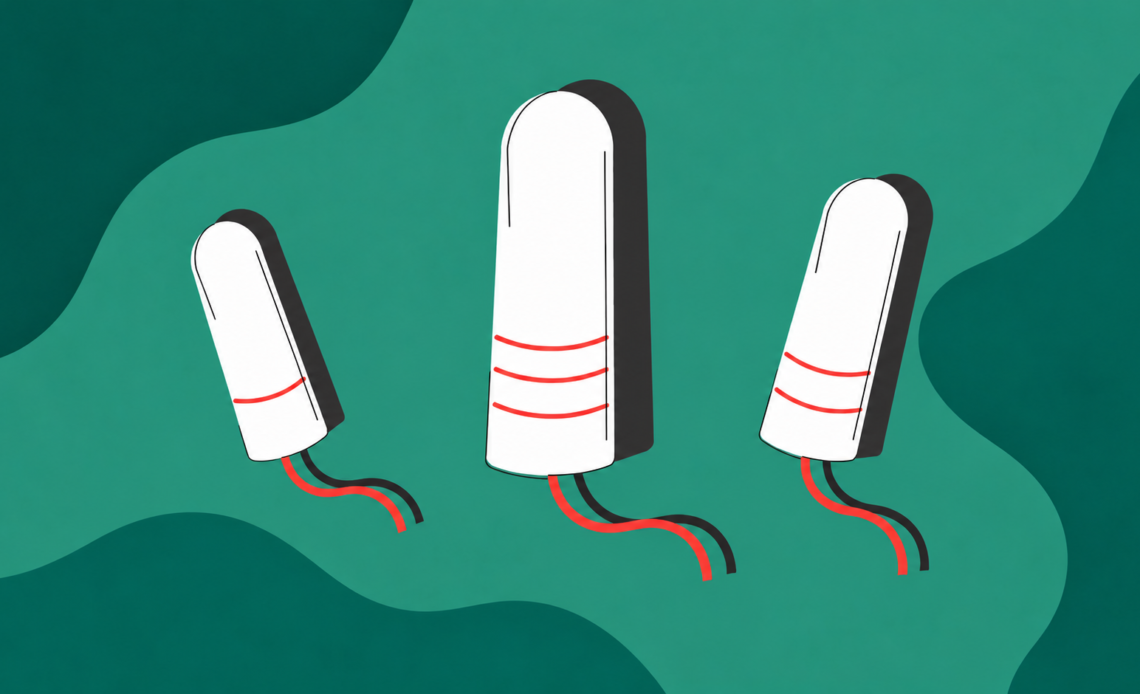
Tampon “size” isn’t about length or width. It’s about absorbency, or how much menstrual blood a tampon can hold. So when your usual size stops working, it’s almost always a sign that the amount you’re bleeding has changed. Your tampon is simply the first place you notice it.
The two signals to look out for:
- Leaking in less than 4 hours usually means your flow has become heavier than your current absorbency can handle.
- A tampon that’s still mostly dry after 6–8 hours usually means your flow has become lighter.
Don’t ignore the dry one. With no blood left to absorb, the fibres pull moisture from the vaginal walls, which is why removal can sting. The FDA also advises using the lowest absorbency that handles your flow to reduce the risk of Toxic Shock Syndrome (TSS). You may learn more about TSS here.
Blog continues after the ad.

Keep in mind that some change is built into every period. Most of your blood loss happens in the first two or three days, so a size that works on day four may not keep up on day one. That’s normal variation, not a sudden shift, and it’s why matching tampon absorbency for different flow days matters. Thinking about cycle variation and period products together helps you tell an ordinary heavy day apart from a real change in your pattern.
If you’ve just been using one size, Nua’s EaseFit Tampons come in Mini, Regular, and Super, so you can switch as needed. For a day-by-day sizing plan, see our guide on how to choose the right tampon size for comfort, protection, and safety. The rest of this article focuses on the why: what’s changed in your body, and whether it needs attention.
First, check it isn’t your placement
Before deciding the answer to “why did my tampon size change suddenly?” is your flow, check the tampon when you remove it. If it’s soaked evenly, it reached its limit, and your flow may genuinely be heavier. If it’s only stained on one side, the issue is placement. Fluid is flowing around the tampon rather than through it. A tampon should sit high enough that you can’t feel it, angled toward your lower back.
If placement looks fine, read on. The signs usually point one of two ways.
Why do I suddenly need a smaller tampon?
If your tampon feels dry, scratchy to remove, or barely used after several hours, your period has probably become lighter. Here are the most common reasons.
Your cycle naturally changes
Periods aren’t identical every month. Stress, travel, illness, changes in diet, and lack of sleep raise cortisol, which can lower the brain signals that tell your ovaries to make estrogen. Less estrogen means a thinner lining and a lighter or later period. It usually settles within a cycle or two.
Learn more about the connection between stress and menstrual cycle changes in our guide here.
Birth control and period flow
Started, stopped, or switched birth control recently? Hormonal contraceptives often make periods lighter by preventing ovulation and thinning the uterine lining. The bleed in your pill-free week isn’t a true period, it’s a reaction to the drop in hormones, and it’s often much lighter. With less blood to absorb, you may find yourself reaching for a lower-absorbency tampon.
Perimenopause and underlying health conditions
During perimenopause, fluctuating estrogen and irregular ovulation can lead to lighter, less predictable periods. These period flow changes with age may mean your usual tampon no longer feels right. Conditions such as an overactive thyroid and Polyendocrine Metabolic Ovarian Syndrome (PMOS) (formerly PCOS) can also affect ovulation, resulting in lighter, irregular, or less frequent periods.
Lighter periods can still be unpredictable, like a quiet morning followed by a heavier afternoon. Carrying a few Mini EaseFit tampons alongside your usual size lets you go smaller on light days without second-guessing the rest.
Could it be pregnancy?
If your period is much lighter or shorter than usual and there’s any chance you could be pregnant, take a pregnancy test. Some people have light bleeding or spotting in early pregnancy that looks like a light period (read more about it here). Tampons aren’t meant for spotting, so a panty liner is the better option while you find out.
Why do I suddenly need a bigger tampon?
If your usual tampon is leaking before it’s time for a change, your flow may have outgrown your current absorbency. If you’ve been wondering “why is my period heavier than usual?”, here are the common reasons.
Natural cycle fluctuations
Your flow changes throughout your period, from heavier days at the beginning to lighter days toward the end. You may also notice gushes when you stand up, because blood pools while you’re sitting or lying down and then comes out at once. That’s why matching tampon absorbency for different flow days is key, and why Nua’s EaseFit Tampons are designed to provide reliable comfort and protection through every phase of your period.
Hormonal and biological changes
Changes in birth control, postpartum recovery, breastfeeding, stress, or perimenopause can affect how much uterine lining your body sheds. Coming off the pill often brings back your natural, heavier flow, and the copper IUD is known for making periods heavier. Postpartum period flow changes are common too, with the first few periods often heavier or irregular. Tampons shouldn’t be used for bleeding in the first weeks after birth until your doctor clears you.
Perimenopause
Heavy bleeding during perimenopause also surprise many people who expect periods to simply fade out. In a SWAN study of 1,320 women aged 42 to 52, 91% had between one and three episodes of bleeding lasting 10 days or more. When ovulation becomes irregular, the lining builds on estrogen alone and sheds heavily.
That doesn’t make a surprise flood during a meeting any less stressful. Keeping both Super and Regular EaseFit tampons on hand lets you size up for the heavy stretch and back down once it eases.
Heavy menstrual bleeding causes
Conditions such as PMOS (formerly PCOS), fibroids, endometriosis, and an underactive thyroid can cause heavy menstrual bleeding, longer periods, or larger clots. Fibroids, for example, spread the lining over a larger area and stop the uterus from contracting properly to slow bleeding. About 1 in 5 women experience heavy menstrual bleeding, according to the CDC.
Is it a one-off or a pattern?
One unusual period is rarely a cause for concern. Your body responds to a stressful month, a long-haul flight, or a bad cold, and it usually bounces back. What matters is whether the change sticks.
For the next two or three cycles, keep a simple note of:
- Which tampon size you used and how often you changed it
- How full the tampon was when you removed it
- How many days you bled, and which days were heaviest
- Any clots, and roughly how big they were
- Anything new in your life: a new medication or contraceptive, weight change, travel, illness, or a stressful stretch
If your flow returns to normal, you’ve probably found your answer. If the new pattern holds, or keeps shifting, these notes will make a conversation with your doctor far more useful.
Can a tampon be the wrong size?
Yes. A tampon that’s too absorbent may feel uncomfortable to remove, while one that’s not absorbent enough may leak before it’s time for a change. Finding the right fit often takes a little trial and adjustment, but once you figure it out, tampons can become one of the most comfortable and fuss-free period products to use.
Nua’s EaseFit Tampons are available in multiple absorbencies to help you stay comfortable throughout your cycle:
- Mini absorbency is ideal for lighter-flow days.
- Regular absorbency provides dependable protection for moderate-flow days.
- Super absorbency is designed for heavier-flow days.
Regardless of the absorbency you choose, change your tampon every 4–6 hours and never wear the same tampon for longer than 8 hours.
When should I see a doctor about changes in my period flow?
The CDC advises seeing a doctor if you soak through a tampon in under 2 hours, need to double up with a pad, bleed for more than 7 days, pass clots larger than about 2.5 cm, or feel constantly tired or breathless. Heavy periods are common, but common doesn’t mean you have to put up with them, especially since they can lead to anaemia.
Lighter or irregular periods deserve attention too. Speak to a doctor if:
- Your periods stop for more than three months and you’re not pregnant
- Your periods become irregular after being regular
- Your periods stay much lighter for three cycles in a row without an obvious reason, like new birth control
- You bleed between periods or after sex
- You have any bleeding after menopause
And if you develop a sudden fever, a sunburn-like rash, vomiting, or dizziness while using a tampon, remove it and seek medical care straight away, as these can be signs of TSS.
The Final Takeaway
If your tampon size has suddenly changed, don’t panic. Your period flow isn’t set in stone, and it’s normal for it to shift with stress, contraception, pregnancy, and age. Check your placement, notice which way your flow is moving, and keep an eye on whether the change lasts. Choosing tampon absorbency for different flow days, rather than sticking to one size out of habit, keeps you comfortable while your body does its thing.
With Nua EaseFit Tampons available in multiple absorbencies, it’s easy to adjust as your flow changes, so you’re comfortable and protected, whatever your period decides to do.
FAQs
1. Why did my tampon size change suddenly?
Usually because your period flow has changed. Stress, illness, birth control, pregnancy, postpartum recovery, perimenopause, and some health conditions can all make bleeding lighter or heavier. Check your placement first: a tampon stained on only one side points to positioning, not flow.
2. Why do I suddenly need a smaller tampon?
You may need a smaller tampon when your menstrual flow becomes lighter. Stress, illness, lifestyle changes, hormonal birth control, perimenopause, and certain health conditions can all affect your bleeding pattern.
3. Why do I suddenly need a bigger tampon?
A heavier flow can mean your usual tampon starts leaking before it’s time for a change. Natural cycle fluctuations, changes in birth control, postpartum recovery, breastfeeding, perimenopause, and some health conditions can contribute to heavier bleeding.
4. Can stress change how heavy my period is?
Yes. Stress raises cortisol, which can lower estrogen and lead to a thinner lining and a lighter or later period. It usually settles within a cycle or two once the stress eases.
5. Is it normal for my period flow to change as I get older?
Yes. Flow often shifts in your late 30s and 40s as you approach perimenopause, and periods can become lighter, heavier, or less predictable. Very heavy or prolonged bleeding is still worth checking with a doctor.
6. When should I see a doctor about changes in my period flow?
See a doctor if you soak through a tampon in under 2 hours, need a pad and tampon together, bleed for more than 7 days, pass clots larger than about 2.5 cm, feel constantly tired or breathless, miss periods for over three months without being pregnant, or bleed between periods, after sex, or after menopause.
Disclaimer
The content of this article is provided for general informational and educational purposes only and is not intended to constitute medical advice, diagnosis, or treatment. The information shared is of a general nature and may not be appropriate for all individuals or specific circumstances. Readers should not disregard, delay, or substitute professional medical advice based on the information contained herein.
If you experience any symptoms, notice anything unusual, or have concerns relating to your health or overall wellbeing, you should consult a qualified healthcare professional. While every effort is made to ensure the information shared is accurate and up-to-date, Nua makes no representations or warranties, express or implied, regarding the accuracy, completeness, or suitability of the information provided and disclaims all liability arising from reliance on this content to the fullest extent permitted by law.