You might think the cost of menstruation is just the price of a pack of pads. But for millions of women and girls, it’s so much more than that. The true cost goes far beyond what you pay at the store. It’s a complex mix of hidden markups, health complications, social pressures and daily compromises that affect your wellbeing, dignity and opportunities. It’s the cost of staying home from school, of missing a day of work or of having to make do with something that isn’t safe.
Today, we’re going to talk about that bigger picture. The real, full cost of menstruation that never shows up on a receipt.
From Pads to Privacy: Direct & Hidden Cost of Menstruation
As per research, you have roughly 456 periods in your lifetime, using around 10,000 menstrual products along the way. That’s not a one-time cost. That’s a steady, lifelong bill that gets much, much longer when you add the costs that go beyond just the products.
Clean water, for instance, comes at a cost so high that many in low-income areas cannot afford it. The basic pipeline installation itself costs roughly ₹10,000 (a lot of money for someone who earns approximately ₹4,750/month), which is followed by a monthly bill of ₹100 or more. This lack of access also extends to proper disposal, which comes at a cost of around ₹50 per month for once-weekly garbage pickups. Without proper disposal, pads are left to linger in community grounds, becoming breeding hubs for germs, leading to health issues.
Perhaps the most significant direct cost of menstruation is the lack of safe and private bathrooms. Many women in rural areas don’t have a washroom at home. They have to pay ₹2-10 to use a public one, which means they don’t change their pads as often as they should to save money. The public bathrooms can also be a long, tiring walk away. This problem is also real for women working informal jobs like maids and construction labourers, as they often have no clean facilities to use at all.
“I work at 3-4 houses a day. While one madam allows me to use the washroom, the others don’t. When I’m on my period, I have to wait to reach her house before I can clean myself and change my pad.” Noorjahan, who works as domestic staff in Ghaziabad, shares her story.
Beyond these, there are expenses related to hygiene or managing period discomfort. Think razors, underwear, hot water bags, heat patches, pain relief medicines or intimate cleaning products. And the problem with these products is that they cost more compared to the same products for men. This is known as the “pink tax”, where products marketed to women often have a high MRP simply because they’re made for women. For example, a regular hot water bag costs around ₹100, but a similar one marketed specifically for menstrual cramps can cost ₹500. The only difference is the more feminine pastel colour or cute flowers printed on it. Does that tiny edit justify a 5x price increase? Is there a larger markup on products for women, especially period-related ones, because menstrual comfort is still treated like a luxury rather than a necessity?
The Cost of Menstruation Beyond Products: Impact on Work & Wellness
When you don’t have the menstrual products you need, the consequences start impacting your health, your daily life and your future. Research shows that in some regions, girls miss nearly 20% of the school year because of a lack of menstrual products and hygiene facilities. Many even completely drop out, compromising their education and career. For women on daily wages, one missed day of work from lack of pads can mean a huge loss of income, trapping them in a cycle of poverty.
“I often have women come to me with infections from using old rags, even on the heaviest days, because they simply can’t afford pads after paying for food, rent and school fees. When I tell them they need to rest, they ask me, “How can we?” Because for families earning less than ₹200 a day, even a single day of lost wages means less money for the next month. So they risk their health and go to work anyway.” Says Dr Hina Rizvi, who serves as a gynaecologist in the small city of Bisalpur.
When money is tight, many are forced to make difficult compromises. Sometimes, families have to make heartbreaking trade-offs, choosing between period products and essentials like food or education. Or instead of using new, safe products, they may reuse old cloths or rely on cheap, low-quality alternatives. In slums, 95% of women and 90% of adolescent girls reuse rags without proper cleaning according to a study.
As per the same study, this absence of safe products and proper hygiene can lead to serious health issues like vaginal infections, urinary tract infections, scabies and even pregnancy complications. Treating these illnesses adds another layer of financial strain, forcing people to spend what little they have on doctor visits and medicine.
Period poverty also has broader economic consequences. Loss of productivity from periods leads to billions of dollars in economic losses globally every year, as per the World Bank. This further proves that the cost of menstruation is multi-layered. It includes health, dignity, education and economic opportunities.
Free or Cheap Pads? Not Always the Answer
When pads are made to be cheaper, something usually gets compromised. Many commercial low-cost pads are packed with synthetic perfumes, printed topsheets, and bright colours. These features don’t improve performance but look premium and are easy to sell.
“A lot of these are added just for show,” says Saloni Mayekar, VP – New Product Development at Nua. “They don’t make the pad work better, but they’re cheaper to include and easier to market, so they get sold as benefits.”
And while they may seem harmless, research has shown that for some people, these gimmicks can lead to rashes, allergic reactions or even more serious infections over time. That’s not just a health concern, it’s also a financial one. Doctor visits, medication, treatment, they all quietly add to the cost of something that was supposed to be “cheaper.”
Even free products can’t guarantee safe periods. State-level and NGO initiatives like the Khushi scheme to distribute free pads to schoolgirls, but the lack of clean toilets, water and disposal facilities in schools makes it hard to actually use the pads. In many cases, students report receiving only a few packets once or twice a year, which run out within weeks. Plus, once girls leave school or graduate, the support disappears.
“There are also schemes that provide pads for just ₹1 to women of all ages, but most people don’t know where to get them or how to enrol. Even when they do, managing periods at home is still impossible. Many women have to go out into open fields to change their pads, where removing, wrapping, disposing of used pads and putting on a new one while trying to stay covered is far from doable,” adds Dr. Hina Rizvi.
An initiative in a refugee camp in Tanzania even tried distributing reusable pads as a more sustainable alternative, but without clean water to wash them or private, safe places to dry and store them, women avoided using them altogether.
So yes, the product might be free, but the systems that make a period truly safe and dignified all have costs.
The Smart Solution: Affordable Period Pads That Actually Work
When it comes to period care, quality and affordability rarely go hand in hand, but Nua set out to change that. To explain the Nua philosophy, Saloni uses a simple analogy. She compares period pads to protein bars. There are ones with flashy packaging, too many flavours, long ingredient lists, artificial sweeteners. They might taste good, but they’re packed with fillers your body doesn’t need. Now think of the clean-label bars with just 4 high-quality ingredients that your body actually needs.
“That’s how we think about our pads,” she adds. “Only what’s needed. Nothing more, nothing less.”
With Nua pads, the top layer is chosen to reduce rashes. The absorbency is tested over and over. And the shape? It was designed after multiple machine trials and dermatological feedback to fit Indian bodies perfectly.
“We didn’t pick a template off the shelf,” adds Parth Ved, Head of Operations at Nua. “We made one that actually worked for Indian women with completely natural, non-toxic materials.”
And once Nua got that right, they set about developing a lower-cost version that wouldn’t compromise on quality.
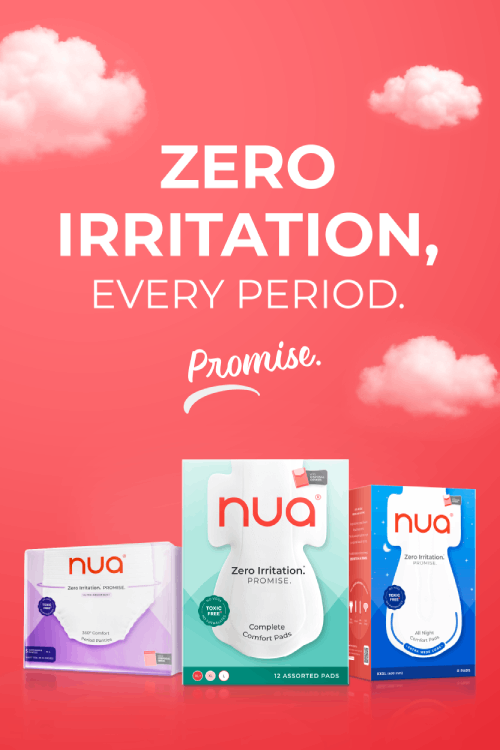
That’s how Nua’s MyWave Pads were created. They’re designed to be pocket-friendly while still staying true to the basics. They come with a soft, 100% skin-safe top layer to prevent rashes, a dual wrapped super absorbent core that locks leaks and all-around channel barriers that keep you protected through the day.
Because lowering the price shouldn’t mean raising the cost to your health or comfort.
Beyond Pads: Policies, Education and Empowerment
When it comes to period care, the lack of women’s empowerment is the first hurdle, as in many homes, women don’t control the money. So, household needs get prioritised over menstrual hygiene. In fact, as per the Population Foundation, some families can’t even spare ₹30-60 a month on pads. On top of this, a deep-seated taboo means many women can’t even say the word “period” out loud, let alone ask for pads or go out to buy them. Even if they get past these barriers, they often find that nearby shops don’t stock enough period products to go around.
Beyond the financial costs, true empowerment also means recognizing and addressing the physical discomfort that can come with a period. For many women, period pain can be truly paralyzing. Yet, there’s rarely any allowance or understanding for it. There’s no “period leave” or a culture of period positivity in offices, which means absenteeism and missed opportunities for many working women, every single month.
This lack of empowerment is worsened by a lack of education. Many people simply don’t have the right information about their bodies. They may not know how to wash their intimate areas during their period, how to properly dispose of a pad or how often to change it. Without this basic knowledge, they suffer from a higher risk of infection.
The final layer is a lack of comprehensive policy. The government made sanitary pads GST-exempt, but unfortunately, that wasn’t enough to truly lower prices on the shelf. As Parth explains, “What most people don’t see is that every step of making a pad still carries tax. From sourcing raw materials to transporting them, packaging and warehousing, it all adds up. So the cost of pads doesn’t really get reduced by a lot.”
This all goes to show that no single solution can bring down the cost of menstruation. It has to be an effort that takes into account everything that a woman needs for safe period management. “We need a uniform and comprehensive National Menstrual Health policy in India that ensures education, infrastructure, waste disposal and inclusion for all menstruators,” says UNICEF Youth Advisor, Oindrila Ghosh.
Paying for Periods: It Shouldn’t Have to Hurt So Much
Periods are a natural part of life, yet the financial, social and emotional costs often make them feel anything but normal. While women may always need to pay for period products, the burden doesn’t have to be crushing. Affordable, well-designed options like Nua’s MyWave pads show that quality and accessibility can coexist.
Beyond products, systemic changes, like better education, safe sanitation, supportive workplaces and inclusive policies can reduce the hidden costs that pile up month after month. The goal isn’t to make periods “free” in isolation, but to create a world where menstruation doesn’t come with compromises, discomfort or shame.