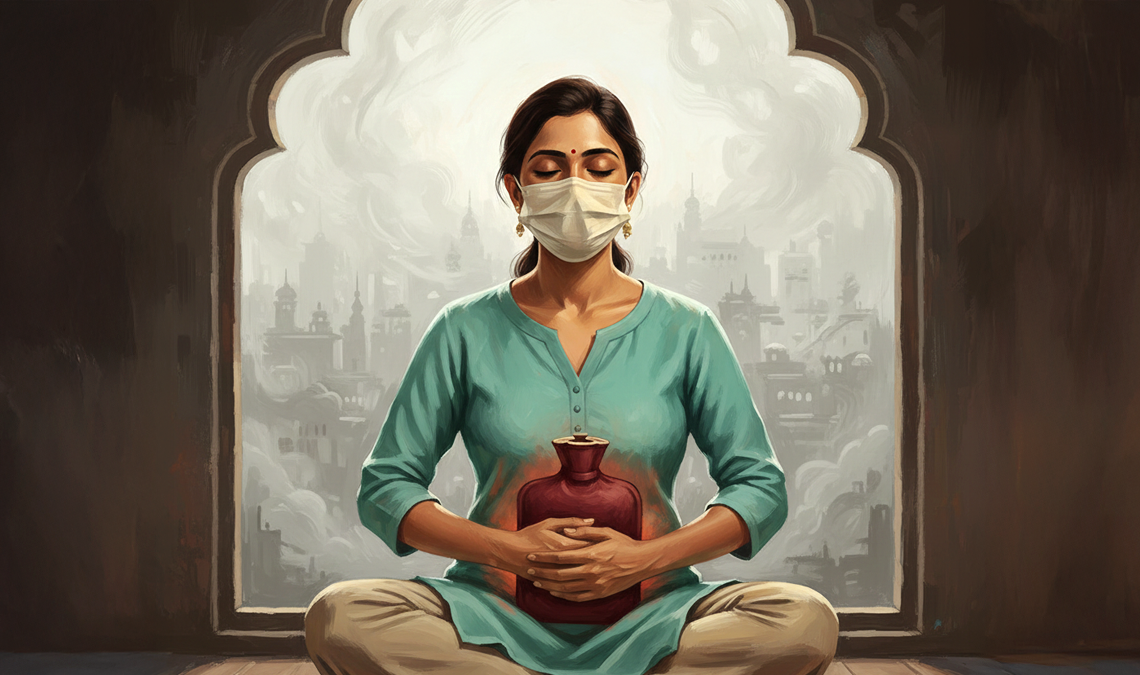
If winter mornings mean checking the AQI before checking your messages, that’s already saying a lot. In a lot of our cities, checking the weather app has become less about sunshine and rain and more about whether you’ll be able to see the car in front of you as you drive to work. Because the air quality seems to just be moving between ‘poor’, ‘very poor’ and ‘severe’. We’ve made peace with the stinging eyes, the scratchy throat and the thousands spend on making sure there’s an air purifier in every room. But inside your body, air pollution may be influencing systems you don’t immediately connect it to, including your menstrual cycle. That’s why researchers are asking, does air pollution affect periods?
We all know bad air can irritate lungs, trigger headaches, and even cause skin reactions. What isn’t talked about nearly enough is whether air pollution affects periods, and more specifically, whether long-term exposure can interfere with hormonal health and cycle regularity.
Recent research is starting to show that it might!
A new study published in The Lancet Planetary Health and co-authored with researchers from MIT, the University of Colorado Denver, and menstrual tracking app Clue has opened a fresh lens on this question using massive real-world data of over 2.2 million menstrual cycles from more than 92,000 people across cities in the United States, Brazil, and Mexico. This large-scale data allowed researchers to explore the pollution impact on the menstrual cycle in real-world conditions, not just lab settings.
What they found is subtle, but potentially profound. Where the air is more polluted, especially in terms of tiny particles called PM2.5m menstrual cycle patterns begin to shift. This emerging link between PM2.5 and the menstrual cycle matters because your period is one of the most sensitive indicators of hormonal balance. When it changes, it often signals something deeper happening in the body.
Let’s talk about what this means…
First: What Is PM2.5, And Why Should You Even Care?
When researchers talk about “air pollution” in this study, they’re specifically talking about fine particulate matter in the air called PM2.5, which is about 2.5 microns or smaller. These are tiny pieces of soot, smoke, exhaust, dust, and chemical fragments that are so small they slip past your lungs into your bloodstream.
PM2.5 might be microscopic, but your body certainly notices it.
PM2.5 has already been linked to a bunch of health problems like asthma, heart disease, stroke, and even premature death. What’s newer is the growing evidence connecting PM2.5 to period disruption and broader reproductive health concerns. Scientists are now asking whether chronic exposure affects systems they once assumed were protected — including the endocrine system.
And here’s the important part, you don’t have to live in a city that looks like Delhi in the winter for these effects to matter. PM2.5 levels fluctuate globally due to traffic, industry, wood burning, and climate conditions. Even moderate but long-term exposure may be enough to influence hormonal timing and menstrual patterns.
Blog continues after the ad.

So, what did the research actually find about air pollution and periods?
Menstrual cycles run on hormones, and hormones run on timing. Ovulation, follicle development, and the buildup and shedding of the uterine lining all follow a tightly coordinated schedule driven by signals between the brain and the ovaries. When that timing shifts, even slightly, cycle length shifts too, which is why cycle patterns are often one of the first places the body shows that something in the system is off (more on that here).
In this study, people living in areas with higher long-term PM2.5 exposure were more likely to have cycles that ran longer than what’s typically expected. Longer cycles often point to delayed ovulation, which can happen when the hormonal signals that mature and release an egg get disrupted or slowed down. It doesn’t mean ovulation stops altogether, but it does suggest the system is taking longer to get there (learn more about cycle variation here).This pattern supports concerns around air pollution and hormonal imbalance rather than sudden, dramatic cycle changes.
That matters because ovulation timing isn’t just about fertility, it reflects how well the entire hormone feedback loop is working. When the brain, pituitary gland, and ovaries aren’t syncing smoothly, the ripple effects can show up as irregular bleeding patterns, shifting PMS symptoms, or cycles that feel unpredictable from month to month.
What makes these findings especially interesting is that the changes weren’t dramatic in any single cycle. Instead, they showed up as small shifts that became meaningful when seen across thousands of people over time. This points to chronic environmental stress, not short-term exposure, as the main driver of pollution-related menstrual changes.
It suggests that this isn’t about one bad week of smog, or just winter-related shifts. It’s about the body adapting and recalibrating in response to the environment it’s living in for months and years at a time.
So How is Pollution Actually Affecting Your Menstrual Cycle?
There’s still a lot we don’t fully understand, but here’s where the emerging biology gets interesting.
Some scientists are hypothesising that:
- Pollutants are interfering with estrogen production or messaging. Estrogen is the hormone that helps follicles in the ovaries mature so that ovulation can happen on time. Some air pollutants can act like hormone “noise,” making it harder for the body to produce estrogen properly or for cells to respond to it. When that signal gets fuzzy, the body may take longer to prep an egg, which can push ovulation (and the whole cycle) later.
- PM2.5 triggering low-grade, whole-body inflammation. Those tiny particles don’t just stay in the lungs, they can enter the bloodstream and activate the immune system. Chronic inflammation can interfere with how the brain and ovaries communicate, which can throw off the hormonal feedback loops that keep cycles predictable. Think of it as static in the signal between different parts of the system.
- Disruption of the luteal phase (the part of the cycle after ovulation). After an egg is released, the body relies on progesterone to support the uterine lining and regulate when bleeding starts. If pollution-related stress affects progesterone levels or how long this phase lasts, it can show up as spotting, heavier or lighter periods, or cycles that feel off even when ovulation technically still happens.
None of these explanations are final answers, but together they help explain how pollution may influence period pain, irregularity, and overall cycle experience.
This Is Not Just About Length, It’s About What Your Cycle Tells You
One of the coolest (and most annoying) things about the menstrual cycle is that it’s basically a monthly status update from the body. When cycles start running longer, shorter, or all over the place, it’s often a sign that something in the system is asking for attention, whether that’s stress, sleep, nutrition, training intensity, illness, or now, potentially, environmental exposure too.
Because the body isn’t just going through the motions. It’s constantly adjusting, prioritising, recalibrating to its environment. Air quality may be one of many inputs influencing how your reproductive system prioritises and recalibrates.
Over time, ongoing cycle irregularity has been linked in other research to higher risks of metabolic conditions, heart disease, and fertility challenges, not because periods cause these issues, but because cycle patterns often mirror how well the body’s regulatory systems are functioning overall.
So when researchers track cycle variability at a population level, they’re not just collecting dates. They’re using the menstrual cycle as a real-time health signal that reflects how bodies are coping with both internal pressures and the environments they live in.
Okay, So Should You Panic? (No.) But Should You Pay Attention? Absolutely.
Here’s the honest truth: the study found associations, not direct cause-and-effect. That means air pollution might influence cycle patterns, but it’s one piece of a larger picture of what shapes menstrual health.
Let’s call that nuance what it is: hopeful and cautious science.
But if you’ve ever had a cycle go off the rails for “no reason,” or you’ve struggled with unexplained variability, or increased pollution-related period pain, this research gives you a new lens — not to blame the world, but to understand your body within it.
And understanding is power.
So What Can You Do To Prevent Pollution Impacting Your Menstrual Cycle?
We can’t all pack up and move to the Swiss Alps, and even if we could, pollution isn’t the only thing affecting menstrual health. But there are practical, grounded ways to use this knowledge.
- Track Your Cycle With Intention
Knowing what’s normal for you gives you a baseline. If things start drifting, whether environmental factors, stress, or lifestyle, you’ll be able to spot patterns sooner. Use Nua’s Period Tracker for these insights! - Tune Into Air Quality Trends
Many cities publish daily Air Quality Index (AQI) forecasts. On days with high PM2.5, consider limiting intense outdoor workouts or high-exposure activities. - Take the Long View
The research suggests it’s long-term exposure that shows the strongest patterns, so lifestyle habits that reduce cumulative exposure like indoor air filters or choosing lower-pollution commuting routes might help over time. - Talk to Your Healthcare Provider
If your cycles are consistently atypical or changing, bringing tracking data into a conversation with your clinician can make those conversations far more insightful and personalised.
We Still Have So Much to Learn… But This Is a Start
There are limits to this research. It doesn’t tell us exactly how air pollution interferes with hormones. It doesn’t capture every nuance of individual experience. And it doesn’t mean that if you live somewhere with lousy air quality, your body is irreparably harmed.
But it does make something clear: your menstrual cycle is not random. It’s sensitive. It’s responsive. And it may reflect the quality of the world around you.
If that doesn’t make you pay attention to your cycle, we don’t know what will.
Because your period isn’t just a monthly event. It’s a conversation your body wants to have with you. And now, thanks to science, we might finally be hearing more of what it’s been trying to say.