Here’s what this blog will cover about menstrual cycle tracking with fitness trackers:
- Your skin temperature rises a few tenths of a degree after ovulation and stays up until your period, which is the single clearest cycle signal a wearable can catch.
- Resting heart rate climbs by roughly 2 to 4 beats per minute in the second half of your cycle, often before any PMS symptom shows up.
- Heart rate variability tends to dip in the days before your period, a quiet stress signal that lines up with feeling more frazzled.
- Sleep data is the least reliable cycle clue, because research shows your sleep stages stay fairly steady even when your temperature and heart rate move.
- No tracker can predict your period to the exact day, but most land within a couple of days once they have learned a few of your cycles.
Every morning you glance at your tracker to check whether you actually slept deeply, whether yesterday’s workout burned what you hoped, whether you closed your rings or hit your step count. You probably check it once, maybe five times a day. Here is something else worth a glance, hiding inside the exact same data you already look at.
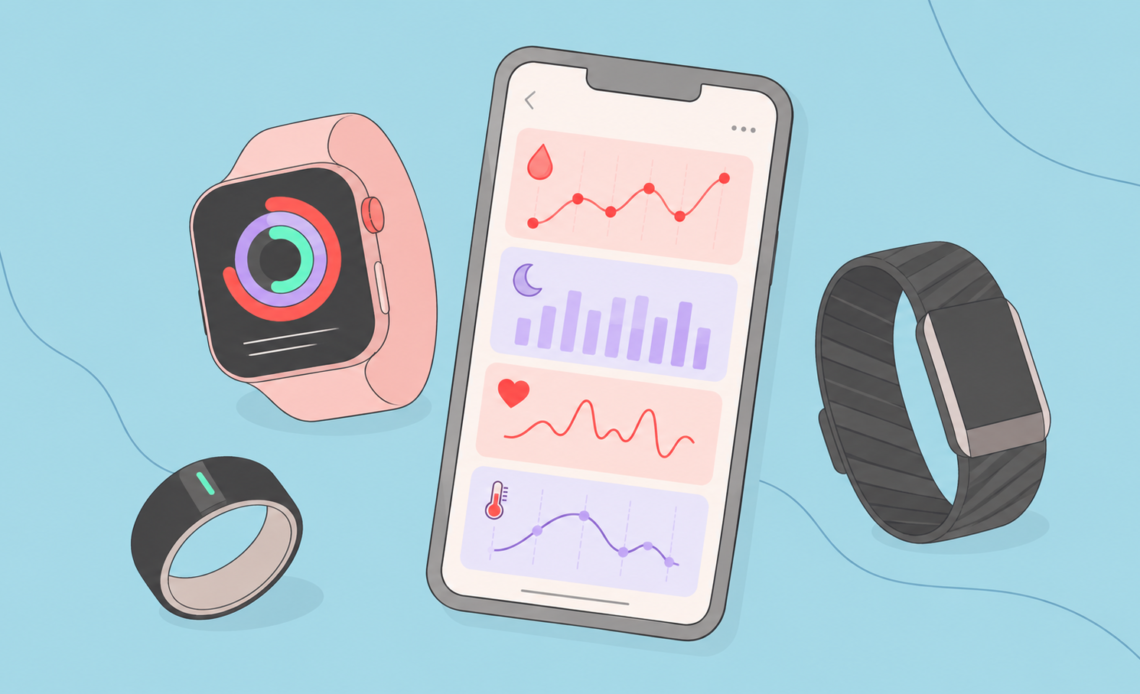
The temperature, heart rate, and sleep numbers your watch logs all rise and fall in a steady rhythm every month. That means menstrual cycle tracking with fitness trackers is something your device is already doing in the background, whether you have noticed it or not. The measurable signals that make it work are called digital biomarkers, and once you learn to read them, the same watch that counts your steps doubles as a surprisingly good period tracker.
Here is what your tracker is actually watching, and how to read it.
What Is A Digital Biomarker In Women’s Health?
A digital biomarker is a body signal, like temperature or heart rate, that a sensor on your fitness tracker can measure for you automatically and periodically, so you get essential health data without visiting a clinic.
Your resting heart rate, your skin temperature and your breathing rate at night are all data points that wearable devices for period tracking record without you lifting a finger. Since reproductive hormones leave fingerprints all over your physiology that align with these data points, you can use them for menstrual health tracking too, as much as you use them to track your fitness.
Blog continues after the ad.

Estrogen and progesterone do not just act on your uterus, they nudge your heart, your blood vessels, and your internal thermostat. So when a watch reads those signals night after night, it is building a map of your hormonal month from the outside in. That map is the foundation of menstrual cycle tracking with fitness trackers.
The Four Biomarkers Worth Watching
Not every signal that is useful for fitness tracking aligns with menstrual health tracking. However, these four can definitely give you the information you need to understand where you are in your cycle.
- Skin temperature: The clearest of the bunch. It dips slightly around ovulation, then rises and stays elevated through the luteal phase. This is the heart of how most wearables confirm that ovulation has happened.
- Resting heart rate: There is a steady climb of a few beats per minute after ovulation. Easy to read and closely tied to your phase, it is the second pillar of menstrual cycle tracking.
- Heart rate variability: These are the tiny timing differences between heartbeats. It usually falls in the luteal phase, mirroring the lower-energy, more-on-edge feeling many people notice before a period.
- Respiratory rate: Your breaths per minute creep up slightly in the luteal phase too. It is subtle on its own, but it adds confidence when the other three agree.
If your numbers say the luteal stretch has begun, that is your cue to restock on Nua’s Sanitary Pads, matched to your flow, so the heavy first morning never gets to surprise you.
Now, let’s go into each of these digital biomarkers in more detail.
How Does Skin Temperature Change Across The Menstrual Cycle?
After you ovulate, your skin temperature climbs a few tenths of a degree and holds there until your period starts.
Sometimes this is called a period fever or and period flu (more on that here).
This is the wearable version of an old trick.
For decades people used basal body temperature for ovulation tracking, measuring it with a thermometer first thing every morning to catch the post-ovulation bump that progesterone causes. The problem was that it was often inconsistent and easy to get wrong.
Modern skin temperature sensor cycle tracking does it for you while you sleep. In one study of 136 women across 437 cycles, wrist sensors picked up that classic two-phase temperature pattern in about 82% of cycles, close to what the old morning-thermometer method manages. The shift is small, often less than half a degree, which is exactly why a sensor sampling you all night beats a single groggy reading at 6 a.m.
Here is the simple version to remember: If your nightly temperature has been quietly creeping up and staying there, your period is usually just around the corner, often a week or two out. Watch for the rise, not a single high number.
There is something reassuring about a number that warns you a few days before anything else does. So when that temperature line ticks up and the countdown to your period begins, the easy move is to already have one of Nua’s Zero Irritation Pad tucked in your bag, turning the day it arrives into a non-event instead of a scramble.
Why Does My Resting Heart Rate Go Up Before My Period?
Because progesterone, the hormone that runs the second half of your cycle, gently speeds up your heart and raises your core temperature.
The link between resting heart rate and menstrual cycle is one of the most dependable signals a wearable can catch. In a Nature Scientific Reports study of 91 women across 274 cycles, resting pulse measured during sleep rose by about 2 beats per minute during the fertile window, then kept climbing to roughly 4 beats above baseline in the mid-luteal phase, the stretch right before bleeding.
You would never feel a 3-beat change on your own, but your tracker logs it, which is why your fitness tracker sometimes seems to know before you do. This is also the backbone of PMS symptoms tracking, because that heart-rate climb tends to arrive alongside the bloating, mood dips, and restless nights of the premenstrual week.
The everyday takeaway: when your resting heart rate has run a few beats above your normal baseline for several days in a row, you are most likely in the back half of your cycle. Take it as a fair warning to plan for your period and to go a little easier on yourself.
Is Sleep Tracking Data Useful For Understanding My Cycle?
Less than you would hope. Sleep is a weaker cycle signal than temperature or heart rate, even though it feels like it should be obvious.
This surprises people, because so many of us sleep badly before a period. Here is the nuance. When researchers tracked 26 women with an Oura ring across a full cycle, the actual structure of their sleep, how long they slept and how much deep sleep they got, stayed fairly stable across phases, even while their skin temperature and heart rate clearly rose in the luteal phase. In other words, the sleep tracker and menstrual cycle connection is real but indirect. Your device is better off reading the temperature and heart-rate data it gathers while you sleep than leaning on the sleep score itself. Poor rest before your period is usually a symptom of the hormonal shift, which is not as easy to measure.
Reading Your Markers: Where Are You In Your Cycle Right Now?
Once you know what each signal does, you can open your tracker on any given day and roughly place yourself in your cycle, no calendar maths required. This is the part of menstrual cycle tracking with fitness trackers that actually pays off day to day. Use the chart below as a quick decoder.
Where you are | What your tracker shows | What it means for you |
| Right after your period | Temperature low and flat, resting heart rate at its baseline, HRV at its highest | Your high-energy stretch. A good window for harder workouts and demanding tasks. |
| Around ovulation | Temperature dips slightly, then starts to rise, heart rate ticks up | Your fertile window. Once the temperature holds higher for a few days, ovulation has already passed. |
| The two weeks after ovulation | Temperature stays up, resting heart rate a few beats above normal, HRV slowly falling | Energy dips and PMS can creep in. Your period is roughly two weeks away. |
| The few days before your period | Temperature at its highest plateau, heart rate highest, HRV lowest, sleep often restless | Your period is just days out. This is your cue to prep. |
| Day 1 of your period | Temperature drops back down, heart rate eases toward baseline | The cycle resets and a fresh follicular phase begins. |
You do not need all four signals to line up perfectly. In real life, temperature and resting heart rate are the two to trust most. When both are clearly up and holding, you are in your luteal phase and your period is on its way, usually within a couple of weeks. When both drop back down, your period has arrived and the cycle has reset. Once you can read it at a glance like this, menstrual cycle tracking with fitness trackers stops being a feature you ignore and starts being something you genuinely use.
One honest caveat before you lean on the numbers too hard is that your temperature, heart rate, and HRV don’t only respond to your cycle. They shift with plenty of ordinary things too. A late workout, a glass of wine, a heavy meal right before bed, a stressful stretch, a cold coming on, a long flight, or even a warm bedroom can all nudge the same readings your tracker uses to map your cycle. Short sleep on its own is enough to do it. And if you’re on hormonal birth control, these cyclical shifts can be muted or missing altogether, because the hormones driving them are being overridden. So when a number looks off, it’s worth asking what else was going on that night before you chalk it up to your cycle.
Can a fitness tracker really tell when you’re ovulating, and are the predictions accurate?
Mostly after the fact, not in the moment. A tracker is great at confirming ovulation happened and decent at predicting your next period, but it is not a replacement for a fertility test if you are trying to conceive.
This is where menstrual cycle tracking with fitness trackers shows both its strength and its limit. Three things are worth knowing.
- How fitness trackers track ovulation: They watch for the temperature rise and heart-rate climb that follow ovulation, then mark it retrospectively, usually a day or two after it happens. The signal confirms ovulation rather than forecasting the exact hour.
- Smartwatch period prediction accuracy depends on you: Once a device has learned a few of your cycles, it usually predicts your period within a couple of days. Very regular cycles get tight predictions, and irregular ones get fuzzier. But this regularity also depends on you actually wearing your tracker regularly, especially at night, when you resting heart rate is read.
- The limit of your wearable: No wrist sensor is a medical fertility tool. It estimates a fertile window from patterns, so for contraception or conception decisions, pair it with a proper ovulation test.
Since no prediction is ever perfect, the smartest backup is simply being ready for the period your body is clearly building toward. Keep a few of Nua’s Sanitary Pads on hand just in case.
How To Actually Start Tracking Your Cycle
Reading the theory is one thing.
Here is how to turn everyday menstrual cycle tracking with fitness trackers into a working routine, in five steps.
Wear it to bed: The cycle signals show up at night, so consistent overnight wear matters far more than daytime steps. Charge it during your morning routine instead.
Give it two to three full cycles: Your tracker needs a baseline before its predictions mean anything, so the first month is really just it getting to know you.
Turn on the cycle and temperature features: Many wearable devices for period tracking have these settings switched off on default, so enable temperature, resting heart rate, and any cycle view in the app.
Log your period start each month: Even smart sensors get sharper when you confirm day one, and that small habit is what makes reproductive health tracking accurate over time.
Watch the luteal trio together: When skin temperature, resting heart rate, and a dip in HRV all move at once, your period is usually a handful of days out. Two or three cycles of this and your period tracker stops guessing and starts knowing.
The Bigger Picture
None of this replaces listening to your own body, but it does give you a second opinion you can actually see. Menstrual cycle tracking with fitness trackers takes the guesswork out of a process that used to feel invisible, turning vague premenstrual hunches into clear, repeatable patterns. The more you treat menstrual health tracking as data you own rather than a mystery you endure, the more in control of your month you get to feel.
FAQs
1. Can fitness trackers track your menstrual cycle?
Yes. Fitness trackers can use digital biomarkers such as skin temperature, resting heart rate, heart rate variability, and respiratory rate to identify patterns linked to different phases of your menstrual cycle.
2. Which fitness tracker data is most useful for menstrual cycle tracking?
Skin temperature and resting heart rate are the most useful signals, while HRV and respiratory rate can provide additional context about where you are in your cycle.
3. Does your skin temperature rise before your period?
Yes. After ovulation, skin temperature typically rises by a few tenths of a degree and stays elevated through the luteal phase until your period begins.
4. Why does resting heart rate increase before your period?
Progesterone rises after ovulation and can increase resting heart rate and body temperature. Wearable data may show your resting heart rate climbing a few beats above your usual baseline during the luteal phase.
5. Can a fitness tracker accurately predict your period?
Fitness trackers can generally predict your next period within a couple of days after learning several cycles, but predictions are less precise with irregular cycles.
6. Can a fitness tracker tell exactly when you ovulate?
Not exactly. Trackers generally identify ovulation retrospectively by detecting changes in temperature and heart rate, rather than predicting the precise time ovulation occurs.
Disclaimer
The content of this article is provided for general informational and educational purposes only and is not intended to constitute medical advice, diagnosis, or treatment. The information shared is of a general nature and may not be appropriate for all individuals or specific circumstances. Readers should not disregard, delay, or substitute professional medical advice based on the information contained herein.
If you experience any symptoms, notice anything unusual, or have concerns relating to your health or overall wellbeing, you should consult a qualified healthcare professional. While every effort is made to ensure the information shared is accurate and up-to-date, Nua makes no representations or warranties, express or implied, regarding the accuracy, completeness, or suitability of the information provided and disclaims all liability arising from reliance on this content to the fullest extent permitted by law.