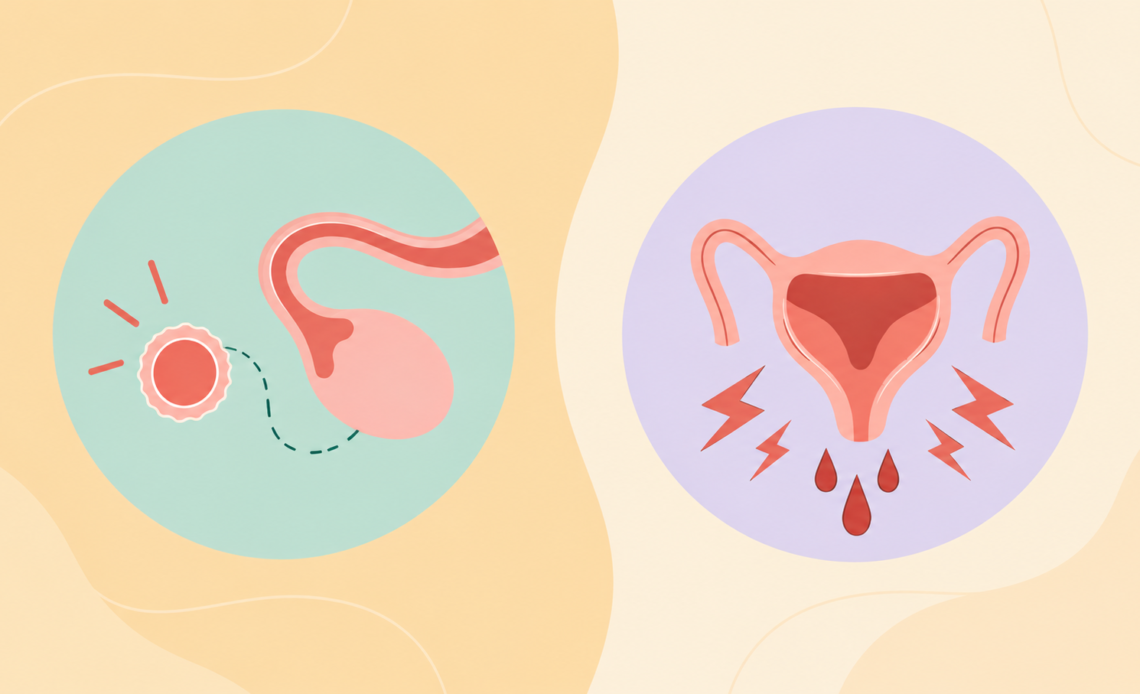
Here’s what you will learn about ovulation cramps vs. period cramps in this blog:
- Ovulation cramps usually show up on one side of your lower belly about two weeks before your period.
- Period cramps sit lower and more central, and arrive right before or during bleeding.
- Period cramps come from prostaglandins, chemicals that make your uterus contract to shed its lining. Ovulation cramps come from a follicle swelling and bursting to release an egg.
- Ovulation pain is brief, often a few minutes to a day or two. Period pain usually lasts longer and peaks in the first day or two of your period.
- Up to 40% of people who ovulate feel ovulation pain at least sometimes, so a mid-cycle twinge is common and usually nothing to worry about.
- Heat, gentle movement, hydration, and anti-inflammatory food ease both kinds of cramp, because they relax the muscle and calm the chemistry behind the ache.
Your period isn’t due for another two weeks, but your lower belly is cramping anyway. Confusing, right? What might be experiencing are ovulation cramps. Now, if you’re wondering what the difference between ovulation cramps vs period cramps is (because the two can feel surprisingly alike while meaning completely different things), the short story is that timing and location. One shows up mid-cycle on one side, the other shows up near your bleed and spreads low across your belly. Telling them apart changes what you do about the pain, when you should pay attention, and when you can happily ignore it.
So, we break down ovulation cramps vs period cramps properly, so you can read your own body instead of guessing at it.
Why do I have cramps two weeks before my period?
Because you’re most experiencing ovulation cramps, not PMS. Around day 14 of a typical cycle, one ovary releases an egg, and that release can pinch, twinge, or ache. People often mistake these for the cramps before your period thinking it’s an early period, but that’s not it. Ovulation sits roughly in the middle of your cycle, far from your bleed. So if you keep wondering why do I have cramps two weeks before period time, ovulation is usually the answer.
Blog continues after the ad.
What Are Ovulation Cramps?
Ovulation cramps are the mild ache or twinge some people feel when an ovary releases an egg, roughly in the middle of the menstrual cycle. Doctors call it Mittelschmerz, German for “middle pain,” and it’s the usual reason you might cramp a full two weeks before your period rather than right before it.
Each cycle, a fluid-filled sac called a follicle grows on one of your ovaries, ripening the egg inside. As it matures it swells and stretches the surface of the ovary, and when the egg is finally released, the follicle ruptures. That stretching and bursting, along with a little fluid or blood that can irritate the surrounding tissue, is what you feel as a cramp. According to the Mayo Clinic, this mid-cycle pain lands about 14 days before your next period and often passes within hours.
Hormonal changes during ovulation drive the timing. Through the first half of your cycle, estrogen climbs as the follicle develops, and that rising estrogen eventually triggers a surge of luteinising hormone, which is the actual signal that releases the egg. So the ache is actually tied to the precise hormonal moment your body ovulates.
Because only one ovary releases an egg in a given cycle, the pain usually settles on one side of your lower abdomen, and it can switch sides from month to month. Common ovulation pain symptoms include a dull or sharp ache on that side, sometimes with light spotting or clear, stretchy discharge that looks a bit like egg white.
On the days that twinge lingers and you’d rather not think about it, a little steady warmth can make iteasier. Nua’s Cramp Comfort Heat Patch warms up in about 15 minutes and sits discreetly under your clothes, so you can carry on with your day while it does the soothing.
Ovulation Cramps vs. Period Cramps: What Actually Causes Each Kind of Cramp?
Ovulation cramps and period cramps have two completely different mechanisms, even though the aches can feel cousin-close. Here’s what’s happening:
Period Cramps
Period cramps are driven by prostaglandins (more on that here), natural chemicals your uterine lining releases as your period begins. They signal the uterus muscle to contract and squeeze out its lining. Higher prostaglandin levels mean stronger contractions and more pain, which sits at the heart of period cramp causes, and explains why menstrual cramps can range from a dull ache to doubled-over pain.
The Cleveland Clinic notes the pain usually begins in the 24 to 48 hours before your period and eases as bleeding settles.
Ovulation Cramps
Ovulation cramps work differently. As a follicle ripens, it swells and stretches the surface of your ovary, then bursts to release the egg. That stretch and rupture, plus a little fluid that can irritate the surrounding tissue, is what you actually feel. Hormonal changes during ovulation set the whole thing in motion. Rising estrogen and ovulation pain are linked, because climbing estrogen triggers the hormone surge that makes the follicle release its egg, and that release is the painful part.
Warmth relaxes that clenching and loosens the squeeze, which is the logic behind the Cramp Comfort Heat Patch. It holds a steady, soothing heat for up to 8 hours, with no hot water bottle and no cord in sight.
How Long Do Ovulation Cramps Last?
Usually a few minutes to a day or two, and rarely longer than that. Compared with period pain, ovulation discomfort is the quick visitor. According to the Mayo Clinic, this mid-cycle pain lands about 14 days before your next period and often passes within hours. The classic ovulation pain symptoms are a dull or sharp ache, often as ovulation pain one side abdomen specifically, sometimes with light spotting or clear, stretchy discharge.
How To Identify If You’re Feeling Ovulation Pain Or Period Pain
The difference between ovulation pain and period pain comes down to four things: timing, location, length, and company. Lined up side by side, the ovulation cramps vs period cramps picture gets clear fast.
- Timing: Ovulation pain lands mid-cycle, about two weeks before your period. Period pain shows up in the day or two before bleeding and during the first days of your period.
- Location: Ovulation pain usually stays on one side of your lower belly. Period pain spreads low and central, and often radiates into your lower back and thighs. Those are the everyday period cramps symptoms most people recognise.
- Length: Ovulation pain is brief, minutes to a day or two. Period pain tends to last longer and softens as bleeding settles in.
- Company: Period pain often travels with bloating, mood shifts, fatigue, and sometimes nausea. Ovulation pain is usually quieter, occasionally with a little spotting or egg-white discharge.
Are Ovulation Cramps Normal, Or Not?
For most people, yes, completely normal. The Cleveland Clinic reports that ovulation pain affects up to 40% of people who ovulate, so an occasional mid-cycle twinge is common and harmless. That said, there’s a line.
People often ask, can ovulation cause severe lower abdominal pain, and the honest answer is that ovulation itself shouldn’t. Mild to moderate is expected. If yours is intense, sharply one-sided, and not letting up, that deserves attention rather than a shrug, because conditions like ovarian cysts or endometriosis can copy ovulation pain. If that’s the case, it’s important to see a doctor and get more information.
How To Relieve Ovulation Cramps
Start with warmth and work down the list. The ovulation cramps vs period cramps overlap is good news here, because one simple toolkit handles both.
Here’s a sensible order to try when you want to know how to relieve ovulation cramps, without reaching straight for medication.
- Heat: It’s the most reliable of the natural remedies for menstrual pain relief, because warmth relaxes the contracting muscle and improves blood flow to the area, which calms the ache at its source. A Cramp Comfort Heat Patch from Nua sticks on discreetly, warms up within about 15 minutes, and keeps soothing for up to 8 hours, so you’re covered whether the cramp clears quickly or lingers all afternoon.
- Movement: A short walk or some light stretching loosens the pelvic muscles and nudges your circulation, which can ease the cramp faster than lying still.
- Hydrate and warm up from the inside: Water cuts down on bloating, and warm drinks like ginger or chamomile tea have mild anti-inflammatory and muscle-relaxing effects.
- Eat anti-inflammatory: Leafy greens, omega-3 rich fish, nuts, and seeds help quiet prostaglandin activity over time, so this one is a slow build that pays off cycle after cycle.
- Breathe and rest: Slow breathing settles your nervous system, and because pain is partly processed in the brain, a calmer mind genuinely registers less of it.
The Takeaway
Once you understand the ovulation cramps vs period cramps difference, your body stops sending you mixed signals and starts sending you information. Mid-cycle and one-sided usually means ovulation. Low, central, and timed to your bleed usually means your period. Both are normal, both are manageable, and neither one has to run your week.
The whole ovulation cramps vs period cramps story really comes down to listening closely and responding kindly. Learn your pattern, keep a little warmth within reach, and the next time your lower belly starts up, you’ll know exactly what it’s telling you and exactly what to do about it.
FAQs
1. What are ovulation cramps?
Ovulation cramps are a mild ache or twinge caused by an ovary releasing an egg, usually around the middle of the menstrual cycle, about two weeks before your period.
2. What is the difference between ovulation cramps and period cramps?
Ovulation cramps usually occur mid-cycle and affect one side of the lower abdomen, while period cramps happen just before or during bleeding and are often felt lower and more centrally.
3. How long do ovulation cramps last?
Ovulation cramps may last a few minutes to a day or two, while period cramps generally continue for longer and ease as menstrual bleeding settles.
4. Are ovulation cramps normal?
Yes, mild to moderate ovulation pain is common and usually harmless. However, severe, persistent, or sharply one-sided pain should be checked by a doctor.
5. How can you relieve ovulation cramps?
Heat, gentle movement, hydration, warm drinks, anti-inflammatory foods, slow breathing, and rest may help ease ovulation cramps and period pain.
6. When should you see a doctor about ovulation pain?
Speak to a doctor if the pain is severe, lasts longer than expected, keeps returning unusually, or is accompanied by other concerning symptoms, as conditions such as ovarian cysts or endometriosis can cause similar pain.
Disclaimer
The content of this article is provided for general informational and educational purposes only and is not intended to constitute medical advice, diagnosis, or treatment. The information shared is of a general nature and may not be appropriate for all individuals or specific circumstances. Readers should not disregard, delay, or substitute professional medical advice based on the information contained herein.
If you experience any symptoms, notice anything unusual, or have concerns relating to your health or overall wellbeing, you should consult a qualified healthcare professional. While every effort is made to ensure the information shared is accurate and up-to-date, Nua makes no representations or warranties, express or implied, regarding the accuracy, completeness, or suitability of the information provided and disclaims all liability arising from reliance on this content to the fullest extent permitted by law.