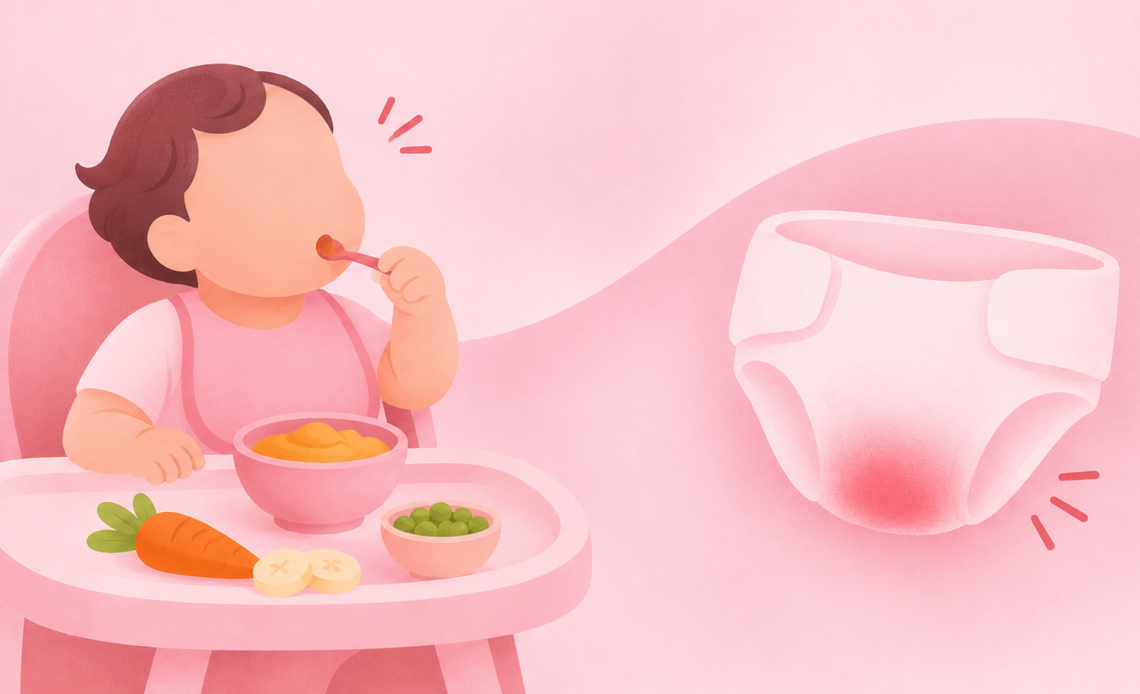
Your baby got through months of milk feeds with a mostly calm bottom. Then you started solids, a few spoons of mashed banana, some dal water, maybe a little tomato soup, and within a week there’s a red, sore-looking patch in the diaper. You haven’t changed the diapers, the wipes or the routine, so it’s natural to wonder what you did wrong. Most likely, nothing. Diaper rash from starting solids is very common, it has a clear physical cause, and once you understand that cause, it’s usually simple to manage.
What you will learn in this blog about babies getting a diaper rash from starting solids:
- Starting solids changes your baby’s poop, making it less acidic and often more irritating to the skin because digestive enzymes become more active.
- Tomatoes, citrus fruits, fruit juices, pears and prunes can trigger rashes by making stools acidic or loose, while too much rice or banana can cause hard stools and tiny tears.
- A red, raw rash around the anus is usually irritation rather than an allergy; hives, facial swelling, vomiting or ongoing diarrhoea may point to an allergic reaction.
- Introduce one new food every three to five days, track changes in your baby’s poop, change soiled diapers promptly and clean gently with water.
- Apply a thick layer of zinc oxide or petroleum jelly at every diaper change, allow diaper-free time and pause suspected trigger foods before gradually trying them again.
- Most rashes clear within two to three days with proper care. Consult a doctor if they persist, spread into skin folds, develop raised red spots or come with other concerning symptoms.
What Diaper Rash Actually Is
Diaper rash is skin that’s been worn down by what sits against it. Doctors call the common type of diaper rash contact dermatitis, which is usually caused by an irritant. “Irritant” means the skin was damaged by contact with something harsh, not by an infection or an allergy, at least at the start.
The outermost layer of your baby’s skin is made of flat skin cells held together by fats. Together, they keep water in and irritants out. This layer works best when the skin’s surface is slightly acidic, at around pH 4.5 to 5.5.
A diaper wears down this layer in three ways. First, it traps moisture. Skin that stays wet absorbs water, swells and turns soft, which makes it easier to damage by rubbing and lets irritants get in more easily. Second, when pee mixes with poop, bacteria in the poop turn a substance in urine called urea into ammonia. Ammonia is alkaline, so it pushes the skin’s pH above its normal, slightly acidic range. Third, poop carries digestive enzymes: proteases, which break down protein, and lipases, which break down fat. In the gut, their job is to digest food. On skin, they break down the proteins and fats that hold the outer layer together.
That third factor is the one that matters most for this topic. The enzymes are the biggest reason babies get diaper rash after starting solids. A study of babies’ poop found that these enzymes were the main things that hurt skin. It found two more things. Bile salts, which the liver makes to help digest fat, made the enzymes do even more damage. And once the enzymes had weakened the skin, other irritants, like ammonia, could get in more easily.
So diaper rash isn’t really about dirt. It’s about chemistry, and the chemistry changes the moment your baby’s diet does.
Why Starting Solids Changes Everything Down There
Before solids, and especially if your baby is breastfed, poop is soft, yellowish, mild-smelling and fairly acidic. Breast milk feeds gut bacteria that produce acids, and acidic poop keeps those skin-damaging enzymes relatively quiet. That’s a big part of why, according to research, breastfed babies have fewer diaper rashes, and why rash becomes more common as babies start eating solid foods and their stool frequency and pH both rise.
Poop changes after starting solids on three fronts at once, and each one adds to the rash risk:
- The poop becomes less acidic: Acid keeps the enzymes that are harmful to your baby’s skin at bay. Solid food makes poop less acidic, so the enzymes are no longer held back. They become more active and do more damage to your baby’s skin.
- The speed and frequency change: The American Academy of Pediatrics explains that solid food changes how often your baby poops and how quickly food moves through their gut. When poop moves through quickly, the digestive enzymes in it don’t have time to break down on the way. So looser, faster poop carries more active enzymes onto the skin. That’s why loose poops cause more irritation than firm ones, even when you change diapers right away.
What’s in the poop changes: At 6 months, your baby’s gut can’t fully digest a lot of solid food yet. That’s why you’ll see whole bits of carrot or peas in the diaper. Some of what isn’t digested, like the acids in tomatoes and oranges, ends up in the poop and irritates the skin.
Many parents think, “my baby’s skin should be tougher by now, so why is this happening at 6 months and not as a newborn?”
The skin is tougher. But the poop got harsher faster than the skin got stronger. That’s why diaper rash tends to peak at around 9 to 12 months rather than in the newborn weeks, and why diaper rashes in 6 month old babies get in the first weeks of weaning isn’t a sign that you’re doing anything wrong.
Foods That Commonly Cause Diaper Rash, and Why
Any new food can shift the stool, but the foods that cause diaper rash most often tend to work in one of three ways: they make poop sting, they make it loose, or they make it hard. Here are the usual suspects:
- Tomatoes: Tomato is acidic, and some of its acids survive digestion. When that stool lands on skin that’s already a bit raw, it stings like lemon juice on a paper cut. Tomato diaper rash typically shows up as a bright red ring hugging the anus. In Indian kitchens, that can be tomato soup, rasam, sambar, or tomatoes cooked into khichdi.
- Citrus fruits and juices: Orange, mosambi and lemon work the same way. Accoring to DermNet, a dermatology reference run by doctors, orange juice is an example of a food that can make stool more acidic and advises pausing a food if you notice that link. Mosambi juice is often one of the first things offered in Indian homes, which makes it a common hidden trigger.
- Fruit juice in general: Apple, pear and prune juices are high in natural sugars like sorbitol and fructose, which a baby’s gut can’t fully absorb. The leftover sugar pulls water into the gut, so poops get loose and frequent, which means more enzymes on the skin, more often. Paediatricians already advise against juice before the first birthday, so this is one easy thing to skip.
- Stool-loosening fruits: Prunes, pears, plums and large servings of fruit purée loosen stool through the same sugar-and-water effect, even without being juiced.
- Foods that firm up stool too much: Lots of rice, banana or ragi without enough fluid can make poop hard and dry. Passing it can cause tiny tears around the anus, called fissures, which then get irritated by the next stool. If you see a small streak of bright red blood on the poop and your baby strains or cries while passing it, this is the likely cause.
Irritation, Allergy or Yeast? How to Tell the Difference
The most common wrong assumption is “a rash after a new food means my baby is allergic.” Most of the time, what looks like a food allergy diaper rash is plain irritation from the stool. The way to tell them apart is to look at where the signs show up and when.
- Irritation from food: The skin is red, shiny or raw-looking, mainly where poop touches most. A rash around baby’s anus after eating something acidic is the classic pattern. It usually appears within about a day, your baby is otherwise happy and feeding well, and it improves within 2 to 3 days once the food is paused and the skin is protected.
- An immediate food allergy: This shows up within minutes to about 2 hours of eating. Look for hives (raised, itchy skin) on the face or body, swelling of the lips or eyes, vomiting, or coughing. The reaction comes from the immune system, not from contact with poop, so it’s rarely limited to the diaper. Any trouble breathing or widespread swelling is an emergency.
- A delayed food allergy: Some allergies, like cow’s milk protein allergy, build slowly. Signs include ongoing diarrhoea, mucus or blood in the stool, eczema patches elsewhere and poor weight gain. Here, the diaper rash is a side effect of the diarrhoea, and the allergy needs a doctor’s diagnosis.
- A yeast infection: Yeast (Candida) lives in poop and grows easily on skin that’s already damaged, so an irritant rash can turn into a yeast rash if it lingers. It’s bright red with sharp, raised edges, it spreads into the skin folds, and it often has small red dots just beyond the main patch. Regular zinc creams won’t clear it, so if a rash lasts more than about 3 days despite good care, see your doctor for an antifungal cream. Wondering if it could be yeast? Read our guide on how to tell a yeast infection apart from a regular diaper rash.
How to Handle Diaper Rash from Starting Solids: A Step-by-Step Guide
The goal with a diaper rash from starting solids is to keep feeding a wide variety of foods while keeping harsh poop off your baby’s skin. These steps do both.
- Introduce one new food at a time: Wait about 3 to 5 days before adding the next one. If a rash appears, you’ll know which food is behind it instead of guessing among five.
- Keep a simple log: Write down the food, the day, what the next poops looked like and whether any redness appeared. A diaper rash from new food usually shows up within 24 hours, so the pattern becomes clear quickly.
- Change poopy diapers right away: The damage depends on how long enzymes sit on the skin, so even ten minutes more makes a difference while you’re introducing new foods. Here’s how to change a baby’s diaper step by step.
- Clean gently with water, and pat dry: Rubbing strips away the skin’s protective fats, and wipes with fragrance or alcohol sting on broken skin. Plain water and a soft cloth are often enough. Read more on wipes vs. plain water for your baby’s skin here.
- Put on a thick barrier layer at every change: A zinc oxide or petroleum jelly cream acts as a shield, so the poop lands on the cream instead of the skin. Apply it like icing, not like lotion. When you change the next diaper, wipe off only the soiled part and add more on top rather than scrubbing it all away. For a full walkthrough, check out our step-by-step guide to applying diaper rash cream.
- Give diaper-free time: Letting your baby lie on a cotton cloth or towel without a diaper for 10 to 15 minutes, a few times a day, lets the skin dry out and its pH settle back to normal. To find out how much diaper-free time your baby needs at each age, read this guide.
- Pause the suspect food, then try again: Stop the food for about 1 to 2 weeks, then offer a small amount mixed into something mild, like a little tomato cooked into dal rather than a bowl of tomato soup. Many babies handle acidic foods well a few weeks later as their gut matures.
- Adjust for poop texture: If stools are loose, cut back on juices, prunes and pears. If they’re hard, offer a few sips of water with meals (fine after 6 months) and more fibre-rich foods like mashed vegetables and dal.
For more everyday prevention, read our guide on how to prevent diaper rash in babies.
A Rash Is Information, Not a Failure
It’s easy to see diaper rash from starting solids as a sign that you’ve introduced the wrong food or that something is wrong with your baby. A better way to see it is that the rash is telling you your baby’s gut is changing, which is exactly what’s supposed to happen.
Tomatoes, oranges and other acidic foods aren’t bad for your baby. They’re a good source of vitamin C and new flavours. The skin just needs extra protection while the gut catches up. Pause, protect, retry, and in most cases the weaning diaper rash phase passes within a few weeks.
For the bigger picture on caring for your baby’s skin, see our simple guide to baby skin care.
FAQs
1. How long does diaper rash from starting solids last?
With quick changes, a thick barrier cream and a pause on the triggering food, most diaper rash from starting solids clears within 2 to 3 days. If it lasts longer than that, spreads into the skin folds or develops small red spots around the edges, see your doctor, since it may have turned into a yeast infection.
2. Which foods cause diaper rash most often?
Acidic foods like tomatoes and citrus fruits (orange, mosambi, lemon) are the most common, along with fruit juices and stool-loosening fruits like prunes and pears. Foods that make stool very hard, like a lot of rice or banana without enough fluid, can also cause trouble through small tears around the anus.
3. Is a red ring around my baby’s bottom after eating a sign of food allergy?
Usually not. A red ring around the anus that appears after an acidic food is almost always irritation from the stool touching the skin. A food allergy tends to show signs outside the diaper area too, such as hives, facial swelling, vomiting or ongoing diarrhoea. If you see those, talk to your doctor.
4. Should I stop giving solids if my baby gets diaper rash?
No. Keep going with solids, but pause only the food you suspect and protect the skin with a barrier cream. Pulling back on solids altogether isn’t needed, and offering a variety of foods matters for your baby’s nutrition and development.
5. Is diaper rash at 6 months normal?
Yes. Six months is when most babies start solids, and the shift in stool makes the diaper area more prone to irritation. Diaper rash is most common between about 9 and 12 months for the same reason. It’s a normal, manageable part of weaning, not a sign that something is wrong.
Disclaimer
The content of this article is provided for general informational and educational purposes only and is not intended to constitute medical advice, diagnosis, or treatment. The information shared is of a general nature and may not be appropriate for all individuals or specific circumstances. Readers should not disregard, delay, or substitute professional medical advice based on the information contained herein.
If your baby experiences any symptoms, or if you notice anything unusual or have concerns relating to their health or overall wellbeing, you should consult a qualified healthcare professional. While every effort is made to ensure the information shared is accurate and up-to-date, Nua makes no representations or warranties, express or implied, regarding the accuracy, completeness, or suitability of the information provided and disclaims all liability arising from reliance on this content to the fullest extent permitted by law.