What you’re going to learn about if periods attract animals in this blog:
- Animals can notice scent changes during your period, but this usually leads to curiosity rather than danger.
- Dogs may become clingy, sniff more, or act protective because they detect hormonal and behavioural changes.
- Cats may notice changes too, but often respond more subtly or ignore them after a quick sniff.
- Sharks are not specifically attracted to period blood, and there is no solid evidence that menstruation increases shark attack risk.
- Wild animals are usually more attracted to food smells, waste, and scented products than to periods.
- Used pads, tampons, or liners should be kept away from pets because ingestion can be harmful.
You’re on your period, and suddenly everything feels a little… observed. Your dog is glued to your side like a tiny, slightly unhinged bodyguard, sniffing, hovering, way too invested in your personal space. Or there’s the beach version of the same spiral. Salty skin, a swimsuit that suddenly feels too thin, toes stalling at the edge of the water while your brain goes, Wait. Is this a thing? Can periods attract animals? Can animals smell this? CAN SHARKS?? Am I about to casually swim into a Discovery Channel episode? It’s half-embarrassed, half-laughing, but fully spiralling. The kind of question that pops up out of nowhere and refuses to leave.
If that thought has ever floated through your mind, you’re not alone. It sits at the intersection of curiosity, the body rules many of us learned too young, half-remembered science, and a long trail of internet myths. Sharks. Bears. Dogs. Cats. The idea that menstruation flips some invisible switch, turning you into a signal, has been passed around for years.
Let’s untangle what’s actually happening. Can animals really smell your period?
Can Animals Smell When You’re On Your Period?
Yes, animals can smell changes related to your period, but that doesn’t mean what people think it means, especially when it comes to questions like can pets smell periods or do animals sense periods without it signalling danger.
Animals experience the world through scent in a way humans simply don’t. According to research, dogs have up to 300 million olfactory receptors compared to our six million. Cats, though more subtle about it, still pick up chemical changes in bodies that humans can’t perceive. Even wild animals rely heavily on scent to understand what’s around them, like food, danger, hormones, territory, and health.
Blog continues after the blog.

Menstrual blood isn’t just blood. It’s a mix of blood, uterine lining, hormones, and bacteria. That creates a distinct chemical signature. To an animal’s nose, it’s new information, interesting information, sometimes confusing information, sometimes comforting information because it still smells like you, just layered differently.
So when a dog suddenly becomes obsessed with someone’s lap, underwear, bathroom trash, or personal space during a cycle, it’s not because you’ve turned into prey. It’s because your scent profile has changed. The body is playing a slightly different chemical playlist than usual.
Dogs especially are wired to investigate novelty through smell. It’s very much a “Oh? New remix dropped? Let’s analyse.”
How To Animals React to Period Smells?
With curiosity! A classic pets period reaction can look like clinginess, sniffing, guarding behaviour, or even gentle protectiveness. Some dogs become extra affectionate during their human’s period, possibly because they detect hormonal shifts linked to stress (more on that here) or discomfort and respond accordingly.
It’s weird, it’s intimate, it can feel invasive. But it’s not predatory. Some would argue it’s even cute (?)
Cats might sniff once and then silently judge from across the room like, “This data has been logged and will never be discussed again.” Same information. Different personalities.
When your body is working so hard, your period products should too. Find comfort your body actually notices. Try Nua’s zero irritation sanitary pads!
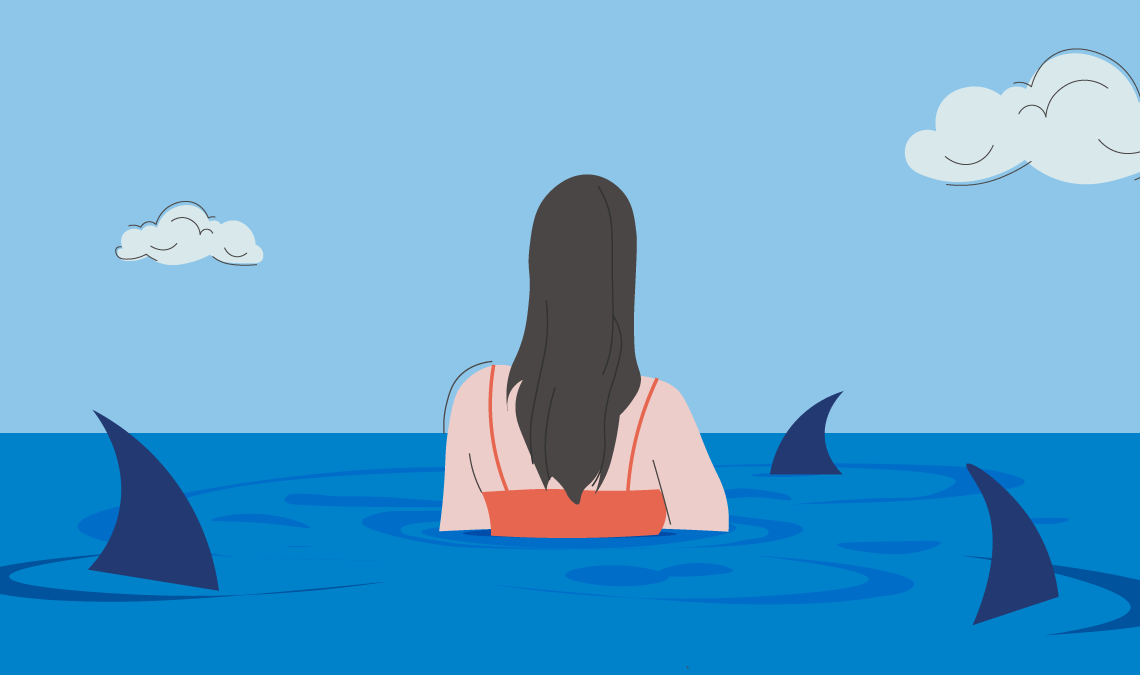
Can Sharks Smell Period Blood? The Sharks Period Myth, Explained
No. If there’s ever been hesitation about swimming in the ocean on a period, that’s just the echo of one of the most persistent menstruation myths, the classic sharks period myth.
Sharks can detect tiny amounts of blood in the water, yes, but the whole idea of menstrual blood animal attraction doesn’t actually hold up. Sharks are not selectively attracted to menstrual blood over any other biological material. Blood is blood. Menstrual blood becomes diluted extremely quickly in open water. The ocean is massive. So your menstruating body is not a floating chum bucket, trust.
Multiple marine studies (like this and this) and decades of beach safety data have not shown a meaningful increase in period shark attacks on menstruating swimmers. If periods were truly a major trigger, lifeguard statistics would look very different.
Sharks also rely heavily on movement patterns, electrical signals from muscle contractions, and irregular splashing to identify prey. Humans simply don’t move like injured fish (unless you’re doing weird chaotic paddleboard yoga).
So the idea that a shark is going to clock a shedding uterus from across the ocean? Not scientifically supported. At all.
If swimming during a cycle feels uncomfortable for personal reasons, physically, emotionally, or logistically, that’s valid. Fear of animal attraction just doesn’t need to be part of the equation.
What Animals Actually Respond To: An Guide for Pet Owners
This is where things get genuinely fascinating. When periods attract animals‘ attention, it’s rarely the blood itself doing the heavy lifting. Here’s what’s actually going on, and what you can do about it.
What your body is doing during your period:
- Hormone levels fluctuate, and animals pick up on these chemical shifts.
- The immune system adjusts slightly.
- Stress hormones may rise, which pets read through scent and body language
- Body temperature can shift.
- Sweat composition changes, altering your overall scent profile
- The microbiome adjusts, adding another layer to what animals detect
What you can do about it:
- Secure your bathroom trash so curious pets don’t get into hygiene products. Ingestion can cause dangerous blockages.
- Keep bathroom doors closed during your period if your pet is particularly obsessive about sniffing.
- Gently redirect pets who are being a little too investigative with your personal space.
- Let extra clinginess or cuddliness from your dog be what it is, emotional attunement, not something to worry about.
- If you’re camping or outdoors, use odour-resistant bags for disposal and pack out all used products securely.
Animals aren’t responding to “period blood”. They’re responding to a whole-body state change across all the phases of menstruation. Which is quite beautiful when you think about it.
If your period is already sending out these signals, your pad should be able to manage them. Here are sanitary pads designed to do just that!
Do Periods Attract Wild Animals Like Bears, Wolves, or Big Cats?
No, at least not specifically your period. Just you in general. The question of whether periods attract animals in the wild is where this fear tends to get greatly exaggerated, and it deserves a grounded answer without fear-spiralling.
What actually attracts wild animals at a campsite:
- Food smells, even wrapped up snacks or granola bar wrappers
- Toothpaste, deodorant, and scented skincare products
- Cooking grease and food packaging in trash
- Scented wipes or any unfamiliar chemical smell
- Improper scent storage. Statistically, a granola bar wrapper is more exciting to a bear than a tampon.
Smart disposal habits for the outdoors:
- Use odour-resistant bags for used period products
- Pack everything out. Don’t bury or leave products at the campsite
- Store waste securely along with food and other scented items
- Keep camp clean across the board because it’s the full scent picture that draws wildlife, not any one thing
This isn’t fear-mongering. It’s about minimising unfamiliar smells in shared ecosystems.
A period in an apartment with a golden retriever is not the same as a period in grizzly territory with open trash.
Why Does This Myth Stick So Hard?
There’s something deeper under this question.
A lot of people were taught, directly or indirectly, that menstruation is something to hide, something embarrassing, something disruptive that needs to be concealed, managed, neutralised, deodorised, and apologised for.
So when the idea surfaces that periods attract animals, there’s an instinctive shame response. “My body is betraying me. I’m exposed. I’m unsafe. I’m being detected.” It taps into that deep vulnerability.
It also taps into older cultural narratives where menstruating bodies were labelled impure, dangerous, or destabilising. Even modern science conversations sometimes accidentally reinforce this by focusing on risk instead of reality.
The truth is a cycle is a normal biological rhythm. Do animals sense periods? They register them the same way they detect pregnancy hormones, stress sweat, illness markers, and emotional shifts. It’s information, not a threat signal.
A body isn’t malfunctioning because it’s detectable. It’s functioning exactly as biology designed it.
Periods are normal. Your products should feel that way too. For zero-irritation period care, try Nua’s pads.
More Related Real-Life Questions
Why does my dog go crazy during my period?
Because the scent changed, behaviour shifted, and dogs are emotionally responsive creatures. Some become protective or affectionate, some become curious, some become mildly weird about it. It’s a normal pets period reaction. If behaviour crosses boundaries, like excessive licking or trying to access hygiene products, gentle redirection and secure trash management usually solve it.
Should period products be kept away from pets?
Yes, not because of attraction in a predatory sense, but because ingestion can be dangerous and cause blockages. Keep trash secured and close bathroom doors if needed. This is a safety issue, not a shame issue.
Is it unsafe to swim in the ocean during a period?
No, from an animal-attraction standpoint, there’s no meaningful evidence that it’s unsafe. The sharks period myth really is just that: a myth. Swim based on comfort, flow management, personal preference, and local conditions, not the fear of sharks.
Do animals know when someone is on their period?
Yes, they likely know something is different. But menstrual blood animal attraction isn’t the dramatic thing pop culture makes it out to be. Animals don’t conceptualise menstruation the way humans do. They simply register chemical and behavioural changes.
Let’s Reframe This: Periods Attract Animals’ Curiosity, Not Danger
Instead of asking “do periods attract animals?” a better question might be: “What does it mean that your body is constantly sending signals to the world, even when you’re not aware of it?”
The answer isn’t something to sanitise into invisibility. A cycle isn’t a liability, it’s a biological signal of health, rhythm, renewal, and internal intelligence. Animals and menstruation existing in the same space is just biology interacting with biology, a reminder of how connected we all are.
A dog offering extra closeness during cramps isn’t embarrassing, it’s relational attunement. A cat noticing hormonal shifts isn’t invasive, it’s sensory awareness.
Bodies aren’t leaking danger into the world, they’re just existing. And existing bodies leave traces, scents, signals, and energy shifts. That’s not something to sanitise into invisibility. It’s something to understand, respect, and maybe even quietly appreciate.
Disclaimer:
The content of this article is provided for general informational and educational purposes only and is not intended to constitute medical advice, diagnosis, or treatment. The information shared is of a general nature and may not be appropriate for all individuals or specific circumstances. Readers should not disregard, delay, or substitute professional medical advice based on the information contained herein.
If you experience any symptoms, notice anything unusual, or have concerns relating to your health or overall wellbeing, you should consult a qualified healthcare professional. While every effort is made to ensure the information shared is accurate and up-to-date, Nua makes no representations or warranties, express or implied, regarding the accuracy, completeness, or suitability of the information provided and disclaims all liability arising from reliance on this content to the fullest extent permitted by law.