Here’s what you will learn about period anxiety in this blog:
- Roughly two in three women reshape their daily choices around period anxiety, not because they leaked, but because they might.
- WaterAid surveyed over a thousand women and found 67% adapt their lifestyle to this anxiety.
- What’s draining isn’t the blood loss, it’s the worry. A 2025 study found anxiety is the actual bridge between period problems and a lower sense of well-being.
- Worry runs on the same mental hardware you use to focus. Every “when can I next change?” loop borrows working memory from the task in front of you, which is why a normal day on your period feels heavier than the same day off it.
- Protection that genuinely lasts, like a full-coverage layer good for 10 hours, doesn’t just catch leaks. It removes the trigger that starts this period anxiety mental loop in the first place.
- Comfort here isn’t a luxury, it’s cognitive freedom, the difference between a brain half-spent on surveillance and one that’s fully yours.
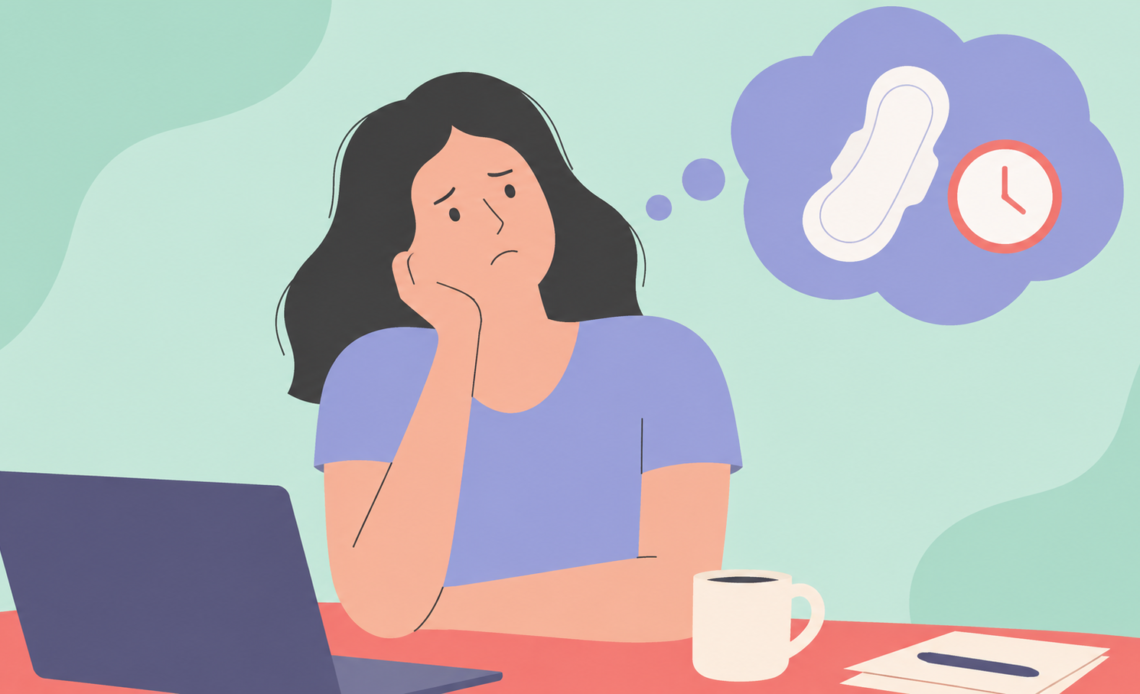
There’s a tab open in your head right now that you never chose to open. It sits in the background, constantly refreshing, asking the same question on a loop, “Do I need to change my pad?” You might not notice it until you’re three hours into a workday, halfway through a long meeting, or on a train with no stop in sight, and suddenly a chunk of your attention goes to do the maths. This is period anxiety, and it’s less about your period and more about the endless low hum of managing it. It’s not obvious, it just runs, tab open, battery draining.
This isn’t just a “you” problem. When WaterAid surveyed more than a thousand women in 2016, 67% said they adapt their lifestyle because of the fear of period mishaps, things like leaking onto clothes, getting caught without a product, worrying about smell, or planning the day around where the nearest clean bathroom is. Three out of four said they regularly dread one of these moments. Two out of three reorganising their lives around a thing that mostly hasn’t happened yet. The possibility alone is enough to change how you dress, sit, move, and plan. That gap, between how rarely disaster actually strikes and how constantly you brace for it, is exactly where period anxiety lives.
But it doesn’t have to be like this. Let’s dissect this problem to understand why.
What’s Actually Running In That Period Anxiety Tab
If you tried to write down everything your brain calculates during your period days, the list would outrun your actual to-do list. The tab isn’t one worry. It’s dozens of tiny ones stacked into a single background process.
- The clock math: How many hours since you last changed your pad, how many until you reasonably can again, and whether the gap between those two numbers is survivable.
- The seating math: Which chair, which side, whether the couch is a pale colour, whether you’ll have to stand up in front of people straight after.
- The outfit math: Dark trousers over the light dress, a dupatta or jacket tied around your waist just in case, the veto on white that starts a week before you even bleed.
- The bathroom map: Where the clean one is, whether it has a bin, whether there’s a queue, whether you can get there without announcing it to the whole room.
- The supply audit: Is there a product in your bag, your desk, your coat, and the small jolt of panic when you realise you’re down to your last one.
- The sound-and-smell surveillance: The worry about a wrapper crinkling, about standing up too fast, about whether anyone nearby can somehow tell.
None of these is dramatic on its own. Together, they’re a full-time job you’re doing on top of your actual job, and nobody clocks how tiring it is.
Blog continues after the ad.
Now picture that entire list collapsing into one settled fact you never have to check. That’s the promise of Nua’s Disposable Period Panties, a full-coverage layer built to hold up for 10 hours, so the clock math, the seating math, and the supply audit become a soft buzz not a loud alarm, and your attention goes back to your actual day.
Why The Tab Is So Expensive
So why does a background worry feel so heavy? Because your brain doesn’t keep a separate engine for worrying. Anxiety and concentration draw from the same limited pool. Research on anxiety and working memory, the mental scratchpad you use to hold a thought, follow a conversation, or add up numbers in your head, shows that persistent worry competes for that scratchpad and crowds out the task you’re trying to do. So when the tab is open, you’re “distracted” because you’re running two programs on one processor, and the period one refuses to close.
And it has a measurable cost to how you feel, not just how you focus. A 2025 study in BMC Women’s Health followed hundreds of women and found that anxiety was the mediator between menstrual problems and lower well-being. In plain terms, it’s not just the cramps or the flow that pull women down, it’s the worrying about the cramps or the flow too. The bleeding is physical but there is a psychological exhaustion too, and it’s the part almost no product bothers to solve.
This is the honest heart of period anxiety. It’s your nervous system doing sensible threat management because you couldn’t fully trust the period protection you use.
When protection is genuinely leakproof and lasts a true 10 hours, the threat your mind is scanning for basically disappears and the loop has nothing to feed on. That’s the logic behind Nua’s Disposable Period Panties, a product to take the tab down for the day.
The Costs You Don’t File Under “Period”
The sneaky thing about this tax is that you rarely label it correctly. You blame yourself for the symptoms instead of the surveillance, so period anxiety stops being abstract and starts charging you real things. It impacts your…
- Confidence: You shrink your movements. You skip the aisle seat, the bold outfit, the wholehearted hug, because a part of you is bracing. Much of that erosion happens pre-emptively, before anything has actually gone wrong.
- Focus: Every check-in costs a re-entry. Getting back into deep concentration after an interruption takes real minutes, so a day of micro-interruptions is a day of never quite arriving.
- Sleep: The overnight version of the tab is its own beast. You sleep lightly, half-guarding the sheets, and wake to check. Poor sleep then feeds next-day anxiety, which is a genuinely unfair loop.
- Spontaneity: The unplanned dinner, the last-minute trip, the “let’s keep walking”, all vetoed because you haven’t run the logistics. The tab makes you say no to things you’d love to say yes to.
- Self-trust: Maybe the cruellest one. Every close call teaches you, wrongly, that your own body can’t be relied on. It can. The product just kept letting you down.
Notice that none of these shows up in a period tracker. They don’t feel like “period problems”, they feel like your personality on a bad week. They aren’t. They’re the invoice for a tab you never agreed to keep open.
You get to hand that invoice back. Slip into something that actually holds, and the spontaneous yes becomes available again. Nua’s Disposable Period Panties are breathable, skin-friendly, and built for a full 10 hours, so “let’s keep going” stops needing a risk assessment first.
The Plot Twist: A Lot Of The Tab Is The Product’s Fault
A large share of what we file under “period discomfort” is not the period, it’s the product. Nua built a whole Zero Irritation promise around this idea, and it’s sharper than it sounds. Some period products contribute to irritation, with harsh plastics, bulky layers, no breathability, textures that leave marks on your skin, and women think this is simply how periods feel.
Most women assume the rashes are their fault, their “sensitive skin”, and never went looking for a solution because it never occurred to them the pad was the problem. That’s the trap. When discomfort is normalised, you stop blaming the product and start blaming your body, which is actually backwards.
And this loops straight back to the tab. Irritation is a second notification pinging all day, the itch, the shift, the chafing, each one another reason to check, adjust, and think about it. Comfort isn’t cosmetic here. A layer that stays soft, breathes, and doesn’t require constant vigilance is a layer your brain can finally stop monitoring. Rash free period panties aren’t a nice-to-have. They’re one fewer tab.
Nua’s Disposable Period Panties are made to do exactly that, soft and rash-free, so nothing is tugging at your attention, and the only thing you notice is that you’ve stopped noticing.
How To Close The Tab: A Field Guide
Awareness is nice, but you came here for a fix. Here’s a genuinely practical sequence you can run, starting tonight, to shrink period anxiety from a background process into a non-event.
- Name your top three triggers: Is it the overnight leak? The mid-meeting check? The white-outfit veto? You can’t quiet a worry you haven’t named, so write the three down.
- Prevent, don’t react: The best answer to how to prevent period leaks is coverage plus time. Choose a product that guards the front-to-back zones and lasts long enough that you’re not racing a clock. Since leakage during periods almost always starts at the edges, coverage is your real first line of defence.
- Solve the overnight separately: Daytime and night are different problems. For sleep, you want full-coverage protection you can trust for the whole night, so your brain powers down instead of standing guard.
- Kill the stain fear at the source: The trick to how to avoid period stains isn’t dark clothes and hyper-vigilance. It’s protection that holds long enough that leaks never reach the fabric. Stain free periods come from better coverage, not better luck.
- Build a five-second exit kit: One spare, one bag for disposal, done. Small, but it deletes the “supply audit” tab entirely.
- Downgrade the check: If you must check, make it a glance, not a spiral. Trust that’s been earned by good protection turns a five-minute worry into a two-second habit.
If that’s a lot of steps, here’s the shortcut that does most of them for you. Nua’s Disposable Period Panties have full-coverage, leakproof, disposable, and good for 10 hours, so prevention, overnight, and stains are handled before the day even starts.
The Period Product That Actually Earns Your Trust
If you’re choosing something to genuinely lower your period anxiety, rather than just soak up the day, here’s the short checklist that matters.
- Real coverage, front to back: This is where period leakage happens, at the edges and the gaps, rarely the centre.
- Honest staying power: Genuine 10 hour protection period panties beat anything you have to swap every couple of hours, because every swap is the tab reopening. That’s what long lasting period panties should actually mean.
- Built for the heavy days: Heavy flow period panties barely shift or bunch, because a well fitted, panty-style layer stays exactly where you put it.
- Breathable and rash-free: So comfort lasts as long as the protection does, and irritation never becomes its own distraction.
- A clean, no-logistics format: Disposable means no rinsing, no carrying, no evidence to manage. Change and move on.
The through-line is simple. You’re not just buying absorbency, you’re also buying the right to stop thinking about it.
The Tab, Finally Closed
Period anxiety was not just about worrying about your period, it’s also proof that you’d never been given protection you could fully trust, so your brain did the sensible thing and stayed alert. Give it something genuinely reliable and it will happily stand down.
That’s the whole point of good period panties. Not just fewer leaks, but a quieter head. A day where the background tab is closed, where you’re not running clock math in a meeting or guarding the sheets at 3am, where your attention belongs entirely to you again. Nua’s Period Panties were built for that specific kind of freedom, the emotional kind as much as the physical.
Your period is going to keep showing up. The mental tab it opens doesn’t have to.
FAQs
What is period anxiety?
Period anxiety is the ongoing worry about leaks, changing products, stains, smell, or finding a bathroom during your period. It can affect how you dress, move, plan, and focus throughout the day.
Why do I feel anxious about leaking during my period?
Fear of period mishaps can keep your brain constantly checking when you last changed, where the nearest bathroom is, or whether your clothes are protected. This ongoing mental monitoring can become a significant source of stress.
Can period anxiety affect concentration?
Yes. Persistent worry competes for the same working-memory resources you use to concentrate, follow conversations, and complete tasks. This can make it harder to stay focused during your period.
Can period products make period anxiety worse?
They can. Irritation, chafing, shifting, frequent changing, and concerns about leaks or stains can create more reasons to check and think about your period throughout the day.
How can I reduce period anxiety?
Start by identifying your main triggers, choosing protection based on your heaviest flow, using adequate coverage, planning separately for overnight protection, and keeping a small spare-product kit handy.
Can better period protection help with period anxiety?
Reliable, full-coverage protection can reduce some of the triggers behind period anxiety, such as worrying about leaks, stains, frequent changes, and running out of products. This can free up attention for the rest of your day.
Disclaimer
The content of this article is provided for general informational and educational purposes only and is not intended to constitute medical advice, diagnosis, or treatment. The information shared is of a general nature and may not be appropriate for all individuals or specific circumstances. Readers should not disregard, delay, or substitute professional medical advice based on the information contained herein.
If you experience any symptoms, notice anything unusual, or have concerns relating to your health or overall wellbeing, you should consult a qualified healthcare professional. While every effort is made to ensure the information shared is accurate and up-to-date, Nua makes no representations or warranties, express or implied, regarding the accuracy, completeness, or suitability of the information provided and disclaims all liability arising from reliance on this content to the fullest extent permitted by law.