
You never forget your first period. Not because it was magical (spoiler: it usually isn’t), but because it marks the start of something no one really prepares you for, probably because you’ve not had a talk about periods yet. There’s a good chance you were in school, trying to act normal with a sweater tied around your waist, calling your mom with something cryptic like “emergency.” And that’s no surprise considering that research shows that in India only 45.17% of girls were aware of the menarche and menstrual cycle before its onset.
If you’re a mom reading this, chances are you’re from a generation where the first period talk for parents was a little… patchy. Maybe you got a basic explanation, or maybe you just figured it out as you went along. But now, you’re doing things differently. You’re not just handing over a pad, you’re equipping your daughter with confidence, facts, and zero shame. You’re breaking cycles. And that’s powerful!
So let’s talk about the right age to talk about periods, how to start the conversation, and what it means to raise girls who are informed, empowered, and ready.
So, When is the Right Age to Talk About Periods?
The reality? There isn’t a magic number. According to research, some girls start puberty at 8, some at 13. But if she’s old enough to ask questions, she’s old enough to hear the answers. A good rule? Start the puberty talk for parents and daughters by age 8. Not a full-on TED Talk about menstruation, but gentle, age-appropriate nuggets: bodies change, periods happen, it’s totally normal.
Waiting until the first period to drop the entire reproductive biology syllabus can feel overwhelming (and a little too late), for her and for you. Instead, make it a series of small, relaxed chats. According to the NHS, periods start about 2 years after breasts start growing (or armpit hair starts growing, or any such physical sign of puberty). This may be a good starting point for these chats. That way, when the big day comes, it doesn’t feel like a plot twist.
The First Period Talk for Parents: Let It Be Real
If you’re nervous, that’s okay. We all carry some awkwardness, especially if your own first period talk (if it even happened) was mumbled, vague, or skipped entirely. But kids notice everything. If you’re calm and open, she will be too.
Here’s the energy to channel: no shame, no drama, just truth. Start simple: “One day soon, your body will start to change, and one of those changes is something called a period.” Use correct terms, but skip the textbook tone. You’re not her science teacher. You’re her safe space.
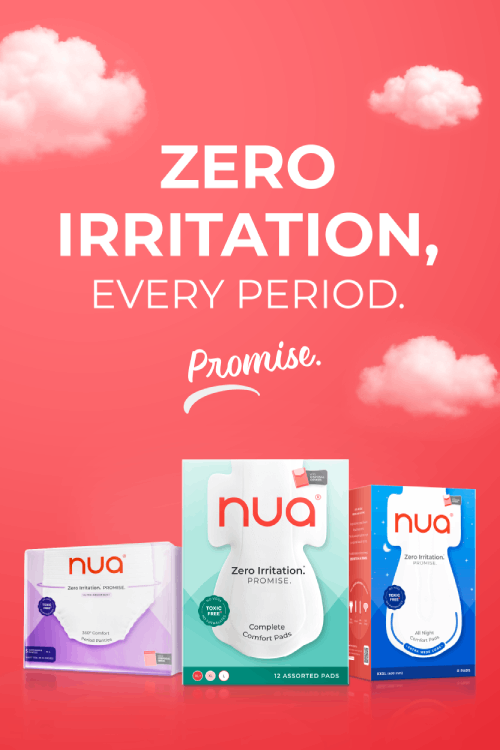
This is where teaching menstrual hygiene comes in. Normalize pads, period panties, and how to stay clean a.k.a. maintain intimate hygiene. Lay out a few pads (preferably Nua’s Complete Comfort Sanitary Pads) . Show her how to use them. Maybe even let her pick a cute pouch to keep in her school bag. Make it feel like a rite of passage, not a medical emergency.
Talk About Periods at Home: Keep It Casual But Keep It Constant
You can’t normalize what you never say out loud. So yes, keep period products in plain sight. Mention your own cycle casually. Let your son hear too. Talking about periods at home shouldn’t be a whispered thing between women. It should be just… normal. Like “pass the salt.”
Use every chance to drop in little moments of education. Watching a movie and a character has cramps? Say it. Buying groceries? Throw in a pack of pads and explain why. These micro-conversations create a home where period talk isn’t taboo, it’s just Tuesday.
Say It Like It Is: No More Code Words
Euphemisms are cute until they’re confusing. It’s not “that time.” It’s a period. Menstruation. Use the words. It takes the sting out of them.
If you’re wondering how to normalize period discussions, start by modelling it. Say things like, “I have my period today, I’m a bit tired,” or “Can you bring me my pads?” Let your kids hear that. Let your daughter know this isn’t some secret club she’s being shoved into.
Bring dads into the chat too. A dad who can buy pads without flinching? Game changer. It shows her that empathy and support don’t come with a gender.
The Key to Making Her First Period Feel Less Scary? Emotional Availability
The first period isn’t just about biology, it’s deeply emotional. She might feel proud, confused, scared, or all three in one day. That’s where you come in.
Preparing your daughter for her first period isn’t just logistics. It’s mindset. Help her see it not as a burden, but a part of her power. Tell her the science, but also tell her she’s strong, capable, and not alone.
This means being emotionally available. Not just, “Here’s how a pad works,” but also, “How are you feeling about all this?” Maybe you write her a note, or build a little first-period kit with her: Nua pads, hand sanitizer, an extra pair of undies, some chocolate, a cute pouch (here’s one with all the essentials she’ll ever need). It’s not just thoughtful, it tells her: “You’re seen, you’re supported, and this is nothing to hide.”
Also, let her know it might not be like the dictionary definition. It could be light, heavy, irregular, painless, awful – every girl’s body is different. And all of it is normal. Give her the freedom to feel whatever she feels, no performance necessary.
Let’s Get You Started…
If you have younger kids, you might wonder how to explain menstruation to kids without it being “too much.” Keep it simple: “Every month, the uterus builds a little nest in case a baby comes. If no baby comes, the nest leaves the body. That’s a period.” That’s it. No shame, no mystery.
They might shrug and move on. Perfect. That means you’re doing it right.
Final Thoughts: You’re Already Doing It Right
There is no perfect script. No one “right way.” But if you’re asking the question, you’re already on the right track.
Talking about periods at home, preparing your daughter for her first period, teaching menstrual hygiene, it’s not one big talk. It’s a lifestyle. It’s making space for her to grow into her body with knowledge instead of fear.
And maybe, years from now, when she’s helping her daughter with her first period, she’ll remember how you made it feel safe. Honest. Uncomplicated.
Like it was always meant to be.