What you will learn about asking anonymous women’s health questions to Nua’s Secret Chat:
- Embarrassment is one of the main reasons women don’t talk about the symptoms they may have around their intimate or sexual health.
- In a study of over 51,000 women, being “too embarrassed” was a top barrier to seeing a doctor about gynaecological warning signs.
- Typing symptoms into a search bar tends to scare you more, not less. Researchers call it cyberchondria: a headache becomes a brain tumour in about four clicks.
- 71% of girls in India reach their first period with no idea what is happening, according to the Dasra “Spot On!” report.
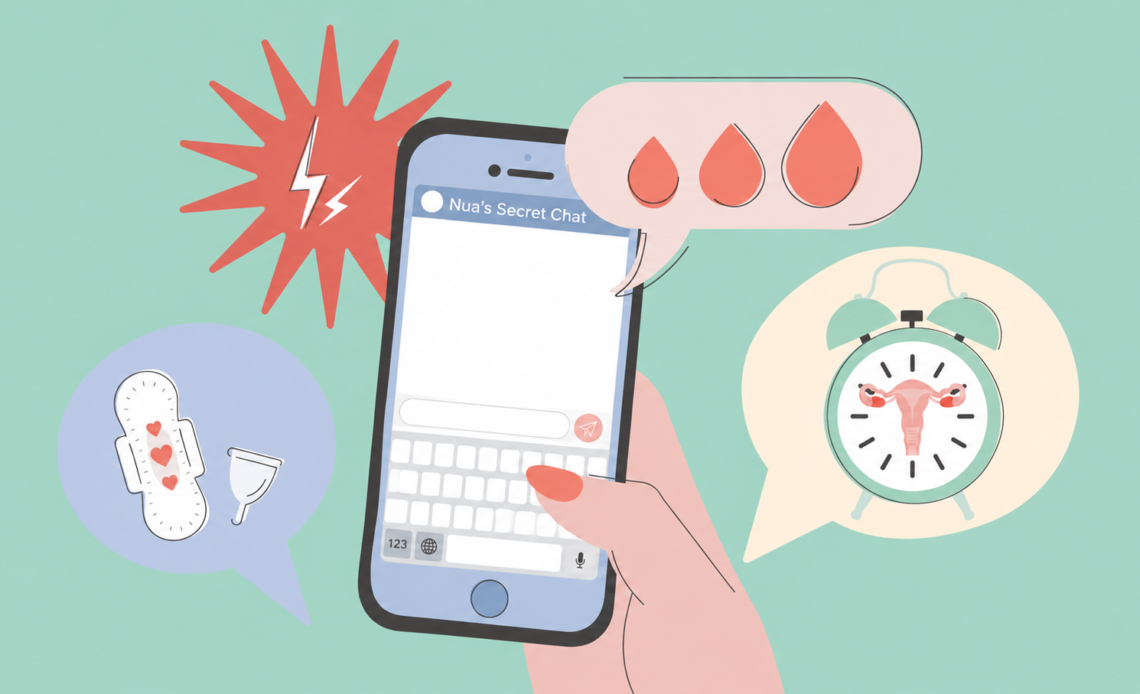
- Nua’s Secret Chat lets you send anonymous women’s health questions and get a real answer from a women’s health expert. No name, no judgement, no lecture.
- Most questions people send are some version of “is this normal?”, and the answer is usually yes, with a reason why.
You know the question. It’s the one you’ve half-typed into a search bar at midnight and deleted, the one you almost asked your gynaecologist before the crowded waiting room talked you out of it. Maybe it’s about a colour, a smell, a missed period, pain during sex, or a lump you’ve quietly been tracking for weeks. You’re not strange for having the question, and you are nowhere near alone in keeping it to yourself. Nua built its Secret Chat for this exact reason, a place to send your most private, slightly terrifying anonymous women’s health questions and get a calm, expert answer back, with your name nowhere in sight.
Why Women Hesitate To Ask Questions About Their Symptoms?
For a lot of us, the embarrassment was installed early. Pads came wrapped in newspaper at the chemist like something illegal. Periods were “chums” or “that time”, anything but the actual word. The Dasra “Spot On!” report found that 71% of girls in India reach their first period with no idea what menstruation even is, so their first lesson about their own body is fear, not biology. When you learn that bleeding is a secret before you learn that it’s normal, you carry that reflex straight into adulthood, and you learn to ask no one.
Blog continues after the ad.
The Biggest Confusion: Where to Ask These Embarrassing Health Questions
1. The Grey Area in Women’s Health
Part of the problem is that the information was never made easy to reach. Bodies that menstruate are wildly varied, and almost nobody teaches you the actual range of normal. A cycle can run anywhere from 21 to 35 days and still be perfectly healthy. Discharge changes texture through the month as oestrogen rises and falls, turning clear and stretchy around ovulation, then thicker afterwards. A heavier flow one month and a lighter one the next is usually nothing abnormal. But “usually” is doing a lot of work in that sentence, and without someone knowledgeable to tell you which side of the line you’re on, every twinge becomes a private guessing game.
2. The Embarrassment
In a Danish study of more than 51,000 women, being too embarrassed was one of the top reasons they didn’t contact a doctor about gynaecological warning signs, right alongside not wanting to waste the doctor’s time. Embarrassment isn’t a trivial little feeling. It changes whether and when you get care, and for some conditions, timing is the whole game. To know how often you should visit your gynaecologist and why, read this blog.
3. The Internet Rabbit Hole
When you don’t ask a person, you ask the internet, and that usually makes things worse. Microsoft researchers Ryen White and Eric Horvitz mapped how people search symptoms and named the pattern cyberchondria, which is when a search engine escalates a common symptom into a rare, frightening diagnosis. A headache becomes a brain tumour. Bloating becomes ovarian cancer. The anxiety then lingers for days and trails you into your next search. You went looking for calm and came back more scared. This is the whole reason a private channel for anonymous women’s health questions is worth having.
There’s a real difference between a search bar that feeds on your panic and a person who wants to settle it. Rather than hand your symptom to Google tonight, you can ask women’s health questions anonymously through Nua’s Secret Chat and get one clear answer instead of forty alarming ones.
Where Can I Ask Period Questions Without Anyone Knowing?
The questions that feel mortifying in your head are almost always the same ones thousands of women are wondering about right now. These anonymous women’s health questions sound dramatic in the dark and turn out to be ordinary to an expert. They’re the kind of anonymous period questions women carry for years before saying them out loud. A few that come up constantly, all worth asking:
- “My period disappeared for two months and I’m not pregnant. Where did it go?” Stress, weight change, thyroid issues, PCOS, and early perimenopause can all pause a cycle, and the cause is usually findable.
- “Is brown blood normal?” Most of the time it’s just older blood leaving slowly. The colour alone rarely means trouble, the context around it does.
- “Sex hurts. Is something wrong with me?” Pain during sex is common and you do not have to accept it. The causes are real and treatable, from simple dryness to conditions like endometriosis or vaginismus.
- “How much discharge is too much, and what does the smell mean?” Discharge is your vagina cleaning itself, and both volume and smell shift across your cycle. A sudden, distinct change is the part actually worth flagging.
- “I’m in my forties and I feel like a stranger in my body. Is this perimenopause?” Quite possibly. The hormone swings before menopause scramble sleep, mood, and cycles, often a full decade before anyone puts a name to it.
If one of those was almost word for word the thing you’ve been Googling, take that as your nudge. Nua’s Secret Chat was built for exactly this, a place to ask period questions anonymously and have your worry met as completely reasonable, because it is.
How to Ask Embarrassing Health Questions Online Without the Cringe
Asking good anonymous women’s health questions can still be intimidating, and a few moves make the answer you get back far more useful. Here’s how to do it well:
- Say the real thing, not the polite version: “Discomfort down there” tells an expert almost nothing. “Itching plus thick white discharge for five days” gets you a real answer. Specifics aren’t embarrassing to a professional, they’re just data.
- Add the boring context: Your age, where you are in your cycle, whether you’re on birth control, and any recent shift in stress, sleep, or weight. This is often what turns a guess into an actual answer.
- Pin down time and pattern: “Three days” and “three months” point to completely different things. Note when it started, whether it’s getting worse, and what makes it better or worse.
- Ask the scary follow-up out loud: The “should I be worried this is something serious?” part is usually the thing you most want answered, so put it in. This is also how to talk about embarrassing period symptoms safely, by naming the fear instead of circling it.
- Use a space that’s actually private: The reason you can be this honest is anonymity, with no name, no profile, and no trail leading back to you. That privacy is the entire point of a tool like this.
You now know how to ask better than most people ever bother to learn. The only step left is to actually send it, and Nua’s secret chat for intimate health gives you a private, no-trace place to put all that detail and get a thorough answer in return.
Confidential Women’s Wellness Advice, Without the Judgement
The dread before asking is rarely about the answer. It’s about the face you imagine the other person making. Here’s what a good answer to your anonymous women’s health questions gives you instead:
- No judgement: Nobody asks why you waited, why you didn’t know, or what you were thinking. The question is taken exactly as you asked it.
- No lecture: You won’t be moralised at about your body, your choices, or your partner. You asked one thing, you get the answer to that thing.
- Plain language: Real explanations rather than a wall of jargon to decode later, because the goal is for you to actually understand your own body.
- Anonymous Reproductive Health Advice that’s grounded in evidence, not myth, not what a relative swears by, and not a forum stranger’s hunch.
- Comfort where it’s warranted, and a clear, calm “this one is worth seeing a doctor about” where that’s warranted instead. Both of those are genuinely useful.
That blend of evidence and warmth is what separates a trusted platform for women’s reproductive health questions from a comment thread full of people guessing.
Picture asking the single most embarrassing question you’ve got and getting none of the reaction you’ve been dreading. That’s the whole experience Nua’s Secret Chat is built around, a real safe space for intimate health questions where the only thing you get back is care and a straight answer.
Your Body Isn’t a Secret You Have to Keep
Every question you’ve been too embarrassed to ask is really a question about one thing: understanding the body you actually live in. That isn’t silly or small. It’s the base layer under every decision you’ll ever make about your health, and you deserve to make those calls with real information instead of fear and half-remembered myths.
An anonymous women’s health chat removes the one thing that actually stops most women, which is the fear of being seen asking. Take that away and the questions come easily. You stop rehearsing the phrasing, stop worrying who might overhear, and just ask. Behind Nua’s Secret Chat there’s a growing Nua women’s health anonymous community of women doing the same quiet thing, getting answers they were once too scared to even search for.
FAQs
1. What is Nua’s Secret Chat?
Nua’s Secret Chat is a private space where you can ask anonymous women’s health questions and receive clear, expert guidance without sharing your name.
2. Why are women often embarrassed to ask about intimate health symptoms?
Many women grow up with shame and misinformation around periods, discharge, sex, and reproductive health. This embarrassment can stop them from asking questions or seeking medical care when they need it.
3. What kinds of women’s health questions can you ask anonymously?
You can ask about missed periods, period blood colour, discharge, vaginal odour, pain during sex, perimenopause, or any other intimate health concern that you may feel uncomfortable discussing openly.
4. Is it better to ask an expert than search symptoms online?
Yes. Searching symptoms online can increase anxiety and lead to frightening conclusions, a pattern known as cyberchondria. An expert can provide context, explain what may be normal, and suggest when medical care is needed.
5. Is Nua’s Secret Chat a replacement for seeing a doctor?
No. It can help you understand your symptoms and decide what to do next, but it does not replace professional diagnosis or treatment. Consult a qualified healthcare professional if symptoms are unusual, severe, or persistent.
Disclaimer
The content of this article is provided for general informational and educational purposes only and is not intended to constitute medical advice, diagnosis, or treatment. The information shared is of a general nature and may not be appropriate for all individuals or specific circumstances. Readers should not disregard, delay, or substitute professional medical advice based on the information contained herein.
If you experience any symptoms, notice anything unusual, or have concerns relating to your health or overall wellbeing, you should consult a qualified healthcare professional. While every effort is made to ensure the information shared is accurate and up-to-date, Nua makes no representations or warranties, express or implied, regarding the accuracy, completeness, or suitability of the information provided and disclaims all liability arising from reliance on this content to the fullest extent permitted by law.