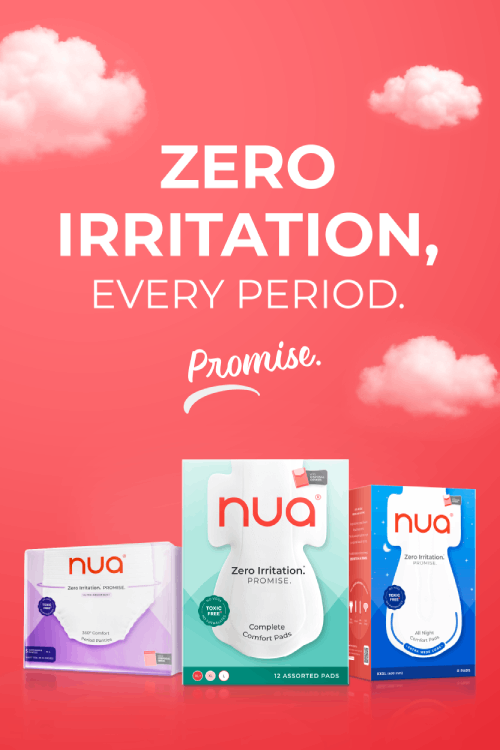
At Nua, zero irritation pads are not a new goal, they’ve always been the standard. The Zero Irritation Promise simply makes that commitment public. For years, Nua’s products have been quietly solving real problems women face during their periods. Now, we’re just getting better at telling our story (more on how we got started here), and that includes talking openly about how our products are (and have always been) made.
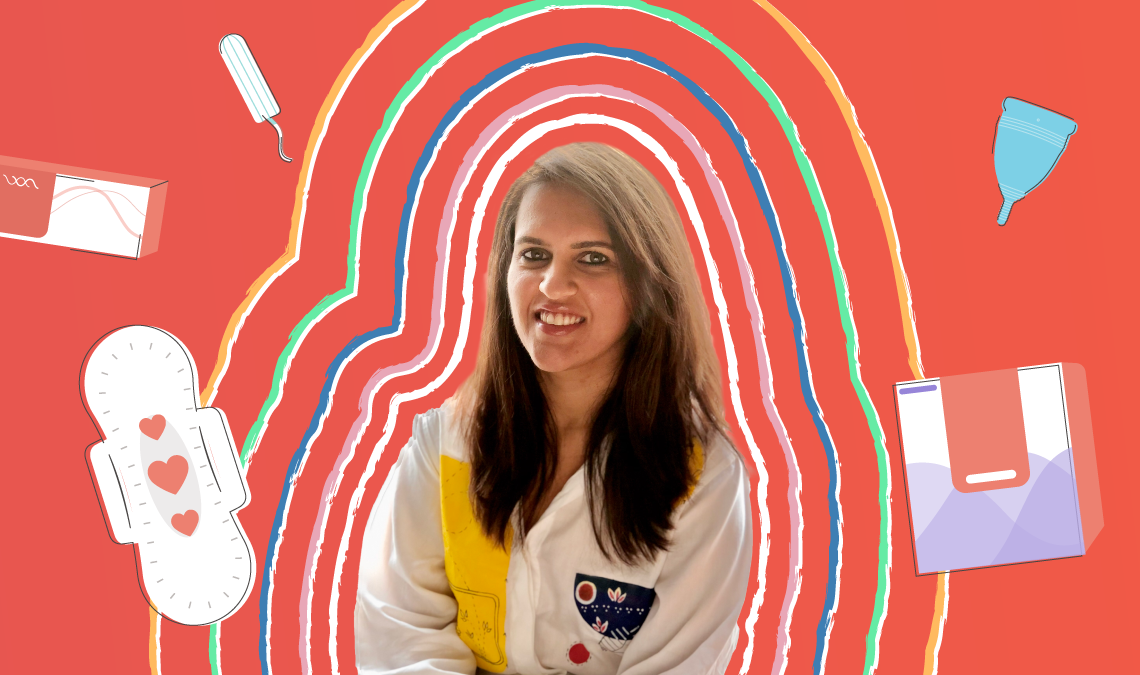
To understand what it takes to deliver on this promise across product categories, we spoke to Saloni Mayekar, who leads Product Development at Nua and plays a pivotal role at the intersection of product development, user insight, and brand purpose. From eliminating hidden irritants to resisting popular but unproven trends, Saloni walks us through how purpose truly meets product. Her insights what it takes to stay honest and accountable while creating something that’s meant to disappear into a woman’s life.
Q1. Were you part of shaping the Zero Irritation Promise, or did it come to you as a brief from marketing?
This was a bit unique. Usually, the proposition comes first, and the product is built around it. But for us, the product came first. We were already ‘rash-free’, and to be honest, that came from a very real insight — you’re already dealing with cramps, mood swings, blood — your pad shouldn’t be another thing that restricts you. Pads that didn’t chafe, didn’t feel plasticky, didn’t add to the list of things you’re already dealing with on your period, that’s what Nua was already designing.
So when the marketing team proposed ‘Zero Irritation’ as the new proposition, it clicked immediately. Because it wasn’t some aspirational claim. It was just the truth. We had already addressed some of the most common irritants women experience during their period—rashes, chafing, discomfort—and designed zero irritation pads that removed those issues from the equation.
To me, it wasn’t a shift in how we develop products. It was just a shift in how we tell our story.
Q2: How do you actually develop products that meet something as layered and emotional as ‘Zero Irritation’?
We start with problems. Specifically, what’s irritating people today? That’s the entry point to all our consumer feedback for menstrual products (find it here). If women were totally happy with what they were using, we wouldn’t need to exist.
Once we identify the irritants — rashes, chafing, discomfort, leakage, inconvenience — we work backward from there. We evaluate every element: the top sheet material, adhesives, chemicals, design fit. It’s not just about what’s in the zero irritation pad, but how it performs when you move, when it’s hot, when you wear tight clothes, when you sleep. It needs to work seamlessly.
For example, we made the back of the pad wider. Why? Because many Indian women tend to have heavier bottoms, and this directly reduces the chance of leakage. It’s a cultural and anatomical insight that wasn’t reflected in most existing pads.
We also added disposable covers. It’s such a small thing, but when you consider that most Indian bathrooms don’t have toilet paper or disposal bins inside, it becomes a huge source of irritation. For years, women were wrapping pads in newspaper or plastic bags, improvising solutions. We just eliminated that step.
Even our subscription service ensures no woman is left in a lurch when she gets her period, scrambling to find a pad, or having to run to the store to get one, or asking someone to go and get one. That’s also irritating when you’ve just got your period.
These aren’t product or brand features, they’re acts of respect.

Q3: How important is user feedback in driving innovation?
It’s crucial, and we use it at two stages. First, to identify existing problems. Then, to validate that we’ve solved them.
Before building our zero irritation pads, we interviewed users of other brands. One woman said she avoided going to the mall with friends during her period because she didn’t want to use public washrooms to change her pad. That stuck with us. The core issue was that the pad felt full quickly and needed frequent changes, a low absorption-to-volume ratio.
We made a pad with higher absorption that didn’t feel soggy or require constant changes. Later, that same user said she finally went to the mall with confidence. That’s how you know your menstrual hygiene product design has worked. It changes behaviour.
But users won’t always spell out the solution. They’ll tell you their feelings, their workarounds, their compromises. You have to connect the dots. That’s what makes this process both difficult and rewarding.
Q4: Can you share some examples of unexpected irritants you discovered and solved for?
One example is our Cramp Comfort Patches. The idea came from a colleague who suffered severe cramps and was taking 3-4 painkillers a day. We know painkillers only block pain receptors, they don’t address the source of the pain. So, we decided to explore pain relief options and found that heat is the only thing scientifically proven to relax the uterine muscles.
However, hot water bags are bulky, and heating pads need electricity. So we designed a patch that could be worn under clothing, that targets the pelvic area, and that retains heat for 8 hours.
That’s what zero irritation promise products mean: innovating for relief AND convenience.
We look at even the smallest of irritants. Recently we looked at the tamper-proof stickers on our sanitary pad packs. They were meant to secure the product, but the glue would cure so strongly that women had to tear open the pack. Having to tear open the pack is one more irritating thing to deal with when you already have cramps, bloating, and stress. So we replaced the glue used for that tiny circular sticker. A two-centimetre detail. That’s the level we operate at.
Q5: Have you had to resist popular trends to stay true to creating Zero Irritation Pads?
Yes, definitely. One big trend we deliberately avoided is the rise of so-called “organic” cotton pads. The word ‘organic’ sounds healthy, but in period care product innovation, it’s incredibly misleading.
Cotton that’s grown organically is yellow, rough, and too absorbent. It has to go through bleaching, softening, and numerous chemical treatments to be usable in pads. Plus, untreated cotton is a breeding ground for bacteria and fungus. So, you have to also treat it to make sure none of these things grow on it. In the end, it may end up containing as many chemicals as a plastic pad, sometimes more. Exposing your most delicate skin to these chemicals would cause irritation. So while the cotton itself may be organic, using it in a sanitary pad may not necessarily be safer or more skin-friendly. So, we prioritize the health of the women we’re developing our products for.
It’s not about what’s trending. It’s about what’s right.
Q6: What’s the working relationship like between the product and marketing teams?
We collaborate closely, but yes, there are tensions. The biggest one is cost. Marketing wants to price affordably to free up budget for awareness campaigns. Product wants to invest in quality and performance. But we always meet at one clear mandate: we will not compromise on product quality.
Marketing may push for bold claims. Our job is to ground those in reality. If they want to call something “the safest pad” or “most effective,” we explain the testing required, the costs involved, and what’s scientifically provable. We won’t make misleading claims, even if it sounds great in an ad.
That’s why we say we co-create. The sanitary pad innovation process isn’t separate from the storytelling. We build it together.
Q7: What impact does the Zero Irritation Promise have on future product development?
It raises the bar for everything. We were already doing this, but now that it’s out there publicly, we’re more conscious than ever. Every decision, from formulation to packaging, now goes through this filter: does it eliminate or reduce irritation?
Even something as small as how easy it is to open a box, how intuitively someone can store or carry it, or how discreetly they can dispose of it. It all matters. Packaging glue. Product shape. Delivery logistics. We look at the entire journey: from the moment someone realizes they need a product, to the moment they throw it away.
For new categories like skincare or wellness, the same applies. We ask: what is the woman going through? What friction can we remove from her day? Our commitment isn’t just about zero irritation pads. It’s about every moment in the vital wellness journey.
Q8: On a personal level, how do you feel about the Zero Irritation Promise?
I feel like it’s about time. It’s about time someone really thought about the nuances of a woman’s life. So much thought has gone into making men’s lives easier across products, industries, and services. Finally, someone is paying attention to women.
I don’t give us too much credit for doing this because it was long overdue. What I do appreciate is that we’ve said it out loud, and we stand by it. We’re trying our best to live up to it. There are so many irritations, and while we may not be able to solve every one, we are looking at the important ones. At least in period wellness, someone is addressing the full picture now.
—
Nua’s Zero Irritation Promise is more than a tagline, it’s a product development philosophy. Research shows that 85% of women reported period discomfort beyond cramps. Through thoughtful design, deep empathy, and data-driven decisions, we’re building menstrual hygiene product designs that eliminate compromises women have quietly made for generations.
Whether it’s the discomfort of poor absorption, the frustration of inadequate disposal, or the pressure of conforming to unsuited trends, Nua is working to make those irritants disappear. And we do it because women deserve better.
As Saloni sums it up: “It’s about time someone thought about the nuances of a woman’s life. We’re just doing what should have been done long ago.”