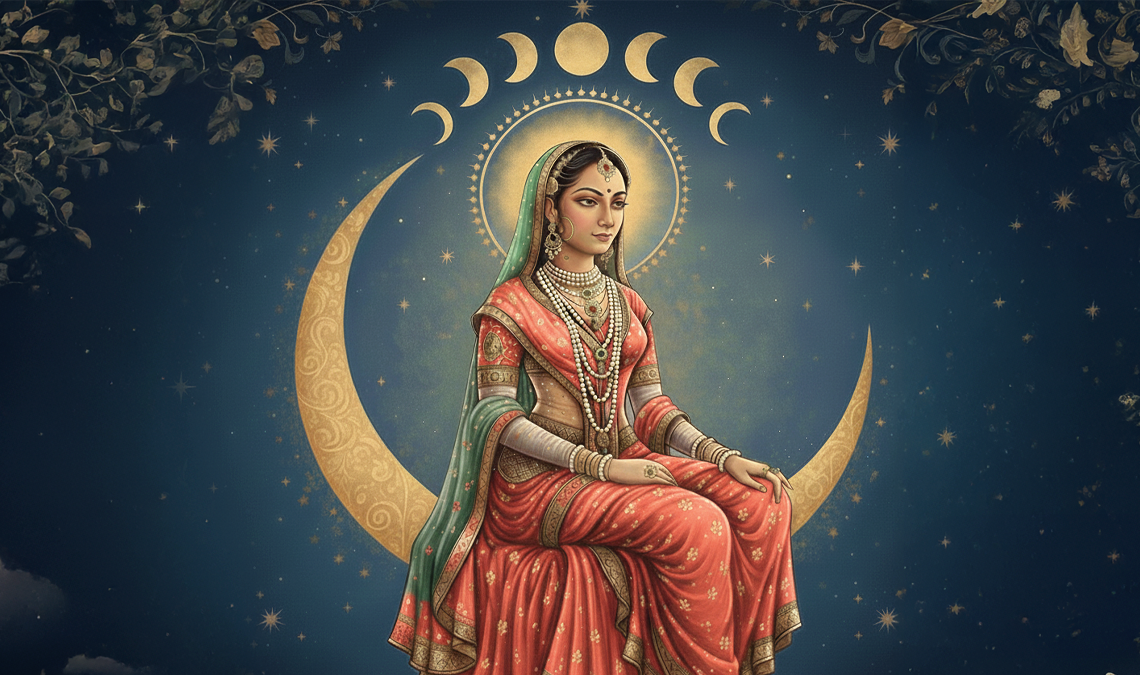
You’ve probably heard it before, someone casually mentioning their cycle lining up with the moon, or that if your period synced with the moon phases, it might mean something about your energy or hormones. It’s one of those things that circulates on Instagram reels or may come up on a group chat as a reply to, “Why am I not getting my period?”. It’s half science, half mystery. The moon phases and the menstrual cycle both hover around 29 days, and that similarity feeds into the mystery, is that a coincidence or something deeper? Are our bodies still listening to a rhythm older than civilization?
Let’s unpack what it might actually mean when your period is synced with the moon and why this idea has persisted through history, biology, and women’s intuition.
The Science Behind the Moon-Menstruation Connection
It comes down to one hormone, Melatonin. Produced by the pineal gland at night when it’s dark, melatonin tells your body it’s time to rest and helps regulate both sleep and hormone balance. As melatonin rises, it signals the brain to adjust reproductive hormones like GnRH, FSH, and LH, the ones that control ovulation. Too much light at night can lower melatonin, which may shift or delay ovulation and make cycles irregular. In short, melatonin works as the body’s internal clock, linking light, rest, and reproductive rhythm. When we stay up late under bright lights, we throw that timing off, which can ripple through the entire menstrual cycle.
Historically, women living closely with nature, without artificial light disrupting circadian rhythms, were more likely to have a lunar cycle period that matched the natural rhythm of the moon, our primary source of light.
When nights were dark during a new moon, women’s bodies might have produced more melatonin, which delayed ovulation slightly, nudging cycles to match the moon’s rhythm. Studies have shown that light exposure at night can suppress melatonin, shifting ovulation timing and shortening or lengthening the cycle length, showing just how sensitive our hormonal balance is to light.
The Modern Reality: Why Many of Us Are Out of Sync
Here’s the catch. Our bodies evolved in natural light cycles, but our lives are now drenched in screens, streetlights, and irregular sleep. We stay up past midnight, bingeing shows, bathed in blue light that tells our brains it’s still daytime. That’s one reason many people’s lunar cycle periods no longer align with the moon.
But the body still remembers. So even if you don’t have a perfect moon period sync, the lunar fertility effect may still be gently tugging at your biology, influencing when you ovulate, how you feel, and how your body restores balance each month.
What Science Says (and Doesn’t Say) About Modern Periods Syncing with the Moon
Well, it says that the moon might have a quiet influence — not enough to dictate your cycle, but enough to nudge it sometimes.
A huge 2024 study that tracked millions of menstrual cycles found a clear weekly rhythm to period start dates (most often Thursdays and Fridays) and a much smaller lunar rhythm layered underneath. In other words, daily life routines and light exposure seem to shape us more than the moon does. Still, that faint lunar pattern is there, just harder to spot in modern life.
Other research has noticed that women whose cycles are close to 29 or 30 days occasionally sync with new or full moons, or even with the moon’s gravitational pull when it’s closest or farthest from Earth. This temporary moon period sync shows up most often in winter, when nights are darker and longer, and fades as we age or spend more time surrounded by artificial light. That makes sense when you consider how light affects melatonin. Less darkness means less melatonin, and that can shift ovulation timing.
Some classic experiments give this idea more grounding. In one older study, women with long, irregular cycles slept near a bright lamp for a few nights mid-cycle. Their periods shortened and became more regular, suggesting light can tweak hormonal rhythms. Other studies on light therapy show that the timing and type of light (morning versus evening) matter too. It’s not proof of mystical lunar control, but it does hint at a lunar fertility effect, where natural darkness and moonlight subtly shape the body’s timing.
So if your lunar cycle period sometimes lines up with the moon, that’s valid, and if it doesn’t, that’s fine too. The moon’s pull seems to vary from person to person and gets drowned out by modern lighting, sleep habits, and stress. Think of it less as a rule of nature and more as a gentle rhythm some bodies still tune into.
Okay, now that the science is covered, let’s get into the mythical a little.
The Ancient Connection Between Women and the Moon
For centuries, women tracked their menstrual cycles by the moon phases. Before clocks or apps, the night sky was the ultimate calendar. The new moon represented renewal (dark, quiet, a time of introspection), while the full moon was symbolic of brightness, fertility, and fullness. According to research, many ancient cultures believed that bleeding with the new moon meant your body was in a natural cycle of rest and inward energy, while bleeding with the full moon represented outward creativity and connection.
What It Means If You Bleed with the New Moon
If your period is synced with the new moon, you might find your energy feels low and reflective during menstruation, almost as if your body is in sync with that inward lunar energy. Traditionally, this phase was called the “white moon cycle,” associated with fertility, cleansing, and renewal. Women in this rhythm were thought to embody nurturing energy, turning inward to rest and recharge before a new cycle of growth.
Psychologically, it often corresponds to emotional introspection and heightened intuition. It’s the body’s natural way of saying: pause, reset, listen.
What It Means If You Bleed with the Full Moon
Bleeding with the full moon? That’s known as the “red moon cycle,” historically linked to women who were healers, teachers, or creative forces in their communities. Instead of withdrawing inward, they were believed to channel their menstrual energy outward, toward creation, wisdom, and connection.
From a physiological perspective, it doesn’t make you any more or less fertile, but it does highlight how your rhythm can mirror different energetic phases. A moon period sync during the full moon can feel powerful, expansive, and expressive. Your hormones might influence mood and creativity in unique ways, some studies suggest estrogen levels right before bleeding can heighten emotional sensitivity and intuition, almost amplifying that lunar charge.
Even if your period doesn’t follow the moon exactly, you might notice subtle patterns like feeling emotional or restless around a full moon, or introspective during the new moon. These shifts aren’t imaginary. Studies have shown that sleep quality and melatonin production can dip around a full moon, influencing hormones like progesterone and serotonin, which in turn affect mood and cycle regulation.
Blog continues after the ad.

How to Track and Reconnect with Your Lunar Rhythm
You don’t need to be a mystic to connect with the moon, just curious. Try this:
- Track both cycles: Note your period start date (these will help) and the moon phase. You can use a journal or an app that includes lunar data. Over time, patterns might surprise you.
- Sync your lifestyle with your phase: During your bleed (new moon energy), rest more. Around ovulation (full moon energy), plan creative or social projects. You’ll start noticing how each phase supports different parts of your life.
- Minimize artificial light at night: Especially during your luteal and menstrual phases. Darkness supports melatonin, which influences both sleep and hormonal balance.
The goal isn’t to force a moon phases menstrual cycle alignment. It’s to honour the rhythm that’s already there.
What If Your Cycle Doesn’t Match the Moon at All?
That’s totally normal. There’s no “right” way to bleed. Your cycle reflects your unique biology, lifestyle, and emotional landscape. Some people naturally fall into a lunar cycle period, others don’t, and both are valid. What matters is awareness.
The moon connection is less about perfection and more about perspective. When you start noticing how your energy rises and falls, how your emotions shift, and how your body communicates, you begin to live cyclically, not linearly. You start respecting the natural ebb and flow within you (more on this here).
The Real Magic of the Moon
So is your period synced with the moon because of some mysterious cosmic pull? Maybe. Or maybe it’s because your body is part of nature, not separate from it. You are made of water, light, and cycles, just like the moon. Whether your bleed aligns perfectly with the new moon, the full moon, or somewhere in between, what matters is that you’re paying attention.
When you live in tune with your rhythms—not just your period, but your energy, emotions, and rest cycles—you start experiencing your body as an ally, not an inconvenience. And that’s the real lunar magic.