
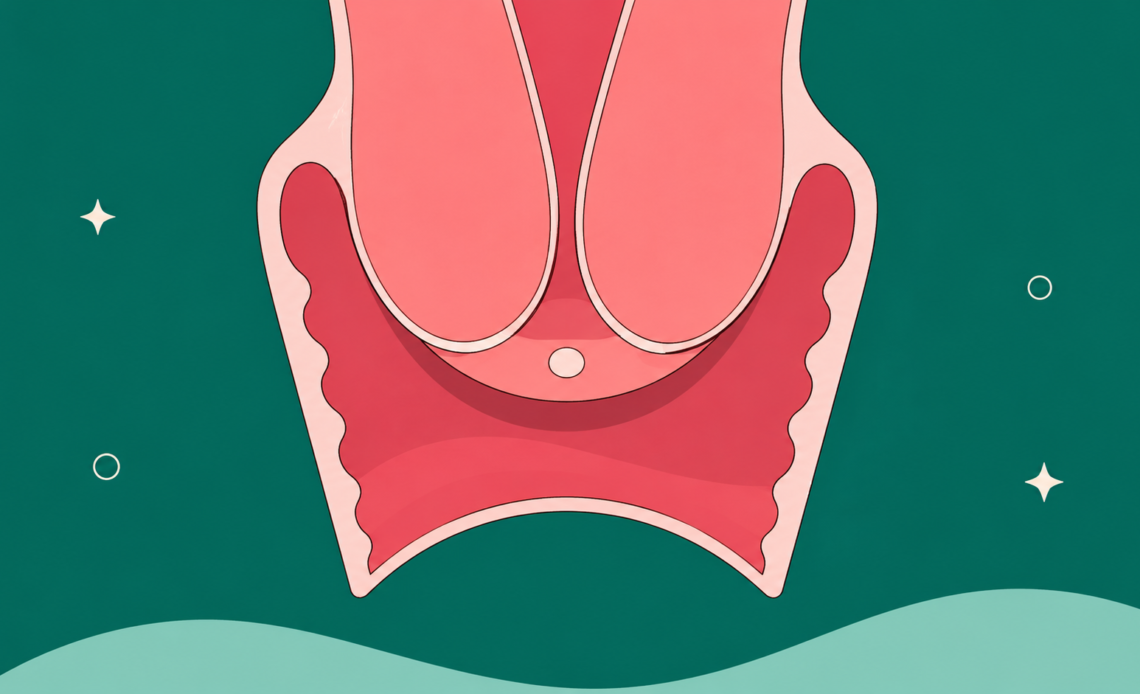
Your cervix is keeping a record of your whole cycle, and most of us were never taught to read it. Most of don’t even know what or where our cervix is! Shifts in cervix position during the menstrual cycle phases from low to high and from firm to soft across the month, and those changes are not random. They track your hormones almost in real time. Learning to read them turns a confusing corner of your body into honest information about your reproductive health.
What you will learn about cervix position from this blog:
- During your period and the days just after, your cervix sits low and feels firm, a little like the tip of your nose.
- As ovulation approaches, rising estrogen pulls it higher, softens it, and opens the tiny os (the donut-shaped opening at both ends of the cervix).
- Right after ovulation it drops back down, firms up, and closes again.
- These shifts are driven by hormone fluctuations, mainly estrogen climbing before ovulation and progesterone taking over after.
- Checking is simple and helps you track ovulation, choose the right menstrual products, and monitor your reproductive health.
What Is The Cervix?
Your cervix is the firm, donut-shaped lower end of your uterus that opens into the top of your vagina. Picture a small, muscular gateway with a tiny opening called the os. That opening is what lets period blood out, lets sperm in, and seals shut for nine months if you are pregnant. The cervix is one of the quietest but busiest players in your reproductive health, and the part you can actually reach with a finger feels a bit like the tip of your nose when it is firm.
None of this is fixed, though.
The same cervix can feel completely different from one week to the next, which is exactly what makes it worth paying attention to.
What Is Cervix Position, And Why Should You Care?
Cervix position simply means how high or low your cervix is sitting, plus how firm or soft and how open or closed it feels on a given day. It matters because that position indicates what exactly is happening in your cycle. It tracks your cycle so closely that, with a little practice, you can roughly tell where you are just by checking.
Blog continues after the ad.

People use it for fertility awareness, for spotting their fertile window, and for understanding menstrual health patterns. Your cervix is narrating your cycle in real time, you just have to learn its language.
Why Does Your Cervix Feel Different At Different Times?
In one word, hormones. Your cervix answers to the same hormone fluctuations that drive the rest of your cycle, mainly estrogen and progesterone.
As estrogen climbs through the first half of your cycle, it lifts the cervix higher, relaxes the tissue so it feels softer, and eases the os open to welcome sperm. According to women’s health resources like Clue, the cervix changes during the menstrual cycle so predictably that fertility educators read these shifts as a sign of where your estrogen sits.
After ovulation, progesterone takes over and reverses all of it, firming the tissue and dropping the cervix back down within a day or two. So your cervix position is basically a live readout of which hormone is currently in charge, which is why your cervix position during the menstrual cycle is never one fixed thing, it is a moving picture.
Reading those shifts gets so much easier when you already know which phase you are standing in. If you want the context behind every change, Nua’s Period Tracker maps your cycle phase day by day, so a soft, high cervix instantly makes sense instead of leaving you guessing.
Your Cervix Position During the Menstrual Cycle
Here is how your cervix moves through a typical cycle, counting from the first day of your period.
During your period: Low, firm, and slightly open to let blood pass. Easy to reach.
Just after your period: Still low and firm, but now closed and on the drier side.
The days before ovulation: Rising, softening, and starting to open as estrogen peaks.
Ovulation: At its highest, softest, and most open, sometimes almost too high to reach.
After ovulation: Your cervix position after ovulation drops fast and firms up again within a day or two as progesterone kicks in.
The luteal stretch: Your cervix during luteal phase stays low, firm, and closed, holding steady until your next period.
That whole arc only becomes useful information once you can watch it repeat, month after month. Logging where you are next to what you feel is where it clicks, and tracking your cycle with Nua turns scattered daily checks into a pattern you can actually trust.
High Vs. Low Cervix, Soft Vs Firm: What Each One Means
The four words people get stuck on, high, low, soft, and firm, are really just two sliders, height and texture. Here is the plain-English version of high vs. low cervix and soft versus firm.
What is a high cervix?
Your cervix has lifted deep enough that your finger has to reach further, which usually happens around ovulation. It signals high estrogen and peak fertility.
What is a low cervix?
Your cervix sits closer to the vaginal opening and is easy to touch, which is typical during your period and the days right after. It signals lower fertility.
What is a soft cervix?
The tissue gives a little, closer to your lips than your nose, which happens as ovulation approaches.
What is a firm cervix?
The tissue feels solid, like the tip of your nose, which is the default setting for most of your cycle outside the fertile window.
The fertile combination to recognize is high plus soft plus open.
The non-fertile one is low plus firm plus closed.
Almost everything you feel is some version of those two states in transition.
Telling soft from firm takes a few cycles of practice, and practice sticks better when every check has somewhere to live. You can note today’s height, texture, and openness in seconds with Nua’s Tracker, so by next month your own normal is obvious at a glance.
So What Does Knowing Your Cervix Position Actually Change?
Quite a lot, because a sign you can read is a sign you can act on. On its own, cervix position is just a sensation. Paired with the rest of your cycle, it turns into information you can use, in ways that show up in real life.
- You can time the fertile window with more confidence: If you are trying to conceive, a high, soft, open cervix flags your best few days, which is exactly when timing matters most. If you are avoiding pregnancy, the same signal marks the days that call for more caution.
- You can confirm ovulation instead of guessing: When your cervix drops and firms right as your temperature rises, that agreement is far more convincing than any single clue, which is the whole logic behind ovulation tracking.
- You can make sense of an irregular cycle: Calendar math falls apart when your periods are unpredictable, but your cervix still answers to your hormones in real time, so it gives you a live read on days when dates cannot.
- You can finally explain why some days feel different: That deeper, harder-to-reach feeling mid-cycle, or why sex or a pelvic exam feels different at certain points, often traces straight back to where your cervix is sitting that day.
- You build a personal baseline worth having: Once you know your own normal, anything off, like a persistent change or unexpected pain, stands out sooner, which is genuinely useful to flag to a doctor and a quiet win for your reproductive health.
None of this needs a lab or a subscription. It is your own body handing you a usable signal, for free, every single day. That is what makes cervix position worth learning, it turns vague awareness into real choices about your menstrual health and your fertility.
How To Check Your Cervix Position, Step By Step
How to check cervix position is genuinely simple, and once you know what to feel for, checking your cervix position takes under a minute. This is also the most reliable way to learn how to track cervix position naturally, with no device required.
- Wash your hands well. Clean, short nails matter here.
- Pick a consistent time of day, ideally not right after a bath or a workout, because both can temporarily shift things.
- Get into the same position every time, like one foot up on the edge of the tub, or a gentle squat. Position changes the reading, so consistency is everything.
- Slide one or two fingers in until you feel your cervix. It is the firmer, rounded spot at the far end.
- Notice three things, how far you had to reach for height, how the surface feels for soft or firm, and whether the os feels open or closed.
- Write it down the same day, before you forget. Patterns only show up when you log honestly.
- Repeat daily for at least one full cycle before you draw conclusions. One reading means little, a month of readings tells a story.
Can Cervix Position Alone Tell You When You Are Fertile?
Honestly, no, not on its own. Cervix position is a strong supporting sign, but it works best as part of a fuller picture. Researchers who study fertility awareness based methods treat the cervix as one biomarker among several, sitting alongside cervical mucus, basal body temperature, and cycle dates. Large systematic reviews of these methods make the same case, that combining several signs beats leaning on any single one.
A cold, a rough night of sleep, stress, or simply checking in a different position can all skew what you feel, so for real ovulation tracking you want the cervix cross-checked against at least one other sign. Used that way, your cervix position genuinely strengthens your fertility picture, whether your goal is to conceive, to avoid pregnancy, or simply to stop being surprised by your own body.
Bringing those signs together is the whole point, and it feels a lot lighter when they share one screen. Whether you are trying to conceive or just done guessing, Nua’s Period Tracker lets your cervix readings, mucus, and dates build one clear story instead of living in separate notes.
The Takeaway
Your cervix is not a mystery, it is a messenger.
Learning to read your cervix position turns a vague sense of where you are in your cycle into something specific and genuinely useful, for fertility awareness, for menstrual health, for reproductive health, and for plain confidence in your own body. Start small.
Check once a day, write it down, and give it a full cycle before you expect the pattern to speak. Your body has been keeping these notes all along, you are finally just reading them back.
FAQs
1. Does cervix position during the menstrual cycle change?
Yes. Your cervix naturally shifts throughout your cycle in response to hormonal changes. It is usually low, firm, and slightly open during your period, rises and softens as ovulation approaches, and then becomes lower, firmer, and closed after ovulation.
2. What does a high, soft cervix mean?
A high, soft cervix usually occurs as ovulation approaches. Rising estrogen causes the cervix to move higher, become softer, and open slightly, making this combination one of the signs associated with the fertile window.
3. What does a low, firm cervix mean?
A low, firm cervix is more commonly felt during your period, just after your period, and after ovulation. It generally indicates that you are outside your most fertile days.
4. Can you check your cervix position yourself?
Yes. With clean hands and short nails, you can gently insert one or two fingers into your vagina until you feel the rounded, firmer area at the far end. You can then note how high or low it feels, whether it is soft or firm, and whether the opening feels open or closed.
5. Can cervix position tell you when you are fertile?
Cervix position can be a useful sign of fertility, but it should not be used on its own to determine when you are fertile. It is more reliable when combined with other fertility signs, such as cervical mucus, basal body temperature, and cycle timing.
Disclaimer
The content of this article is provided for general informational and educational purposes only and is not intended to constitute medical advice, diagnosis, or treatment. The information shared is of a general nature and may not be appropriate for all individuals or specific circumstances. Readers should not disregard, delay, or substitute professional medical advice based on the information contained herein.
If you experience any symptoms, notice anything unusual, or have concerns relating to your health or overall wellbeing, you should consult a qualified healthcare professional. While every effort is made to ensure the information shared is accurate and up-to-date, Nua makes no representations or warranties, express or implied, regarding the accuracy, completeness, or suitability of the information provided and disclaims all liability arising from reliance on this content to the fullest extent permitted by law.