
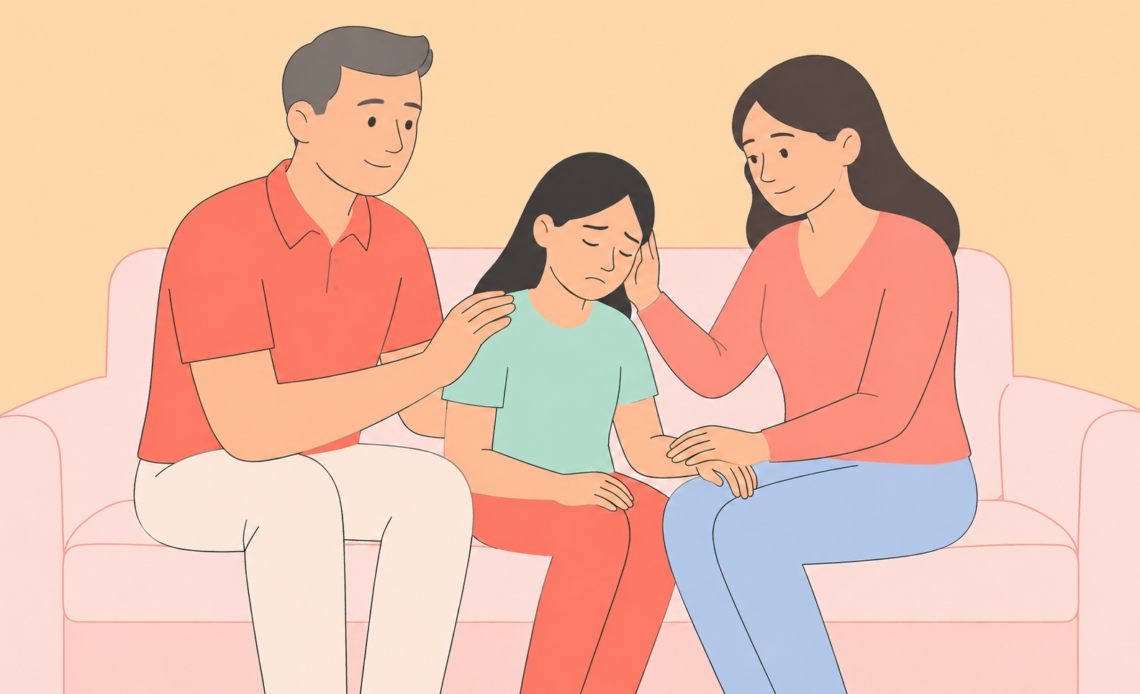
What you’ll learn about preparing for your daughter’s first period from this guide:
- Fathers shape how a daughter experiences her first period, even if they aren’t there when it happens.
- Menarche is usually preceded by physical signs that both parents can learn to recognise.
- A dad doesn’t need to be an expert, just calm, supportive, and present.
- Regular, everyday conversations about periods work better than one big talk.
- Feeling prepared and supported helps build confidence during her first period.
First, why should fathers be prepared for their daughter’s first period?
A father’s reaction to his daughter’s first period can shape how she feels about her body, menstruation, and asking for support for years to come. Being prepared doesn’t mean becoming a period expert, it means knowing what to expect, responding with calmness, and helping create an environment where she feels supported instead of embarrassed.
Nobody sits a father down and explains what to do when his daughter’s first period arrives. Moms get warned, girls get the “talk”, but dads? Nothing. They usually find out after the fact, awkward and underprepared. And that gap, that little silence in the room, matters more than we think.
Because daughters are watching how the men in their lives react to their bodies. A dad who handles this moment with warmth rather than discomfort is teaching her that she doesn’t have to be ashamed. That’s a big deal.
So if you’re a mom wondering how to loop your husband in, this one is for you.
What Is Menarche, and Why Does a Father’s Reaction Actually Matter?
Menarche is the medical term for a girl’s very first period, and it marks the start of her reproductive years. According to the Cleaveland Clinic, it typically happens between ages 11 and 14, and it’s driven by a hormonal cascade, specifically rising estrogen levels that develop the uterine lining. But the science isn’t really what makes this moment loaded. The emotion around it is.
Research in adolescent psychology consistently shows that a father’s response to puberty-related events shapes how a girl internalizes her own body image. If dad goes quiet, or visibly uncomfortable, she clocks that. She learns that this part of her is something to hide, even from the people who love her most. But if he stays calm, maybe even cracks a joke and buys her chocolate, she learns something much healthier.
Blog continues after the ad.

The study also shows that while fathers recognize the importance of talking about body image with their daughters, many don’t feel confident or competent to do so effectively. So talking to your husband and preparing for your daughter’s first period is not just a logistical task. It’s an emotional one, and your husband is a key player in it.
She deserves to feel held, not just helped, when this moment comes.
Built for the first time, and every time after, Nua’s Teen Comfort Pack was made so she has everything she needs for this phase of her life.
What Are the Signs of a Girl’s First Period That Dads Should Know About?
Signs of a girl’s first period usually show up weeks or even months before it actually happens. Here’s what to flag for your husband so he isn’t blindsided:
- Breast development starts around ages 8-13 and is one of the earliest signs. Period usually follows about 2-3 years after breast buds appear.
- Pubic and underarm hair growth signals that estrogen is doing its thing. This typically means a period is 6-12 months away.
- Vaginal discharge, usually clear or white, often starts 6-12 months before menarche. It’s completely normal, but a lot of girls panic because nobody told them about it.
- Mood swings and fatigue in the weeks leading up to the first period, as progesterone and estrogen fluctuate. It can look like she’s just “in a mood” but there’s real hormonal activity behind it.
- Abdominal cramping or bloating can appear even before bleeding starts, as prostaglandins (hormone-like chemicals) begin to trigger uterine contractions.
Your husband doesn’t need to memorize a medical textbook. He just needs to know enough that if she comes to him first, he doesn’t freeze. How fathers can support their daughter during puberty starts with simply not treating any of this like it’s weird.
How Do You Actually Talk to Your Husband About This?
Most moms handle this solo because it feels easier. But looping him in isn’t that hard if you treat it like a normal parenting conversation instead of a biology lecture. Here’s how to do it without making anyone squirm:
- Start with the practical, not the emotional. Tell him that periods can start anytime between 11 and 14, and send him this beginner’s guide to menarche.
- Give him language he can actually use. Something like: “Are you okay? Do you need anything?” is genuinely enough. He doesn’t have to deliver a TED talk. He just needs to not say the wrong thing, and ‘the wrong thing’ is usually silence or visible discomfort, send him this guide of what NOT to do.
- Walk him through what she might feel. Cramping, headaches, fatigue, mood shifts. When he understands there’s physiology behind the grumpiness, he stops taking it personally. That’s a win for everyone.
- Tell him what she might need from him specifically. For some girls it’s space, for others it’s hot chocolate and a movie. Ask your daughter (or think back to what you needed), and pass that intel to him in advance.
- Make sure he knows where the supplies are. If he’s ever alone with her when it starts, he needs to be able to say ‘there are pads in the bathroom cabinet, second shelf’ without hesitation. That confidence is everything to a panicking twelve-year-old.
- Normalize talking about it together as parents. The more you both treat talking about periods with your daughter as a regular thing, the less weight it carries. That normalization is protective for her long-term relationship with her own body.
When it happens, the last thing she should be worried about is whether her pad will hold. Nua’s Teen Comfort Pack is rash-free, leak-proof, and designed for her body.
How to Explain Menstruation to Your Child Without the Awkward Science Class Vibe
How to explain menstruation to your child comes down to age-appropriate honesty. You don’t need to front-load every detail at once. But you do need to start early enough that she isn’t shocked.
Around ages 7-8, you can introduce the concept simply. Say that once a month, the body sheds a little lining from the uterus because it’s getting ready for the possibility of a baby, and when it doesn’t happen, the lining comes out as blood. That’s it. No drama, no excessive clinical detail. Just matter-of-fact.
What makes the first period conversation with parents go well isn’t the perfect script. It’s the tone. Kids are incredibly good at reading whether their parents find something shameful or normal. If both parents can talk about it calmly, preferably without the other parent leaving the room, she absorbs that this is a normal biological process, not a secret to manage.
Dads specifically can contribute to this by not avoiding the topic in front of her. He doesn’t have to initiate the detailed talk. But if the word ‘period’ comes up at dinner and he doesn’t visibly flinch, that small thing does meaningful work.
Read more about when to start the period talk with your daughter and how to do it here.
As a Dad, How To Support Your Daughter During Her First Period?
Supporting your daughter during her first period isn’t a one-day event. It’s an ongoing posture. Here’s what that looks like practically:
- Stock the right supplies before she needs them: Period products like Nua’s Teen Comfort Pack sitting in the cabinet before the first period arrives are a message in themselves, we were ready for you, this is normal, you are not a problem to solve.
- Take her pain seriously: Prostaglandins, the same chemicals that drive labour contractions, are what cause period cramps. They’re real, they can be intense, and brushing them off with ‘it’s just a little cramp’ teaches her to minimise her own pain. Dads especially need to hear this one.
- Let her set the tone: Some girls want to talk about it, some want to pretend it didn’t happen. Following her lead and not making it a bigger deal than she wants it to be is its own form of support.
- Keep the ‘preparing girls for puberty’ conversation ongoing: It’s not one talk, it’s many small ones. Keep the door open instead of delivering one perfect monologue.
- Normalise comfort: She should know it’s completely okay to want pain relief, rest, or a heating pad. Part of knowing how to feel confident during first period is knowing that taking care of yourself isn’t weakness.
Confidence on the first day shouldn’t have to be earned through discomfort. See what zero-irritation actually feels like with Nua Teen Comfort Pack, because her first experience of period care should set the right standard.
What It All Comes Down To
Your daughter’s first period will happen whether you prepare for it or not. The only thing you control is what the experience feels like for her, and the simplest way to make it feel okay is to make sure the people she loves most have already quietly got her covered.
That includes your husband. Not because he needs to become a period expert, but because the moment he doesn’t flinch, the moment he knows where the pads are, the moment he asks ‘do you need anything?’ without it being weird, she learns something that will stay with her. She learns that her body is not a burden.
That’s the whole conversation. Have it with him tonight.
Frequently Asked Questions
How can fathers support their daughter during her first period?
Stay calm, offer reassurance, and ask how you can help. A supportive, matter-of-fact response can make her feel safe and understood.
What should dads know about menstruation?
Periods are a normal part of puberty, and symptoms like cramps, fatigue, and mood changes are common. Knowing the basics helps dads respond with confidence.
What should be included in a first-period kit?
Include sanitary pads, an extra pair of underwear, tissues or wipes, and a small pouch to carry everything discreetly.
How should parents talk about periods with their children?
Start early with simple, honest conversations and encourage questions. Treating periods as normal helps reduce fear and embarrassment.
At what age should parents discuss periods with their child?
It’s best to start introducing the topic between ages 7 and 9, before puberty begins, so the first period doesn’t come as a surprise.
Why is it important for both parents to be involved?
When both parents are supportive, girls are more likely to feel confident, ask questions openly, and view menstruation as a normal part of growing up.
Disclaimer
The content of this article is provided for general informational and educational purposes only and is not intended to constitute medical advice, diagnosis, or treatment. The information shared is of a general nature and may not be appropriate for all individuals or specific circumstances. Readers should not disregard, delay, or substitute professional medical advice based on the information contained herein.
If you experience any symptoms, notice anything unusual, or have concerns relating to your health or overall wellbeing, you should consult a qualified healthcare professional. While every effort is made to ensure the information shared is accurate and up-to-date, Nua makes no representations or warranties, express or implied, regarding the accuracy, completeness, or suitability of the information provided and disclaims all liability arising from reliance on this content to the fullest extent permitted by law.