


If you’ve ever Googled “Ramadan fasting on period,” welcome, you’re in the right place. Every year, as Ramadan begins, the conversations around fasting, spirituality, food, and prayer start to pick up. But there’s one topic that somehow always stays at the edge of the circle: menstruation.
For Muslim women, Ramadan is a beautiful time. But let’s be real, it’s also complicated when you’re on your period. And if you’ve ever felt confused, guilty, or even just weirdly left out during those days, you’re far from alone. So let’s get into it.
Ramadan, also known as Ramazan, is the ninth month of the Islamic calendar. During this month, Muslims across the world fast for 29-30 days after sighting the crescent moon. They fast from anywhere between 12-16 hours or more and break their fast at dusk.
Can you fast during your period in Ramadan?
No, you can’t fast while menstruating during Ramadan.
In Islam, menstruating women are exempt from fasting. Not because they’re impure or less than, but because the body is already going through enough. It’s an act of divine mercy, not a punishment.
Think about it, fasting is physically demanding, and when you’re already losing blood and dealing with cramps, fatigue, or hormonal swings, skipping the fast is not just allowed, it’s prescribed. You can always make up for the missed fasts later.
Is it a sin to eat during the day while on your period in Ramadan?
Absolutely not.
This is one of those weird societal things that no one says out loud, but we all feel. You’re not fasting, but you still feel like you should hide your meal or eat in secret? That guilt isn’t from God. It’s from cultural expectations.
The truth is, eating during your period is okay. You’re not doing anything wrong. Your body deserves nourishment, especially when it’s bleeding and repairing. You are still part of Ramadan, just observing it in a different way.
Can fasting affect your period?
Yes, fasting can impact your menstrual cycle (more on that here).
Ramadan shakes up your whole routine—sleep, food, hydration, stress, everything. And your menstrual cycle is extremely sensitive to change. Some women notice irregular periods, heavier or lighter bleeding, or even skipped cycles during and after Ramadan.
One study from Iran found that women who fasted more than 15 days during Ramadan experienced temporary changes like irregular cycles or heavier bleeding. Another study saw shifts in teenagers’ periods, especially in blood volume. That said, fasting can also help with hormone balance in some women, especially those with PCOS (more of PCOS here).
The science is still emerging, but the link between Ramadan fasting and menstruation is real. Listen to your body. If your cycle gets wonky, it’s worth noting and maybe bringing up with your doctor.
How can you take care of yourself during Ramadan on your period?
You’re still spiritually connected, even if you’re not fasting. Here’s how to look after yourself:
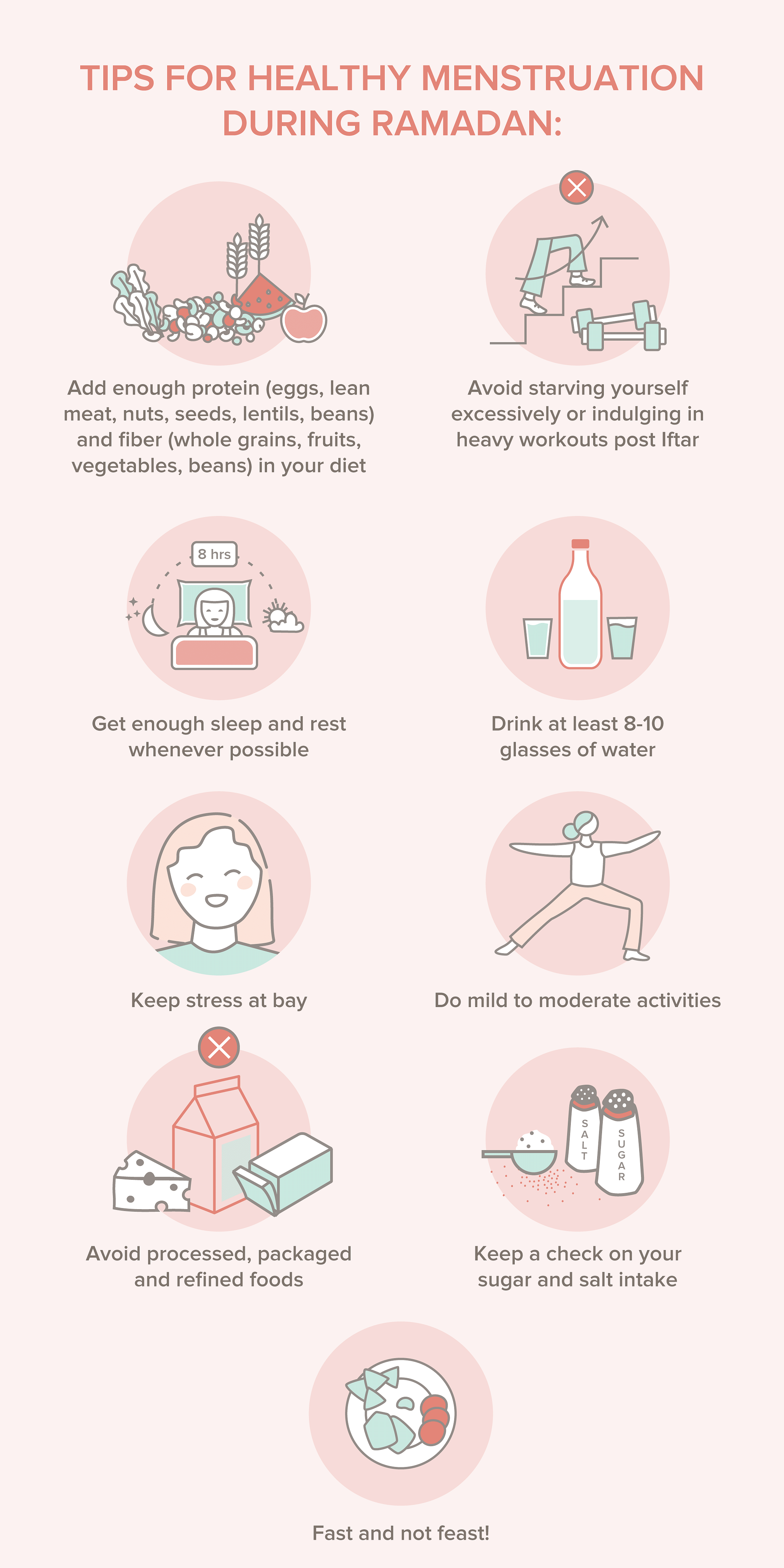
Eat real food: It is important to eat healthy during suhoor. You can have oats porridge, daliya porridge, moong chilla, roti veggie roll, mixed vegetable paratha, muesli with milk and fruits.
During Iftar 2-3 dates + 1 bowl mixed vegetable soup/chicken soup, whole wheat egg sandwich, paneer/chicken shawarma, oats haleem, whole wheat pasta with veggies + 1 glass coconut water/lemon juice/kokum sherbet + 1 fruit are some ideal food options to have.
Hydrate: 8-10 glasses of water a day. Your uterus will thank you.
Avoid extremes: No starvation, no intense post-Iftar workouts. Balance is key.
Rest: Don’t underestimate the power of sleep and stillness.
Move gently: Light stretching, walks, yoga—just enough to keep blood flowing.
Stay away from processed foods: They mess with your hormones and energy.
Check your sugar/salt: Bloating and mood swings? This might be why.
Manage stress: Journaling, breathing, praying, venting to a friend—whatever helps.
Fast, don’t feast: Iftar isn’t a competition. Eat to nourish, not to overcompensate.
Do you have to make up missed fasts after your period?
Yes, you can make them up after Ramadan ends.
Once your period is over and you’re feeling up for it, you can continue fasting for the rest of Ramadan, After Eid, you can begin to make up the missed fasts at your own pace before the next Ramadan. There’s flexibility here, and it’s totally okay to take your time.
Your period doesn’t disconnect you from Ramadan
Let’s stop acting like your period puts you in a timeout from spirituality. You’re not benched. You can still make dua, read or listen to the Quran, reflect, donate, connect with your community. There are countless ways to participate!
Ramadan fasting on period doesn’t mean you’re less devoted. It just means your form of devotion looks a little different for a few days.
No one gets to tell you that your experience of Ramadan is less meaningful just because you’re not fasting for a few days. Your body is divine too. And honouring it is a form of worship in itself.