Here’s what you will learn about effective pain relievers in this blog:
- Period cramps are caused by prostaglandins making the uterus contract, with pain often peaking just before and during the first days.
- Heat, gentle movement, massage, and rest can provide quick relief, while regular exercise may reduce pain over time.
- Ginger, magnesium-rich foods, hydration, better sleep, and stress management can support period pain relief.
- Painkillers can be effective when used appropriately, but the right option depends on your health, age, and other medicines.
- Preparing a period-pain kit with heat patches, a roll-on, water, snacks, and approved medication can make difficult days easier.
- Severe, worsening, unusually heavy, or disruptive pain warrants a gynaecologist visit to check for conditions such as endometriosis or fibroids.
Period cramps can often be managed with simple options like heat, movement, massage, and rest. Painkillers can also help when used appropriately. If cramps are severe, suddenly worse, or interfere with daily life, speak to a gynaecologist to rule out conditions such as endometriosis or fibroids.
In this blog, we’ll delve into some safe and effective pain relievers for period cramps that can provide you with comfort during your periods.
Why Period Cramps Happen
Cramps often start as a dull ache low in your belly a day before you bleed, then spread to your lower back and thighs, sometimes with digestive issues or nausea. None of this means something is wrong with you.
Your uterus is a muscle. Each month it builds a thick lining, and when there’s no pregnancy, that lining breaks down and releases chemicals called prostaglandins (read more about them here). The American College of Obstetricians and Gynecologists identifies prostaglandins as the cause of everyday period cramps. Their job is to make the uterus squeeze so the lining can leave your body.
Blog continues after the ad.
Those squeezes also briefly press shut the small blood vessels feeding the uterus. A muscle short on oxygen hurts, which is the same reason a calf cramp hurts. Prostaglandins reach your gut too, and that’s where the digestive issues come from. Levels peak just before and during the first day or two of your period, then fall as the lining sheds. Some people simply make more prostaglandins than others, which is why your friend may barely notice her period while you’re curled up in bed.
If day one reliably knocks you flat, it helps to have warmth ready before it starts. We recommend you keep a Cramp Comfort Heat Patch in your bag for that first morning, so steady heat is on hand the moment the ache begins.
A Quick Guide To The Best Period Pain Relievers
Some remedies ease pain within the hour, while others lower it gradually over months. Here’s how the main options for period cramps relief compare:
| Remedy | How fast it works | Strength of evidence | Best for |
| Heat patch or hot water bag | Minutes to an hour | Strong (controlled trials) | Day one and two cramps, lower back ache |
| Painkillers | Usually within an hour | Strong | Severe pain, with advice from your doctor or pharmacist |
| Gentle stretching | Minutes | Moderate | Muscle tightness on the day |
| Regular exercise and yoga | Weeks to months | Moderate (many trials, mixed quality) | Making future periods milder |
| Ginger | A few hours | Moderate (small trials) | A food-based option in the first few days |
| Massage and roll-ons | Minutes | Limited (small trials) | Quick comfort at school, work or on the move |
| Magnesium-rich foods | Weeks | Limited | Everyday diet, not fast relief |
| Water and warm drinks | Hours | Weak | Diarrhoea, constipation and bloating |
| Better sleep, less stress | Over several cycles | Moderate (observational studies) | Months when cramps feel worse than usual |
The common mistake is expecting everything to work fast. Heat and massage are the fast-acting pain relievers for the moment you’re in. Exercise and diet change how your next few periods feel. A mix of both works best.
What About Painkillers?
Many women take a painkiller for cramps, and that’s completely okay. They’re among the most studied pain relievers for period pain, and there’s no reward for pushing through a painful day just to prove you can.
What matters is that the one you take suits your body, your age, and any other health conditions or medicines you have. Speak to your doctor or pharmacist about what’s right for you, especially if you take them every month.
If you’d rather try drug-free relief first, here’s what works.
How Heat Eases Cramps
Heat works directly on the problem, in two ways. Warmth relaxes muscle and widens blood vessels, so more blood reaches the squeezing uterus and eases the oxygen shortage behind the pain. Warmth also switches on heat sensors in your skin, whose signals travel to the spinal cord along the same routes as pain signals and crowd them out.
In a 2001 trial published in Obstetrics & Gynecology, women with period pain wore a heat patch at about 39°C for 12 hours a day over two days. Heat alone relieved pain as well as a standard over-the-counter painkiller. About 70% of women using heat alone reported complete relief at some point, compared with 35% of those given a dummy patch and dummy tablet. Women using heat and the painkiller together felt relief in about 1.5 hours, versus nearly 3 hours on the painkiller alone.
It’s low, steady heat for hours, not a short blast of strong heat, that’s makes a real difference. A hot water bag starts very hot, cools noticeably within 30 to 60 minutes, and only works while you lie still. That’s great for an evening on the sofa, less so for a working day. A heat patch for period pain contains iron powder that reacts with oxygen once you open the pack. It’s the same reaction as rusting, sped up, and it gives off gentle, even warmth for hours while stuck to your underwear or inner layer, so you can walk, sit in class or travel.
If you want that steady, hours-long warmth without being stuck in bed, a wearable patch is the easier option. Nua’s Cramp Comfort Heat Patch gives up to 8 hours of gentle heat and sits flat under a kurta or shirt. It won’t change your prostaglandin levels, but it can make a long day of cramps far easier to get through.
Movement and Yoga for Period Pain
When your belly hurts, lying feels obvious, and many of us were told to rest during our periods. But stillness can make cramps worse. The muscles in your lower back, hips and belly tighten to guard against the pain, and that tension adds a second ache on top of the cramp.
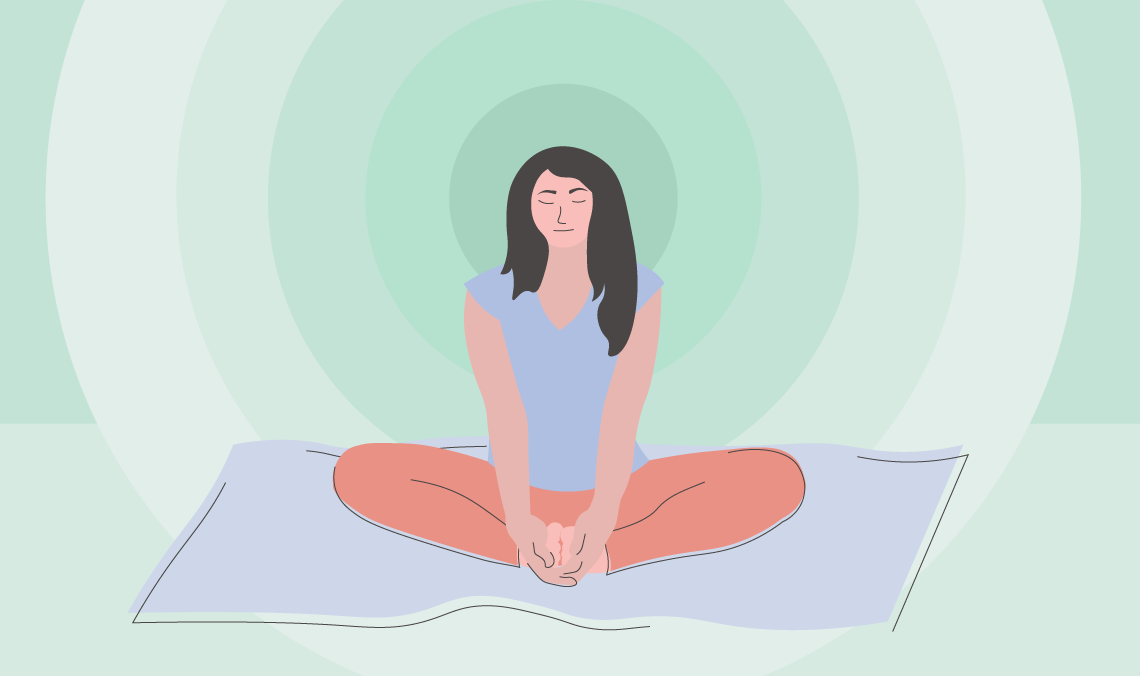
Gentle movement on the day loosens those guarding muscles. A 10 to 15 minute walk, child’s pose, the cat-cow stretch, or hugging your knees to your chest while lying on your back can ease that tension within minutes. Learn more about which yoga poses help here.
The bigger effect comes from moving regularly all month. A 2019 Cochrane review found that exercising for about 45 to 60 minutes, three or more times a week, reduced period pain by around 25 points on a 0 to 100 scale, whether women did yoga and stretching or aerobics and dance. Regular exercise improves blood flow to the pelvis, lowers stress hormones and raises endorphins, your body’s own pain-dampening chemicals.
Food and Drinks That Help
Food won’t stop a cramp within the hour the way heat can, but a few choices have real evidence behind them. These natural remedies for period pain work best when you know what each one does and how long it takes.
- Ginger: Ginger contains compounds that appear to slow the body’s production of prostaglandins.
- Magnesium-rich foods: Calcium tells muscle cells to contract, and magnesium helps them relax afterwards. Good sources include dal, rajma, chana, pumpkin seeds, almonds, palak, bananas, and millets like ragi and bajra.
- Water: Being a little dehydrated on day one can add to the squeezing and the oxygen shortage behind your cramps. In a 2021 study of 140 university students, a group asked to drink more water reported less period pain and used fewer painkillers than the group that kept their usual habits.
Massage and Roll-Ons
Rubbing the skin sends touch signals to your spinal cord that compete with pain signals, which is why you automatically rub your elbow after bumping it. Massage also loosens the tight lower back and belly muscles that guard against cramps.
A cramp relief roll-on works on the same pain pathway without the rubbing. It uses ingredients like Laung (clove) oil, Satva pudina (menthol crystals) and eucalyptus oil to flood the nerves in that area with temperature signals. Those signals reach the spinal cord and crowd out some of the pain signals coming from the uterus. That’s why relief can start within minutes, and why it’s strongest where you apply it.
When a cramp spikes in the middle of a lecture or meeting, you want something that takes just a few minutes. Nua’s Cramp Relief Roll-On changes how the cramp feels rather than what’s causing it, but on a busy day that’s often exactly what you need.
Sleep and Stress
Two things can make cramps worse. The first is sleep. A short night lowers your pain threshold, so the same cramp feels sharper the next morning, and cramps that wake you up keep the loop going. Sleep on your side with your knees drawn up and a pillow between them, which takes pressure off your belly muscles, and use a hot water bag before bed rather than through the night.
The second is stress. Research following women across several cycles has linked high stress in one month with more painful periods the next, partly because stress keeps muscles tense. Slow breathing helps in the moment. Breathe in for four counts and out for six to eight. A long breath out tells your nervous system it can leave alert mode, and tense muscles start to let go.
A short, repeatable wind-down routine on period nights helps your body learn to relax on cue.
Relief You Can Carry for School, Office and Travel
Here’s how to set up period pain relief around exams, meetings and journeys.
- Know when day one is coming: Track your cycle in an app or calendar (Nua’s Period Tracker). Since prostaglandins peak just before and on the first day, knowing the date lets you start relief at the first twinge, when pain is easier to keep down.
- Pack a kit the night before: Keep a heat patch, a roll-on, extra pads or your usual period product, water, a snack, and any medicine your doctor has okayed in one pouch, so you’re not hunting mid-cramp.
- Put the patch on in the morning: Stick it on your underwear or inner layer over your lower belly or back before leaving home. Steady heat from the start beats chasing pain at noon, and it doesn’t show under a uniform or kurta.
- Move every hour: Sitting for hours tightens your hips and lower back. Stand up, refill your bottle, or do a few seated twists. Two minutes is enough.
- Keep the roll-on for the spikes: When a cramp flares in class or at your desk, step into the washroom, roll it over your lower belly or back a few times and let it dry.
- Set up long journeys before you leave: Put your heat patch on just before you set off, so its hours of warmth cover the trip. On a bus, train or flight, choose an aisle seat so you can stand and stretch every hour, because sitting still for hours tightens your hips and lower back.
- Tell one person: A teacher, school nurse or manager who knows you may need a short break makes it easier to take one without explaining yourself each time.
Getting through a full day comfortably is mostly about having the right things with you before the pain starts. A pack of Cramp Comfort Heat Patches slips into a bag pocket and covers the hardest days of most periods, so you’re not waiting for a free moment to find warmth.
Myths That Don’t Help
- “Severe pain is normal, everyone has it”: Some pain is very common, and ACOG notes that more than half of women with periods have pain for a day or two each month. But common and normal aren’t the same thing. Pain that stops you from living your day deserves attention.
- “Cold water, curd or ice cream make cramps worse”: Food goes to your stomach, not your uterus, and its temperature doesn’t reach it. There’s no good evidence that cold foods change how strongly your uterus contracts.
- “Don’t bathe or wash your hair on your period”: There’s no medical basis for this. A warm bath or shower is actually heat therapy for your whole lower body (more on this myth here).
- “Exercise makes the pain and bleeding worse”: Regular exercise tends to make periods less painful, and gentle movement loosens the muscles that tighten around a cramp.
- “Cramps will go away after marriage”: Marriage and sex don’t change prostaglandin levels. Many women find cramps ease with age or after childbirth, but that isn’t guaranteed, and waiting for a life event can delay spotting a condition that needs treatment.
- “Needing help every month means you’re not tough enough”: Pain tolerance isn’t a character trait. Some people make far more prostaglandins than others, so two women can have very different periods for purely chemical reasons.
When to See a Doctor
Most period pain comes from prostaglandins alone and often gets milder with age. Sometimes, though, it comes from a condition in the uterus or pelvis, most commonly endometriosis or fibroids.
See a gynaecologist if you notice any of these:
- Pain that disrupts your life: You miss school, college or work, or the pain doesn’t ease with heat, rest and your usual pain relievers.
- Pain that’s getting worse: Your cramps grow stronger each year, or painful periods started after years of easy ones. Ordinary cramps tend to settle with age, so pain that grows is worth checking.
- Pain outside your period: You feel pain during sex, when passing stool or urine, or in your pelvis on days you’re not bleeding. These are common signs of endometriosis.
- Very heavy or long periods: You soak a pad every one to two hours, pass clots bigger than a coin, or bleed for more than seven days. These can point to fibroids and can also leave you low on iron.
- Trouble getting pregnant: Both conditions can affect fertility, so mention your period pain if you’ve been trying for a while.
- Sudden severe pain: Get urgent care for sudden, strong pain with fever, fainting or vomiting, or if there’s any chance you’re pregnant.
Getting a clear answer can take a few appointments, and your cramps don’t pause while you wait. Keeping your days manageable in the meantime still matters, which is what Nua’s Cramp Comfort Heat Patch and Cramp Relief Roll-On are for. They help with comfort and are never a substitute for getting checked.
The Real Goal Is a Plan, Not Toughing It Out
Most of us grew up believing period pain was something to quietly endure. It’s more useful to see it as a predictable chemical process with a timeline. Prostaglandins rise, the uterus squeezes, and levels fall within a few days. Once you know that, you can get ahead of it with heat and movement on the day, regular exercise across the month, and pain relievers from your doctor or pharmacist if you need them. Keep a short note each cycle of what helped, and if your pain ever breaks its usual pattern, take that to a gynaecologist.
Frequently Asked Questions
1. How Do I Stop Period Cramps Fast?
If you want to know how to stop period cramps fast, put heat on your lower belly or back, curl up on your side or rest in child’s pose, and breathe slowly with a long breath out.
2. Is It Safe to Take a Painkiller Every Period?
Many women do, but whether it’s right for you depends on your health and any other medicines you take. Speak to your doctor or pharmacist about what’s right for you, especially if you take them every month.
3. Which Painkiller Is Best for Cramps?
There’s no single best option for everyone. The right choice depends on your age, health conditions and other medicines, so a doctor or pharmacist is the best person to advise you.
4. Do Heat Patches Really Work?
Yes. Heat is one of the best-studied drug-free pain relievers for cramps. In a controlled trial, a low, steady heat patch relieved period pain as well as a standard over-the-counter painkiller. Patches work best worn early and for several hours over the lower belly or back.
5. Why Are My Cramps Worse This Month?
Stress, poor sleep and moving less can all make the same cramp feel stronger. One bad month isn’t usually a worry, but if cramps get worse cycle after cycle, see a gynaecologist.
6. Which Home Remedies Work Immediately?
Of the common menstrual cramps home remedies, heat, massage and gentle stretching act fastest, often within minutes. Ginger and warm drinks take a few hours, while regular exercise and magnesium-rich foods work over weeks to make future periods milder.
This article is based on guidance from the American College of Obstetricians and Gynecologists (ACOG) and peer-reviewed research, linked throughout.
Sources:
- American College of Obstetricians and Gynecologists (ACOG). Painful Periods. Frequently Asked Questions. https://www.acog.org/womens-health/faqs/painful-periods
- Akin MD, Weingand KW, Hengehold DA, Goodale MB, Hinkle RT, Smith RP. Continuous low-level topical heat in the treatment of dysmenorrhea. Obstetrics & Gynecology. 2001;97(3):343–349. doi:10.1016/s0029-7844(00)01163-7. https://pubmed.ncbi.nlm.nih.gov/11239634/
- Armour M, Ee CC, Naidoo D, Ayati Z, Chalmers KJ, Steel KA, de Manincor MJ, Delshad E. Exercise for dysmenorrhoea. Cochrane Database of Systematic Reviews. 2019;9(9):CD004142. doi:10.1002/14651858.CD004142.pub4. https://pmc.ncbi.nlm.nih.gov/articles/PMC6753056/
- Torkan B, Mousavi M, Dehghani S, Hajipour L, Sadeghi N, Ziaei Rad M, Montazeri A. The role of water intake in the severity of pain and menstrual distress among females suffering from primary dysmenorrhea: a semi-experimental study. BMC Women’s Health. 2021;21:40. doi:10.1186/s12905-021-01184-w. https://pmc.ncbi.nlm.nih.gov/articles/PMC7845092/
Disclaimer
The content of this article is provided for general informational and educational purposes only and is not intended to constitute medical advice, diagnosis, or treatment. The information shared is of a general nature and may not be appropriate for all individuals or specific circumstances. Readers should not disregard, delay, or substitute professional medical advice based on the information contained herein.
If you experience any symptoms, notice anything unusual, or have concerns relating to your health or overall well-being, you should consult a qualified healthcare professional. While every effort is made to ensure the information shared is accurate and up-to-date, Nua makes no representations or warranties, express or implied, regarding the accuracy, completeness, or suitability of the information provided and disclaims all liability arising from reliance on this content to the fullest extent permitted by law.